Lawmakers Press BPPE on Fees, Enforcement and Student Protections at Sunset Review Hearing
March 17, 2026 | California State Assembly, House, Legislative, California
This article was created by AI summarizing key points discussed. AI makes mistakes, so for full details and context, please refer to the video of the full meeting. Please report any errors so we can fix them. Report an error »
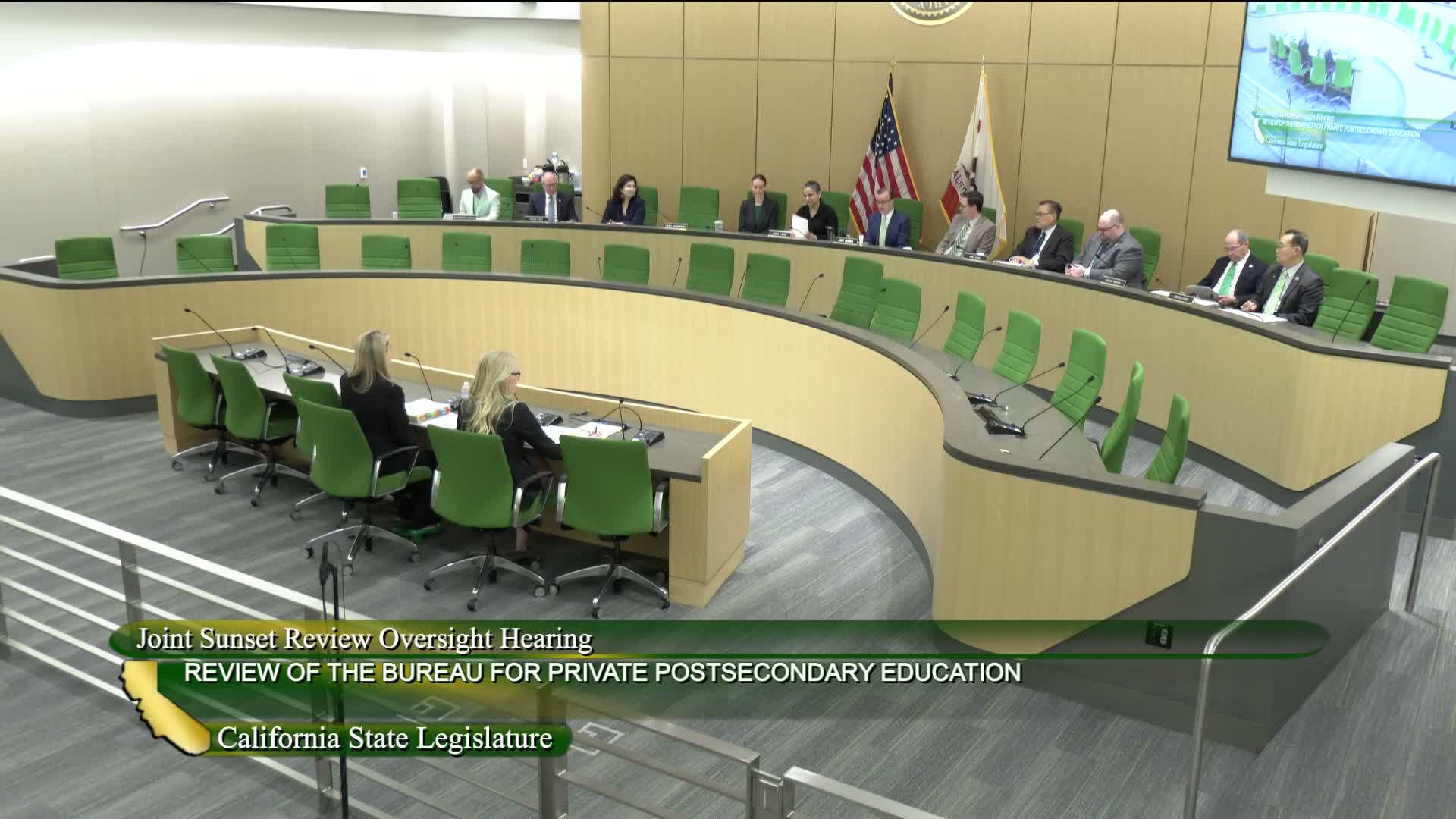
A joint California legislative hearing on March 17 examined recommendations to reauthorize and strengthen the Bureau for Private Postsecondary Education, with lawmakers pressing the bureau on financial solvency, enforcement tools and student protections.
Bureau Chief Deborah Cochran told members that the agency has increased inspections and disciplinary actions under her leadership but still faces a long-term structural deficit that has been addressed only with position reductions, temporary general-fund infusions and other short-term measures. "We are meeting our mandates regarding inspections of approved institutions for the first time since the act was chaptered in 2009," Cochran said, but she added the bureau "cannot take additional steps without legislative action to increase fees or reduce mandates."
The hearing focused on three interlocking issues: how the bureau holds bad actors to account, whether proposed fee changes are justified, and the health and design of the Student Tuition Recovery Fund (STRF). Senators and assembly members pressed the bureau on examples of schools that target immigrant communities, on whether fines and license revocation are adequate deterrents, and on the bureau’s ability to prevent previously sanctioned owners from opening new operations.
Cochran outlined BPPE enforcement tools: a citation-and-fine program for fixable violations and formal accusations that can lead to license revocation or probation. She said fines for approved institutions are allowed up to $5,000 per violation, with average citation amounts nearing $8,000 and some citations totaling "upwards of $10,000 or $20,000." For operators without required approvals, fines can reach $100,000. Cochran said the bureau’s data systems track ownership and control but that current law limits the bureau’s ability to bar bad actors from opening replacement entities; she called for legislative authority to deny new approvals when a prior operator harmed students.
Lawmakers also asked about criminal referrals; Cochran said revocation proceedings can include refund orders and the bureau can refer matters to other law enforcement bodies, but prosecutorial outcomes are outside the bureau’s direct control.
On STRF, Cochran described the fund as an insurance-like pool that is currently above its statutory maximum and therefore not collecting assessments from students. "The fund balance at this time is over $25,000,000," she said. Cochran said STRF claims data included in the sunset report show roughly 1,100 approved claims and approximately $17,000,000 paid over the last four years. Some lawmakers criticized the assessment design as inequitable — students at some institutions paid assessments while others did not when assessments were turned off — and urged study of alternatives such as surety bonds or adjusted premium systems.
Fee proposals drew sustained scrutiny. Cochran said BPPE aligned many application fees to workload analyses and proposed a revenue-based annual fee model with minimums and maximums to distribute the burden across institutions. One specific proposal in the report would raise the five-year out-of-state registration from $1,500 to $10,000 (a proposed annualized increase equivalent to about $300 to $2,000). Senators warned the proposed out-of-state fees would make California among the most expensive regulators for some institutions and asked for fee-by-fee documentation tying costs to enforcement and monitoring work.
Members probed prevention tools as well as reactive remedies. Cochran described a mix of planned and current prevention efforts: compliance inspections (one announced and one unannounced every five years), earlier inspections after new approvals, workshops for institutions, data partnerships to detect anomalous reporting, and increased documentation so recurring minor issues can trigger escalations.
Stakeholders at the hearing largely supported reauthorization but urged targeted reforms. Industry representatives warned that proposed fee increases would disproportionately affect small schools; representatives of large accredited institutions urged a risk-based regulatory approach so low-risk institutions do not receive the same regulatory burden as high-risk actors. Nonprofit advocates recommended statutory clarifications for provisional approvals, stronger record protections so student transcripts remain accessible after closures, and tighter standards for ownership and control reporting.
The committees provided BPPE and DCA staff requests for follow-up materials — including fee workload analyses and STRF claims detail cited in the bureau’s report — and signaled more conversations will follow before any final legislative action.
The hearing adjourned with no formal vote. Members said they will continue to weigh whether the bureau’s proposed fee changes and additional statutory authorities are necessary to ensure long-term consumer protection without imposing undue burdens on legitimate institutions.
Bureau Chief Deborah Cochran told members that the agency has increased inspections and disciplinary actions under her leadership but still faces a long-term structural deficit that has been addressed only with position reductions, temporary general-fund infusions and other short-term measures. "We are meeting our mandates regarding inspections of approved institutions for the first time since the act was chaptered in 2009," Cochran said, but she added the bureau "cannot take additional steps without legislative action to increase fees or reduce mandates."
The hearing focused on three interlocking issues: how the bureau holds bad actors to account, whether proposed fee changes are justified, and the health and design of the Student Tuition Recovery Fund (STRF). Senators and assembly members pressed the bureau on examples of schools that target immigrant communities, on whether fines and license revocation are adequate deterrents, and on the bureau’s ability to prevent previously sanctioned owners from opening new operations.
Cochran outlined BPPE enforcement tools: a citation-and-fine program for fixable violations and formal accusations that can lead to license revocation or probation. She said fines for approved institutions are allowed up to $5,000 per violation, with average citation amounts nearing $8,000 and some citations totaling "upwards of $10,000 or $20,000." For operators without required approvals, fines can reach $100,000. Cochran said the bureau’s data systems track ownership and control but that current law limits the bureau’s ability to bar bad actors from opening replacement entities; she called for legislative authority to deny new approvals when a prior operator harmed students.
Lawmakers also asked about criminal referrals; Cochran said revocation proceedings can include refund orders and the bureau can refer matters to other law enforcement bodies, but prosecutorial outcomes are outside the bureau’s direct control.
On STRF, Cochran described the fund as an insurance-like pool that is currently above its statutory maximum and therefore not collecting assessments from students. "The fund balance at this time is over $25,000,000," she said. Cochran said STRF claims data included in the sunset report show roughly 1,100 approved claims and approximately $17,000,000 paid over the last four years. Some lawmakers criticized the assessment design as inequitable — students at some institutions paid assessments while others did not when assessments were turned off — and urged study of alternatives such as surety bonds or adjusted premium systems.
Fee proposals drew sustained scrutiny. Cochran said BPPE aligned many application fees to workload analyses and proposed a revenue-based annual fee model with minimums and maximums to distribute the burden across institutions. One specific proposal in the report would raise the five-year out-of-state registration from $1,500 to $10,000 (a proposed annualized increase equivalent to about $300 to $2,000). Senators warned the proposed out-of-state fees would make California among the most expensive regulators for some institutions and asked for fee-by-fee documentation tying costs to enforcement and monitoring work.
Members probed prevention tools as well as reactive remedies. Cochran described a mix of planned and current prevention efforts: compliance inspections (one announced and one unannounced every five years), earlier inspections after new approvals, workshops for institutions, data partnerships to detect anomalous reporting, and increased documentation so recurring minor issues can trigger escalations.
Stakeholders at the hearing largely supported reauthorization but urged targeted reforms. Industry representatives warned that proposed fee increases would disproportionately affect small schools; representatives of large accredited institutions urged a risk-based regulatory approach so low-risk institutions do not receive the same regulatory burden as high-risk actors. Nonprofit advocates recommended statutory clarifications for provisional approvals, stronger record protections so student transcripts remain accessible after closures, and tighter standards for ownership and control reporting.
The committees provided BPPE and DCA staff requests for follow-up materials — including fee workload analyses and STRF claims detail cited in the bureau’s report — and signaled more conversations will follow before any final legislative action.
The hearing adjourned with no formal vote. Members said they will continue to weigh whether the bureau’s proposed fee changes and additional statutory authorities are necessary to ensure long-term consumer protection without imposing undue burdens on legitimate institutions.
Don't Miss a Word: See the Full Meeting!
Go beyond summaries. Unlock every video, transcript, and key insight with a Founder Membership.
✓
Get instant access to full meeting videos
✓
Search and clip any phrase from complete transcripts
✓
Receive AI-powered summaries & custom alerts
✓
Enjoy lifetime, unrestricted access to government data
30-day money-back guarantee
