Bill would let Alaskans donate part of PFD to senior services; committee seeks Department of Revenue details
March 17, 2026 | 2026 Legislature Alaska, Alaska
This article was created by AI summarizing key points discussed. AI makes mistakes, so for full details and context, please refer to the video of the full meeting. Please report any errors so we can fix them. Report an error »
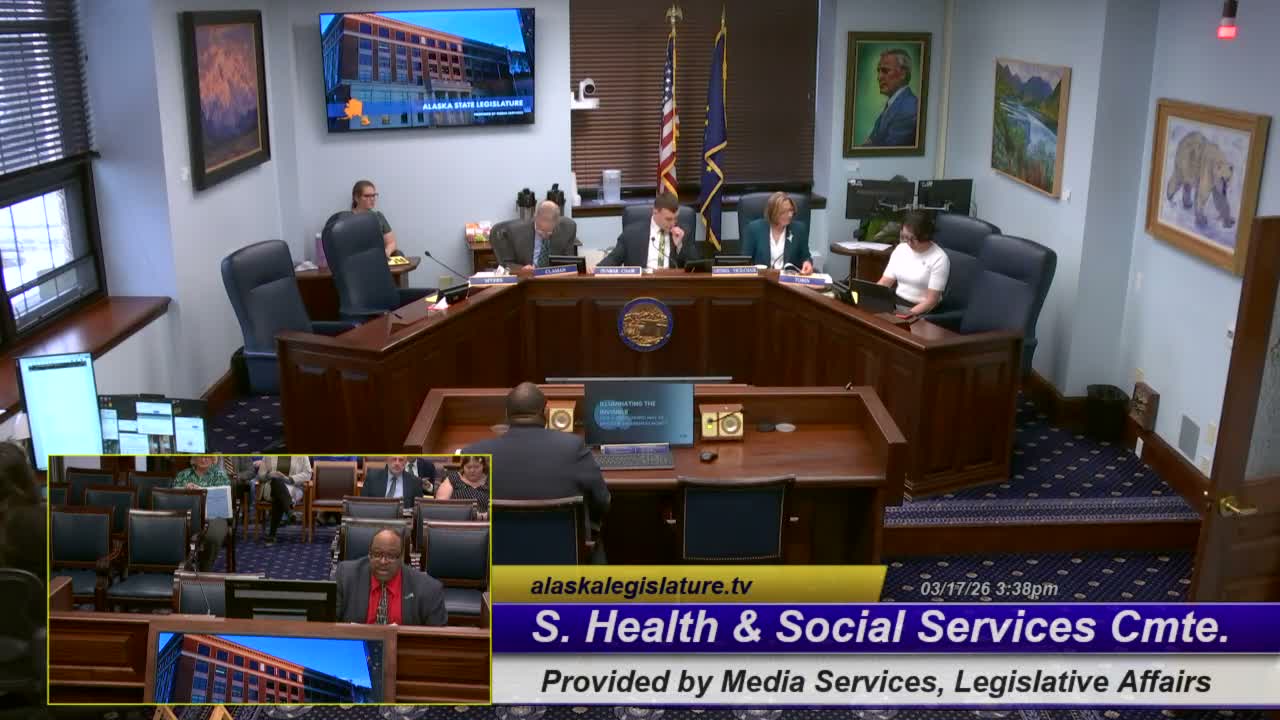
A bill to let Alaskans donate a portion of their Permanent Fund dividend toward grants for senior services and a raffle to incentivize donations drew support from advocates and questions from legislators at a March 17 Senate Health and Social Services Committee hearing.
Joe Hayes, staff to the Senate State Affairs Committee, presented SB 240 as a voluntary, self-funded mechanism that would establish a Senior Citizen Grant Endowment and a Senior Citizen Grant Dividend Raffle administered by the Department of Revenue. "Senate bill 240 allows Alaskans to donate a portion of their permanent fund dividend on a voluntary basis to support grants for nonprofit organizations that serve Alaskan senior citizens," Hayes said.
Invited testimony came from Vivian Stuyver, director of Moore Street Senior Housing and a member of the Alaska Commission on Aging, who said the bill targets critical senior needs and proposed a distribution split in the bill packet: 50% for home-delivered meals, 25% for transportation, and 25% for housing supports. She said Alaska's senior population is growing rapidly and current federal and constrained state funding is insufficient to meet rising demand.
Committee members pressed several technical and fiscal questions. Senators asked whether the raffle would "compete" with the existing education raffle and whether ticket pricing and structure matched the education raffle; Hayes said the design mirrors the education raffle and donors could direct contributions among funds. Members also focused on endowment triggers written into the bill: transfers when the Permanent Fund's average market value exceeds $1,000,000,000 and a $300,000,000 threshold cited for transferring raffle balances to the endowment. Several senators voiced concern such thresholds could mean many decades before substantial endowment payouts.
On fiscal details, Hayes said the Department of Revenue submitted an indeterminate fiscal note because an upgraded application system has made it difficult to forecast programming costs for the requested logic. He provided historical figures from the education raffle: $6,555,200 raised to date, with $3,000,000 disbursed to the Department of Education and $1.6 million routed both to the education endowment fund and the raffle pool. Hayes also said start-up and ongoing material costs since 2018 total $43,070.31, excluding staff time. "There are programming costs associated with the initial 2018 implementation of the raffle... Since then, annual expenses have been limited to ticket purchasing and printing, advertising, auditing, and a few other minor costs," Hayes said.
The committee set SB 240 aside and directed staff to request more detailed information from the Department of Revenue ahead of further consideration in finance and future committee hearings.
Joe Hayes, staff to the Senate State Affairs Committee, presented SB 240 as a voluntary, self-funded mechanism that would establish a Senior Citizen Grant Endowment and a Senior Citizen Grant Dividend Raffle administered by the Department of Revenue. "Senate bill 240 allows Alaskans to donate a portion of their permanent fund dividend on a voluntary basis to support grants for nonprofit organizations that serve Alaskan senior citizens," Hayes said.
Invited testimony came from Vivian Stuyver, director of Moore Street Senior Housing and a member of the Alaska Commission on Aging, who said the bill targets critical senior needs and proposed a distribution split in the bill packet: 50% for home-delivered meals, 25% for transportation, and 25% for housing supports. She said Alaska's senior population is growing rapidly and current federal and constrained state funding is insufficient to meet rising demand.
Committee members pressed several technical and fiscal questions. Senators asked whether the raffle would "compete" with the existing education raffle and whether ticket pricing and structure matched the education raffle; Hayes said the design mirrors the education raffle and donors could direct contributions among funds. Members also focused on endowment triggers written into the bill: transfers when the Permanent Fund's average market value exceeds $1,000,000,000 and a $300,000,000 threshold cited for transferring raffle balances to the endowment. Several senators voiced concern such thresholds could mean many decades before substantial endowment payouts.
On fiscal details, Hayes said the Department of Revenue submitted an indeterminate fiscal note because an upgraded application system has made it difficult to forecast programming costs for the requested logic. He provided historical figures from the education raffle: $6,555,200 raised to date, with $3,000,000 disbursed to the Department of Education and $1.6 million routed both to the education endowment fund and the raffle pool. Hayes also said start-up and ongoing material costs since 2018 total $43,070.31, excluding staff time. "There are programming costs associated with the initial 2018 implementation of the raffle... Since then, annual expenses have been limited to ticket purchasing and printing, advertising, auditing, and a few other minor costs," Hayes said.
The committee set SB 240 aside and directed staff to request more detailed information from the Department of Revenue ahead of further consideration in finance and future committee hearings.
Don't Miss a Word: See the Full Meeting!
Go beyond summaries. Unlock every video, transcript, and key insight with a Founder Membership.
✓
Get instant access to full meeting videos
✓
Search and clip any phrase from complete transcripts
✓
Receive AI-powered summaries & custom alerts
✓
Enjoy lifetime, unrestricted access to government data
30-day money-back guarantee
