Alaska revenue forecast rises on higher oil prices, but officials flag wide volatility
March 16, 2026 | 2026 Legislature Alaska, Alaska
This article was created by AI summarizing key points discussed. AI makes mistakes, so for full details and context, please refer to the video of the full meeting. Please report any errors so we can fix them. Report an error »
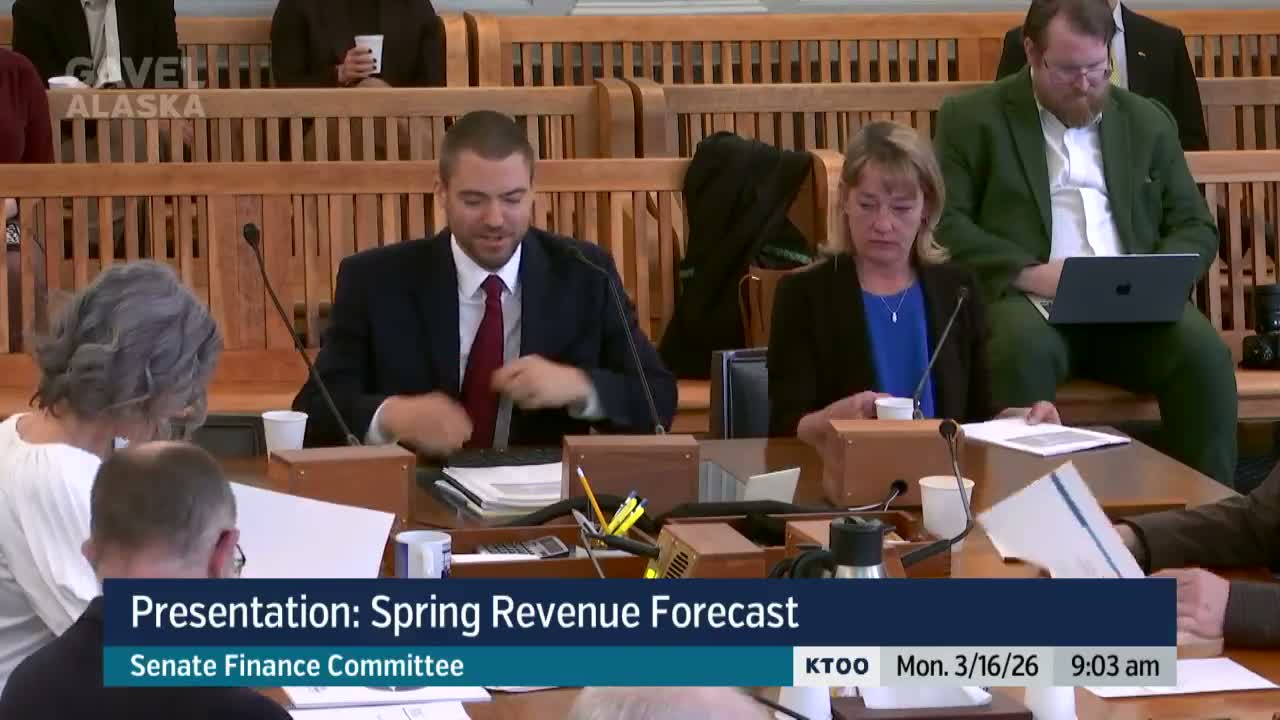
For the record, Dan Stickel, chief economist with the Department of Revenue, told the Alaska Senate Finance Committee on March 16 that the department’s spring revenue forecast shows materially higher near‑term receipts driven largely by an improved oil‑price outlook.
"Our forecast for Alaska North Slope average oil prices has increased by $9.77 per barrel for the current fiscal year 2026, and by $13 per barrel for fiscal year 2027," Stickel said, summarizing the department’s revisions. The department now projects a $75‑per‑barrel average for FY2027 and an additional $545 million in unrestricted revenue for FY2026 and $510 million for FY2027 compared with the fall forecast.
Why it matters: those topline increases affect legislators’ calculations about supplemental spending and the potential need to draw on the Constitutional Budget Reserve (CBR). Committee members pressed the department for a break‑even oil price that would keep the budget from requiring a CBR draw; Stickel said staff will calculate an exact number and pointed to sensitivity tables in the report.
Breakdown: Stickel told the committee the FY2026 increase breaks down roughly as $105 million from higher non‑petroleum corporate tax collections (mining and oil‑and‑gas services), about $370 million from increased production tax and royalty revenue tied to the higher price outlook, $20 million from additional oil and gas corporate tax, $30 million from higher property tax assessments (notably a reassessment of Trans‑Alaska Pipeline System property values), and about $18 million from other non‑petroleum sources, including mining and investment earnings.
"Investment revenue is the largest source of unrestricted revenue," Stickel added, noting permanent fund distributions and market returns remain the foundation of the state’s long‑term forecast even as oil prices create near‑term swings.
Risk and sensitivity: Stickel emphasized the forecast’s large range. Using futures and options market data, the department showed a wide probability distribution for prices: a roughly 10% chance of prices well above $200 per barrel later in the fiscal year and a roughly 10% chance of prices around $30 per barrel. For the remainder of FY2026, the department’s March–June price path of $91.09 per barrel yields a forecast of about $6.5 billion in unrestricted revenue; under alternative price outcomes the department showed a range of roughly $1.5 billion between low and high scenarios.
Committee members asked for additional percentile and standard‑deviation breakdowns of the implied price distribution; Stickel said the department had already included the 10th, 25th, 50th, 75th and 90th percentiles in its materials and can produce more granular percentiles on request.
Next steps: the committee did not take formal action on the forecast itself, but senators signaled they will use the updated revenue picture in deliberations over supplemental requests and potential CBR draws. The committee reconvened in the afternoon for additional amendments and Office of Management and Budget responses.
"Our forecast for Alaska North Slope average oil prices has increased by $9.77 per barrel for the current fiscal year 2026, and by $13 per barrel for fiscal year 2027," Stickel said, summarizing the department’s revisions. The department now projects a $75‑per‑barrel average for FY2027 and an additional $545 million in unrestricted revenue for FY2026 and $510 million for FY2027 compared with the fall forecast.
Why it matters: those topline increases affect legislators’ calculations about supplemental spending and the potential need to draw on the Constitutional Budget Reserve (CBR). Committee members pressed the department for a break‑even oil price that would keep the budget from requiring a CBR draw; Stickel said staff will calculate an exact number and pointed to sensitivity tables in the report.
Breakdown: Stickel told the committee the FY2026 increase breaks down roughly as $105 million from higher non‑petroleum corporate tax collections (mining and oil‑and‑gas services), about $370 million from increased production tax and royalty revenue tied to the higher price outlook, $20 million from additional oil and gas corporate tax, $30 million from higher property tax assessments (notably a reassessment of Trans‑Alaska Pipeline System property values), and about $18 million from other non‑petroleum sources, including mining and investment earnings.
"Investment revenue is the largest source of unrestricted revenue," Stickel added, noting permanent fund distributions and market returns remain the foundation of the state’s long‑term forecast even as oil prices create near‑term swings.
Risk and sensitivity: Stickel emphasized the forecast’s large range. Using futures and options market data, the department showed a wide probability distribution for prices: a roughly 10% chance of prices well above $200 per barrel later in the fiscal year and a roughly 10% chance of prices around $30 per barrel. For the remainder of FY2026, the department’s March–June price path of $91.09 per barrel yields a forecast of about $6.5 billion in unrestricted revenue; under alternative price outcomes the department showed a range of roughly $1.5 billion between low and high scenarios.
Committee members asked for additional percentile and standard‑deviation breakdowns of the implied price distribution; Stickel said the department had already included the 10th, 25th, 50th, 75th and 90th percentiles in its materials and can produce more granular percentiles on request.
Next steps: the committee did not take formal action on the forecast itself, but senators signaled they will use the updated revenue picture in deliberations over supplemental requests and potential CBR draws. The committee reconvened in the afternoon for additional amendments and Office of Management and Budget responses.
Don't Miss a Word: See the Full Meeting!
Go beyond summaries. Unlock every video, transcript, and key insight with a Founder Membership.
✓
Get instant access to full meeting videos
✓
Search and clip any phrase from complete transcripts
✓
Receive AI-powered summaries & custom alerts
✓
Enjoy lifetime, unrestricted access to government data
30-day money-back guarantee
