House Finance Committee reviews proposed changes, fiscal notes for Alaska elections bill (SB 64)
March 13, 2026 | 2026 Legislature Alaska, Alaska
This article was created by AI summarizing key points discussed. AI makes mistakes, so for full details and context, please refer to the video of the full meeting. Please report any errors so we can fix them. Report an error »
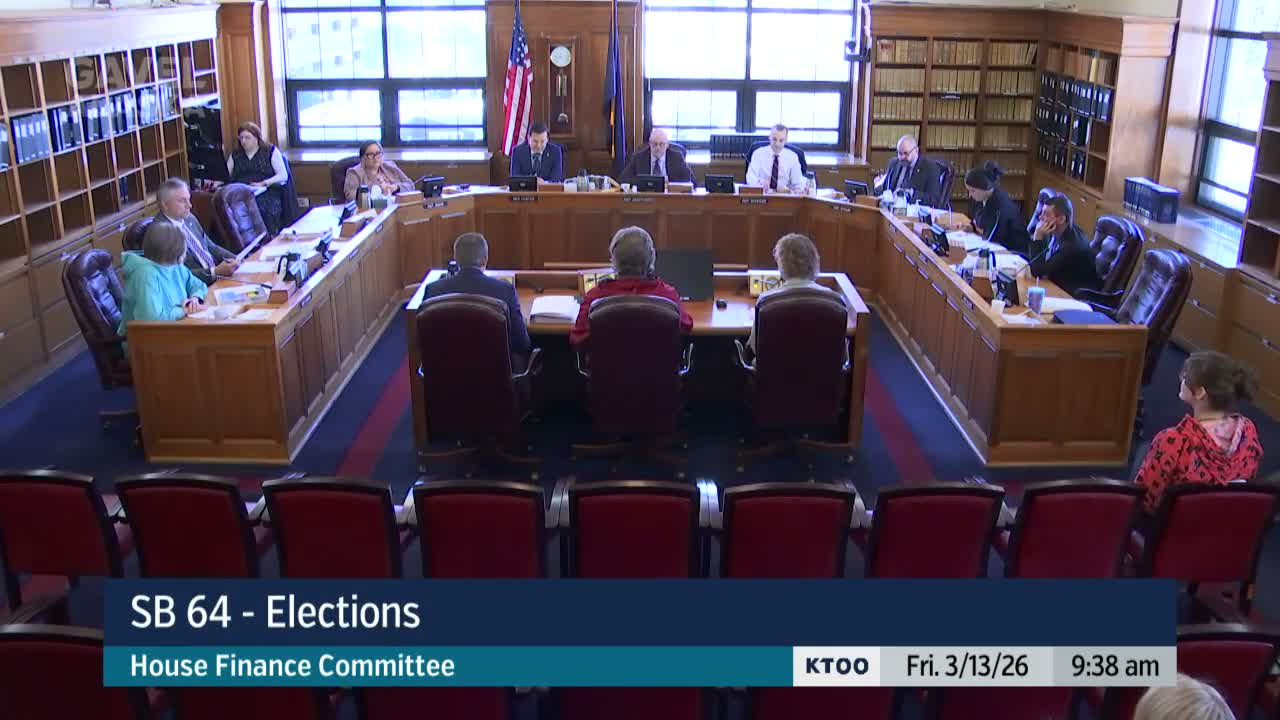
The Alaska House Finance Committee on March 13 continued consideration of Senate Bill 64, an elections bill that sponsors say has been under development for years, as legislators heard updated fiscal notes and reviewed a set of proposed clarifying changes to be included in a committee substitute next week.
Bridal Anderson, staff to Co‑chair Foster, presented two newly filed fiscal notes for the measure and said the Division of Elections’ FY27 operating estimate is $888,100, down about $397,700 from last year’s submission, and that capital costs for FY27 are estimated at $765,000. Anderson said the division still expects to need one full‑time rural‑liaison position (range 16) at an estimated $124,200 and five temporary staff for the ballot‑curing process (about $80,000). “In FY ’27, the total operating cost for this fiscal note will be $888,100,” Anderson told the committee.
Carol Beecher, director of the Division of Elections, answered lawmakers’ questions about the assumptions behind those numbers and about how the Permanent Fund Dividend (PFD) data is used for voter registration and address updates. Beecher said that the absentee‑envelope analysis used the number of envelopes sent with an assumption of response and that the division can provide actual return‑rate figures. On the PFD list the division receives, she said, “By that, I mean the whole list of those who are 18 or older and have noted that they are U.S. citizens,” and that the PFD automatic voter‑registration process sends a notice and allows recipients to opt out.
Several lawmakers asked whether merging PFD data into voter files can inadvertently change a voter’s residence address and thus voting district. David Dunsmore, staff to the sponsor, said the PFD application form has been updated to clarify address fields and that the Permanent Fund Division now provides an explicit pop‑up telling applicants they can opt out of updating voter registration. Dunsmore said the change to the PFD form has reduced reports of inadvertent changes.
Sen. Wolokowski, sponsor of SB 64, walked the committee through a sequence of non‑substantive revisions the sponsor plans to include in the forthcoming committee substitute. Among the changes he described were a drafting correction on page 3 (adding a missing “or”); removing a proposed requirement about maintaining a physical address outside Alaska for a 28‑month period (to avoid capturing Alaskans with out‑of‑state vacation properties); replacing a specific reference to the federal SAVE program with language referring to a system or systems for verifying citizenship; adding an encryption and retention limitation for any confidential data the division would transmit to outside entities; and clarifying that collaboration on voting access in rural areas apply to absentee voting and to early voting only where it is available.
The sponsor also described proposed language to ensure ballots that are properly cured will be counted. Staff said they will add language to section 22 stating that, notwithstanding provisions that could reject a ballot, a ballot properly cured under AS 15.22.22 shall be counted. Dunsmore characterized most of the listed edits as technical clarifications intended to address concerns raised during committee review and in meetings with the division.
Committee members pressed the division and sponsor on timing and implementation risk. Beecher cautioned the committee about the Division’s limited staffing, saying the division has only a few regional staff and two IT staff and that she could not “guarantee” a complex system rollout would be thoroughly tested in time for the elections calendar this year. “So implementing something ... that we could say that this has been thoroughly tested and that we can guarantee you it’s going to work well, I would not be able to say that I could guarantee that,” Beecher said. In response, the sponsor proposed adjusting effective dates for ballot tracking and ballot‑curing provisions so they would take effect after the primary but in time for the general election to give the division more time to implement changes.
No formal motions or votes were taken. Chair Foster said a formal committee substitute with the proposed language will be filed next week, the amendment deadline will be extended and announced at that time, and the committee will take public testimony later that day at 1:30 p.m. The committee adjourned at 10:13 a.m.
Bridal Anderson, staff to Co‑chair Foster, presented two newly filed fiscal notes for the measure and said the Division of Elections’ FY27 operating estimate is $888,100, down about $397,700 from last year’s submission, and that capital costs for FY27 are estimated at $765,000. Anderson said the division still expects to need one full‑time rural‑liaison position (range 16) at an estimated $124,200 and five temporary staff for the ballot‑curing process (about $80,000). “In FY ’27, the total operating cost for this fiscal note will be $888,100,” Anderson told the committee.
Carol Beecher, director of the Division of Elections, answered lawmakers’ questions about the assumptions behind those numbers and about how the Permanent Fund Dividend (PFD) data is used for voter registration and address updates. Beecher said that the absentee‑envelope analysis used the number of envelopes sent with an assumption of response and that the division can provide actual return‑rate figures. On the PFD list the division receives, she said, “By that, I mean the whole list of those who are 18 or older and have noted that they are U.S. citizens,” and that the PFD automatic voter‑registration process sends a notice and allows recipients to opt out.
Several lawmakers asked whether merging PFD data into voter files can inadvertently change a voter’s residence address and thus voting district. David Dunsmore, staff to the sponsor, said the PFD application form has been updated to clarify address fields and that the Permanent Fund Division now provides an explicit pop‑up telling applicants they can opt out of updating voter registration. Dunsmore said the change to the PFD form has reduced reports of inadvertent changes.
Sen. Wolokowski, sponsor of SB 64, walked the committee through a sequence of non‑substantive revisions the sponsor plans to include in the forthcoming committee substitute. Among the changes he described were a drafting correction on page 3 (adding a missing “or”); removing a proposed requirement about maintaining a physical address outside Alaska for a 28‑month period (to avoid capturing Alaskans with out‑of‑state vacation properties); replacing a specific reference to the federal SAVE program with language referring to a system or systems for verifying citizenship; adding an encryption and retention limitation for any confidential data the division would transmit to outside entities; and clarifying that collaboration on voting access in rural areas apply to absentee voting and to early voting only where it is available.
The sponsor also described proposed language to ensure ballots that are properly cured will be counted. Staff said they will add language to section 22 stating that, notwithstanding provisions that could reject a ballot, a ballot properly cured under AS 15.22.22 shall be counted. Dunsmore characterized most of the listed edits as technical clarifications intended to address concerns raised during committee review and in meetings with the division.
Committee members pressed the division and sponsor on timing and implementation risk. Beecher cautioned the committee about the Division’s limited staffing, saying the division has only a few regional staff and two IT staff and that she could not “guarantee” a complex system rollout would be thoroughly tested in time for the elections calendar this year. “So implementing something ... that we could say that this has been thoroughly tested and that we can guarantee you it’s going to work well, I would not be able to say that I could guarantee that,” Beecher said. In response, the sponsor proposed adjusting effective dates for ballot tracking and ballot‑curing provisions so they would take effect after the primary but in time for the general election to give the division more time to implement changes.
No formal motions or votes were taken. Chair Foster said a formal committee substitute with the proposed language will be filed next week, the amendment deadline will be extended and announced at that time, and the committee will take public testimony later that day at 1:30 p.m. The committee adjourned at 10:13 a.m.
View the Full Meeting & All Its Details
This article offers just a summary. Unlock complete video, transcripts, and insights as a Founder Member.
✓
Watch full, unedited meeting videos
✓
Search every word spoken in unlimited transcripts
✓
AI summaries & real-time alerts (all government levels)
✓
Permanent access to expanding government content
30-day money-back guarantee
