House Energy Committee weighs funding levels for Renewable Energy Fund, asks AEA for generation data
March 17, 2026 | 2026 Legislature Alaska, Alaska
This article was created by AI summarizing key points discussed. AI makes mistakes, so for full details and context, please refer to the video of the full meeting. Please report any errors so we can fix them. Report an error »
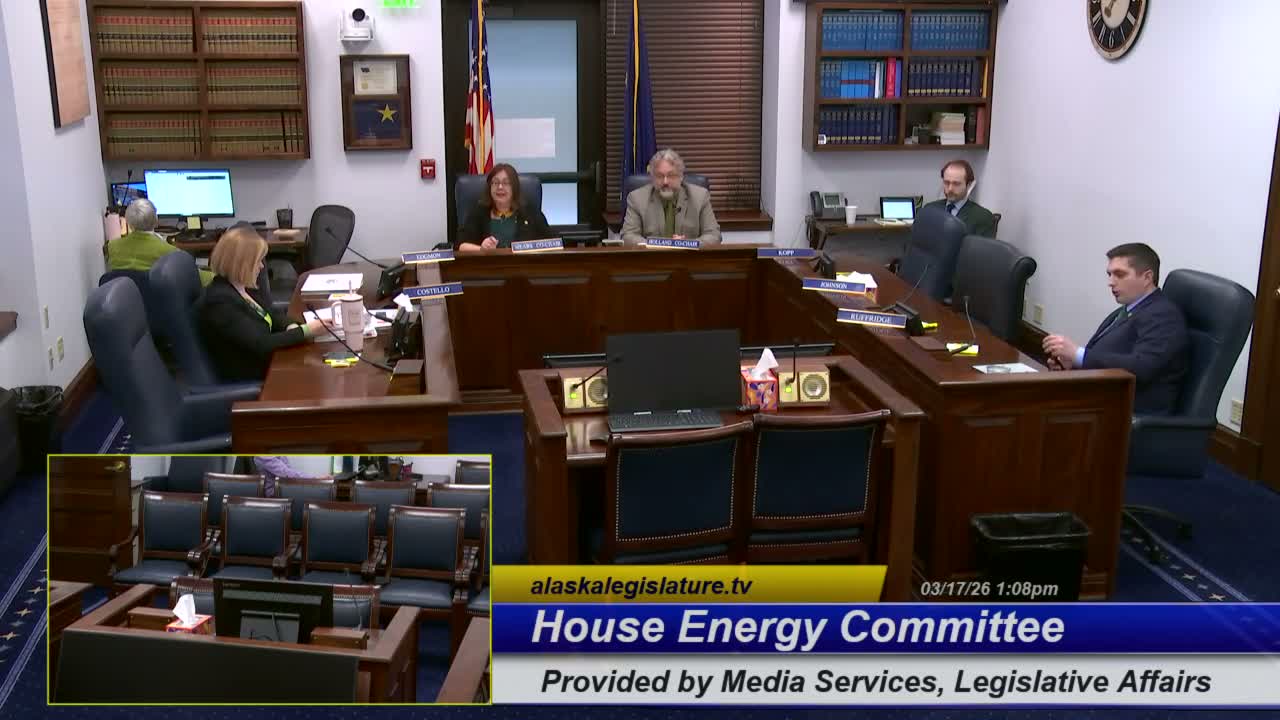
Juneau — The Alaska House Energy Committee on March 17 discussed three recommended funding levels for the state Renewable Energy Fund and agreed to follow the Alaska Energy Authority’s prioritized project list while asking AEA for more data on expected power generation.
Co‑chair Donna Meares opened the meeting and said the governor’s budget includes no placeholder funding for Renewable Energy Fund projects this year, leaving the committee an opportunity to recommend language and funding levels to the House Finance Committee. “So the entire list is just over $41,000,000. So that’s 28 out of 28 projects funded,” Meares said, describing three tiers of funding presented in a committee memo: a full package of about $41 million, a middle tier just under $25 million funding 13 projects, and a lower tier near $7 million that would cover about five projects.
The committee heard from Heinrichsen, director of planning at the Alaska Energy Authority, about how AEA evaluates project benefits. Heinrichsen said annual displacement figures in the packet show short‑term fuel reductions, but AEA uses benefit‑cost ratios over a project’s lifetime to measure value. “When we look at the benefit‑cost ratio… the average for the projects submitted this year is a ratio of 1.4,” Heinrichsen said, explaining that some remote projects have lower ratios because of higher infrastructure and logistics costs but can nevertheless deliver long‑term fuel savings over 20 years.
Representative Mark Ruffridge (Representative Ruffridge) pressed for more information on expected generation from the projects and said he could not support funding every item on the list without that data. “We’re not really generating a lot in the way of electrons with these projects,” Ruffridge said, and added that many proposals are in planning stages or are non‑generation system elements such as batteries or switchgear.
Other committee members urged that the legislature maintain AEA’s ranked order and fund full project lines rather than partial funding that could prevent completion. One member expressed appreciation that the chairs had not re‑ordered the AEA list and emphasized the importance of geographic and project‑type diversity in the packet.
Heinrichsen and staff said the generation figures requested by the committee had been provided to AEA’s Director Fair and would be transmitted to the committee “in very short order.” The meeting ended without a formal vote; Meares said the committee will hear a committee substitute for House Bill 369 (the energy omnibus) on Thursday.
What this means: Committee members signaled support for following AEA’s technical ranking but reserved a final fiscal endorsement until staff provides more detailed generation and lifetime‑savings data. No formal funding decision or legislative language was adopted at the March 17 meeting.
Co‑chair Donna Meares opened the meeting and said the governor’s budget includes no placeholder funding for Renewable Energy Fund projects this year, leaving the committee an opportunity to recommend language and funding levels to the House Finance Committee. “So the entire list is just over $41,000,000. So that’s 28 out of 28 projects funded,” Meares said, describing three tiers of funding presented in a committee memo: a full package of about $41 million, a middle tier just under $25 million funding 13 projects, and a lower tier near $7 million that would cover about five projects.
The committee heard from Heinrichsen, director of planning at the Alaska Energy Authority, about how AEA evaluates project benefits. Heinrichsen said annual displacement figures in the packet show short‑term fuel reductions, but AEA uses benefit‑cost ratios over a project’s lifetime to measure value. “When we look at the benefit‑cost ratio… the average for the projects submitted this year is a ratio of 1.4,” Heinrichsen said, explaining that some remote projects have lower ratios because of higher infrastructure and logistics costs but can nevertheless deliver long‑term fuel savings over 20 years.
Representative Mark Ruffridge (Representative Ruffridge) pressed for more information on expected generation from the projects and said he could not support funding every item on the list without that data. “We’re not really generating a lot in the way of electrons with these projects,” Ruffridge said, and added that many proposals are in planning stages or are non‑generation system elements such as batteries or switchgear.
Other committee members urged that the legislature maintain AEA’s ranked order and fund full project lines rather than partial funding that could prevent completion. One member expressed appreciation that the chairs had not re‑ordered the AEA list and emphasized the importance of geographic and project‑type diversity in the packet.
Heinrichsen and staff said the generation figures requested by the committee had been provided to AEA’s Director Fair and would be transmitted to the committee “in very short order.” The meeting ended without a formal vote; Meares said the committee will hear a committee substitute for House Bill 369 (the energy omnibus) on Thursday.
What this means: Committee members signaled support for following AEA’s technical ranking but reserved a final fiscal endorsement until staff provides more detailed generation and lifetime‑savings data. No formal funding decision or legislative language was adopted at the March 17 meeting.
Don't Miss a Word: See the Full Meeting!
Go beyond summaries. Unlock every video, transcript, and key insight with a Founder Membership.
✓
Get instant access to full meeting videos
✓
Search and clip any phrase from complete transcripts
✓
Receive AI-powered summaries & custom alerts
✓
Enjoy lifetime, unrestricted access to government data
30-day money-back guarantee
