House Education Committee urges Congress to pass Kids Online Safety Act, citing youth harm from algorithms
March 13, 2026 | 2026 Legislature Alaska, Alaska
This article was created by AI summarizing key points discussed. AI makes mistakes, so for full details and context, please refer to the video of the full meeting. Please report any errors so we can fix them. Report an error »
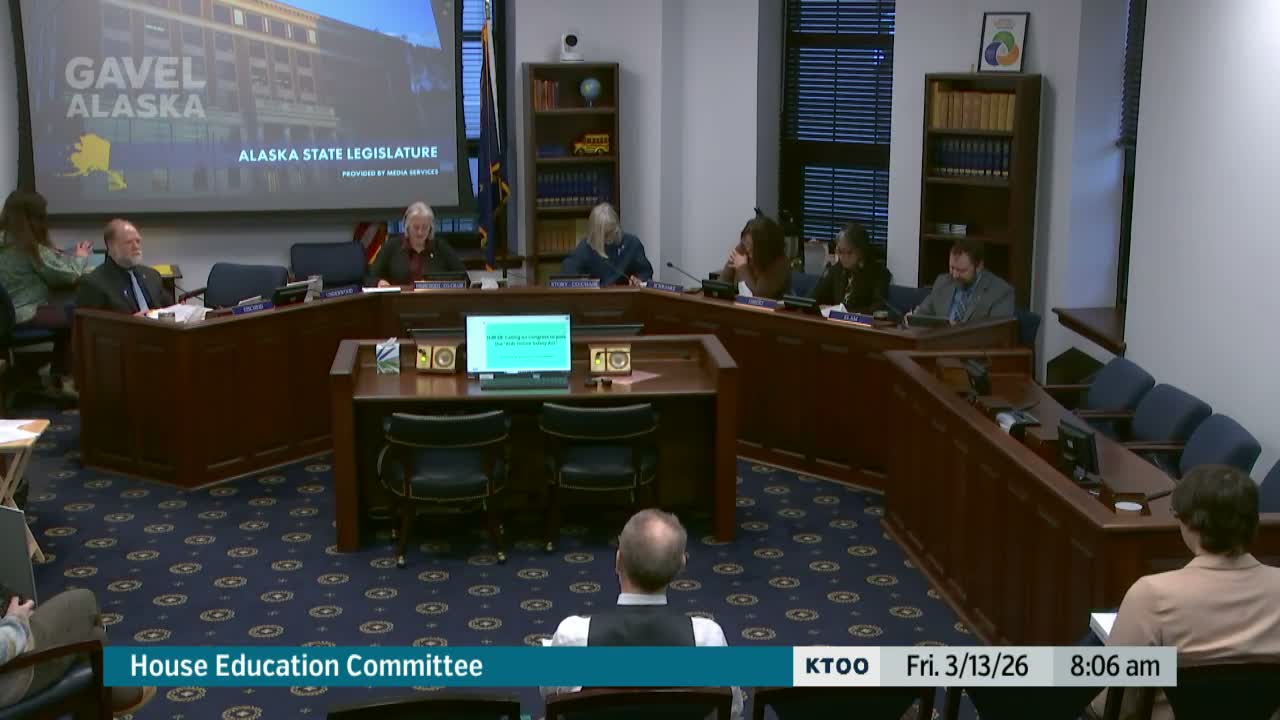
The House Education Committee on March 13 moved House Joint Resolution 28 forward with attached fiscal notes and individual recommendations, urging Congress to pass the Senate Kids Online Safety Act (often called COSA or KOSA) and preserve a federal ‘‘duty of care’’ standard for platforms.
Representative Ted Eischeid, sponsor of the resolution, told the committee the measure is bipartisan and urged federal action to protect children from harms caused by social media algorithms. "Why wouldn't we protect our children against online harm?" he asked, describing platforms that "feed into addictive behaviors" and exposing young people to depression, eating disorders and predatory contacts.
Michael Busey, staff to Representative Eischeid, outlined recent federal history, saying the Senate bill previously passed the Senate with strong bipartisan support (reported as a large margin in committee remarks) but stalled in the House. He told the committee the Senate version includes a duty‑of‑care requirement that would require covered platforms to take reasonable steps to mitigate foreseeable harms.
Testimony from child‑welfare and clinical groups supported the resolution. Trevor Storrs, president and CEO of the Alaska Children's Trust, said the organization "supports policies that promote online safety, responsible use of social media and an accountable digital ecosystem," urging that covered platforms exercise reasonable care in design to prevent harms such as severe harassment and mental‑health problems.
Jess Rood, executive director of the Alaska Eating Disorders Alliance (ACETA), gave remote testimony emphasizing the algorithms' role in amplifying body‑image and eating‑disorder risk. "Our kids should not be competing with billion‑dollar algorithms designed to capture their attention," she said, and she urged the committee to back the Senate COSA with the duty‑of‑care provision intact.
Committee members focused discussion on the substance of the federal bills: members asked for the Senate bill's status and compared the House and Senate proposals, noting that some House versions remove states' ability to regulate platforms and weaken duty‑of‑care language. Representative Underwood and others urged the committee's resolution to support the Senate approach with robust duty‑of‑care requirements.
Representative Elam moved the resolution out of committee; with no objections the motion carried and the resolution will be forwarded with attached fiscal notes and the committee's recommendations.
The committee took no further formal action on federal policy beyond advancing HJR 28; staff will complete the paperwork following the meeting.
Representative Ted Eischeid, sponsor of the resolution, told the committee the measure is bipartisan and urged federal action to protect children from harms caused by social media algorithms. "Why wouldn't we protect our children against online harm?" he asked, describing platforms that "feed into addictive behaviors" and exposing young people to depression, eating disorders and predatory contacts.
Michael Busey, staff to Representative Eischeid, outlined recent federal history, saying the Senate bill previously passed the Senate with strong bipartisan support (reported as a large margin in committee remarks) but stalled in the House. He told the committee the Senate version includes a duty‑of‑care requirement that would require covered platforms to take reasonable steps to mitigate foreseeable harms.
Testimony from child‑welfare and clinical groups supported the resolution. Trevor Storrs, president and CEO of the Alaska Children's Trust, said the organization "supports policies that promote online safety, responsible use of social media and an accountable digital ecosystem," urging that covered platforms exercise reasonable care in design to prevent harms such as severe harassment and mental‑health problems.
Jess Rood, executive director of the Alaska Eating Disorders Alliance (ACETA), gave remote testimony emphasizing the algorithms' role in amplifying body‑image and eating‑disorder risk. "Our kids should not be competing with billion‑dollar algorithms designed to capture their attention," she said, and she urged the committee to back the Senate COSA with the duty‑of‑care provision intact.
Committee members focused discussion on the substance of the federal bills: members asked for the Senate bill's status and compared the House and Senate proposals, noting that some House versions remove states' ability to regulate platforms and weaken duty‑of‑care language. Representative Underwood and others urged the committee's resolution to support the Senate approach with robust duty‑of‑care requirements.
Representative Elam moved the resolution out of committee; with no objections the motion carried and the resolution will be forwarded with attached fiscal notes and the committee's recommendations.
The committee took no further formal action on federal policy beyond advancing HJR 28; staff will complete the paperwork following the meeting.
Don't Miss a Word: See the Full Meeting!
Go beyond summaries. Unlock every video, transcript, and key insight with a Founder Membership.
✓
Get instant access to full meeting videos
✓
Search and clip any phrase from complete transcripts
✓
Receive AI-powered summaries & custom alerts
✓
Enjoy lifetime, unrestricted access to government data
30-day money-back guarantee
