Committee hears wide‑ranging teacher recruitment and retention bill; work draft adopted, further review planned
March 13, 2026 | 2026 Legislature Alaska, Alaska
This article was created by AI summarizing key points discussed. AI makes mistakes, so for full details and context, please refer to the video of the full meeting. Please report any errors so we can fix them. Report an error »
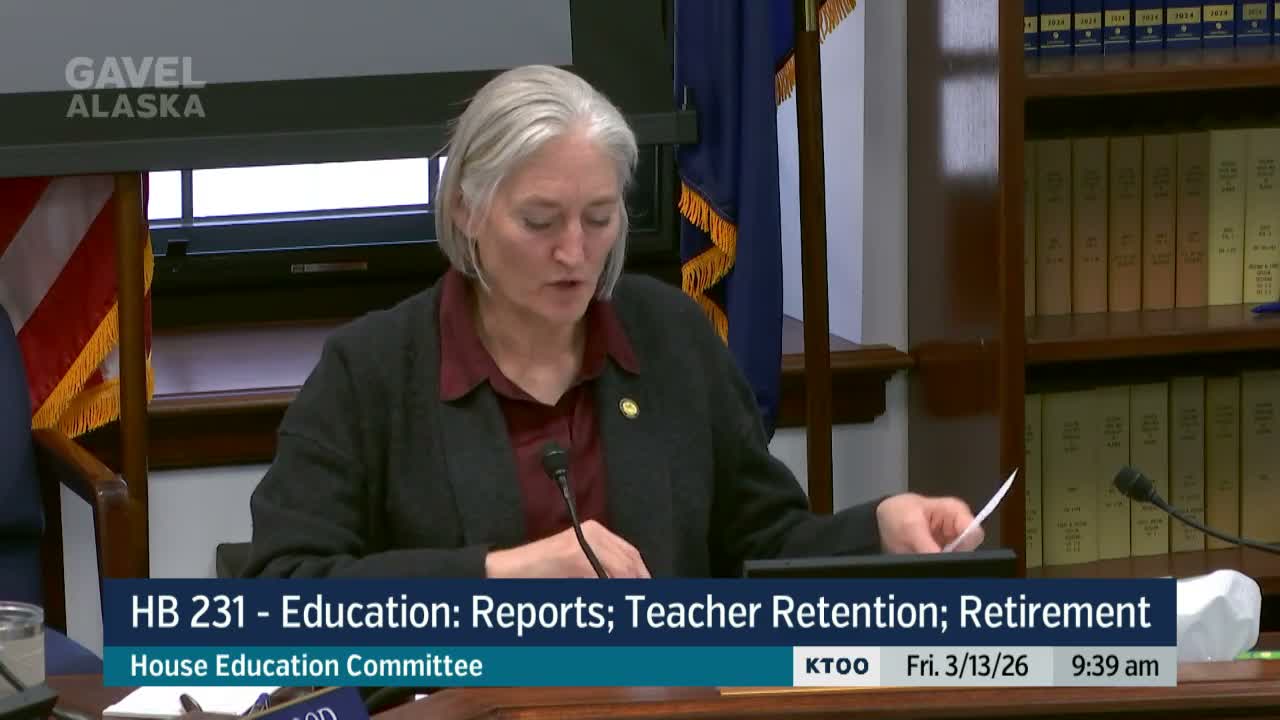
The House Education Committee held an initial hearing on HB 231 on March 13, adopting the committee substitute (work draft version H) as its working document and taking a sponsor presentation without detailed questions.
Representative Robin Neop Freer, sponsor of HB 231, said the bill responds to persistent teacher vacancies and turnover, particularly in rural districts. She described extensive components to increase stability and recruitment: mandatory third‑party teacher exit interviews, reporting on educator housing habitability, alignment with the federal E‑rate program to help districts obtain 1 Gbps broadband, mentoring and retirement/financial planning training for educators, educator housing subsidy and upgrade grant programs, and options enabling some educators to transfer between defined benefit and defined contribution retirement plans.
Ella Lubin, committee aide, summarized the sectional changes in version H: reporting and habitability requirements (sections 1, 2, and 8), E‑rate local share support to reach 1 Gbps (section 3), mentoring and retirement training (section 4), educator housing programs (section 6), retirement plan restructuring (sections 9–20) and recruitment and retention bonuses between $5,000 and $15,000 (section 25). The sponsor's chief of staff clarified a technical correction to the retirement opt‑in language during the presentation.
Representative Freer emphasized the bill's 'grow‑your‑own' and retention focus and cited district hiring data and job‑fair trends showing a steep drop in applicants over recent years. Because the bill is large and complex the committee chose to set the item aside for more detailed review, planning to return with questions and possible amendments at a later meeting.
No formal vote on substantive provisions occurred at this hearing; the committee adopted the work draft as its working document and will schedule follow‑up sessions for deeper review and fiscal analysis.
Representative Robin Neop Freer, sponsor of HB 231, said the bill responds to persistent teacher vacancies and turnover, particularly in rural districts. She described extensive components to increase stability and recruitment: mandatory third‑party teacher exit interviews, reporting on educator housing habitability, alignment with the federal E‑rate program to help districts obtain 1 Gbps broadband, mentoring and retirement/financial planning training for educators, educator housing subsidy and upgrade grant programs, and options enabling some educators to transfer between defined benefit and defined contribution retirement plans.
Ella Lubin, committee aide, summarized the sectional changes in version H: reporting and habitability requirements (sections 1, 2, and 8), E‑rate local share support to reach 1 Gbps (section 3), mentoring and retirement training (section 4), educator housing programs (section 6), retirement plan restructuring (sections 9–20) and recruitment and retention bonuses between $5,000 and $15,000 (section 25). The sponsor's chief of staff clarified a technical correction to the retirement opt‑in language during the presentation.
Representative Freer emphasized the bill's 'grow‑your‑own' and retention focus and cited district hiring data and job‑fair trends showing a steep drop in applicants over recent years. Because the bill is large and complex the committee chose to set the item aside for more detailed review, planning to return with questions and possible amendments at a later meeting.
No formal vote on substantive provisions occurred at this hearing; the committee adopted the work draft as its working document and will schedule follow‑up sessions for deeper review and fiscal analysis.
View the Full Meeting & All Its Details
This article offers just a summary. Unlock complete video, transcripts, and insights as a Founder Member.
✓
Watch full, unedited meeting videos
✓
Search every word spoken in unlimited transcripts
✓
AI summaries & real-time alerts (all government levels)
✓
Permanent access to expanding government content
30-day money-back guarantee
