House Finance Committee adopts committee substitute for Senate Bill 64, sets amendment deadline
March 16, 2026 | 2026 Legislature Alaska, Alaska
This article was created by AI summarizing key points discussed. AI makes mistakes, so for full details and context, please refer to the video of the full meeting. Please report any errors so we can fix them. Report an error »
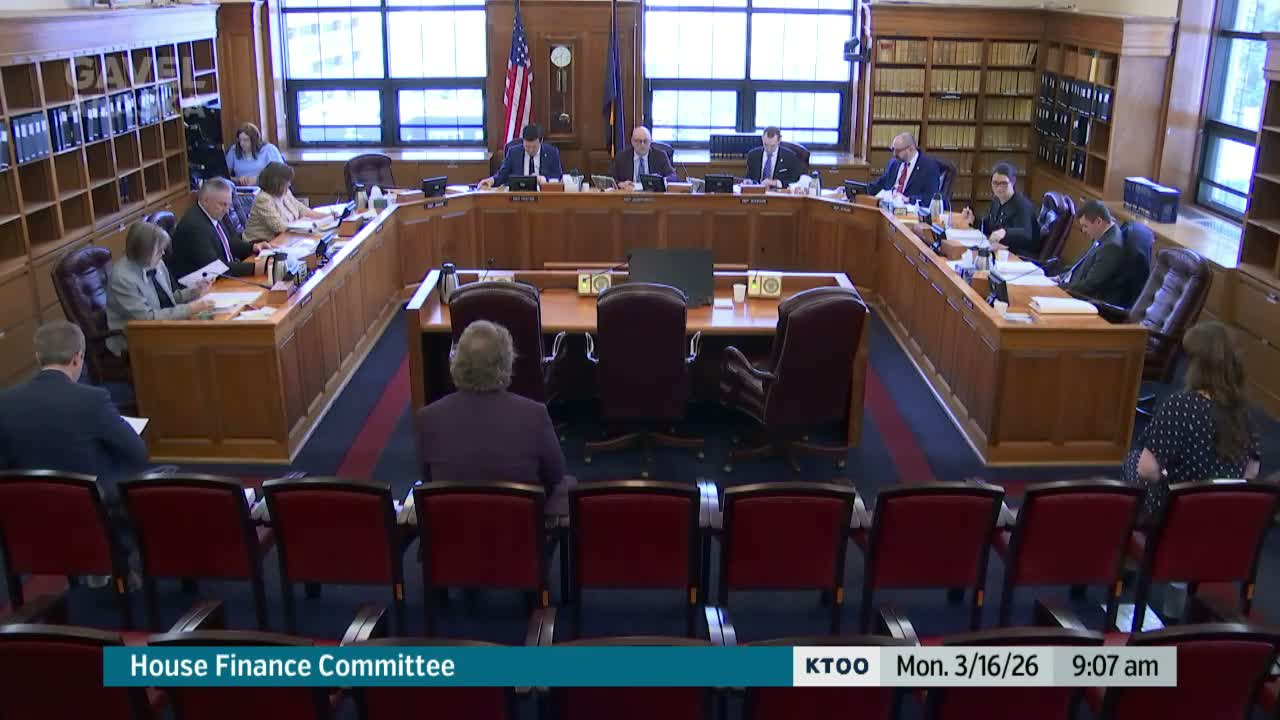
The Alaska House Finance Committee on March 16 adopted a committee substitute for Senate Bill 64, an elections bill, after staff walked members through a redline of technical edits and policy changes and a committee objection was withdrawn.
Co-Chair Foster said the committee would use the committee substitute version B (work draft 34-LS0153\b) as its working document; a committee member moved to adopt it and staff from both the sponsor and the Division of Elections explained the changes.
Why it matters: The substitute adds provisions affecting voter-roll cleanup criteria, limits on how outside organizations may use shared voter data, revised references to Permanent Fund Dividend (PFD) data, and effective-date language intended to allow the Division of Elections to begin regulatory and procurement work immediately while delaying other provisions until later in the election cycle.
Staff and major edits
Brody Anderson, staff to Co-Chair Foster, and David Dunsmore, staff to Senator Wilczkowski, told the committee they were relying on three documents: the adopted committee substitute, a senator's statement of changes, and a redline delivered that morning. Anderson guided members through page-by-page changes while Dunsmore clarified technical points.
Dunsmore said the redline makes several substantive clarifications. On page 3 the text was altered to add the word "or," clarifying that meeting any one of a list of criteria (A–G) triggers a notice rather than requiring all items to be met. The substitute also removes a prior subsection (H) that had tied a cleanup trigger to maintaining a physical address outside the state for 28 months.
The substitute replaces a single named database for citizenship verification with language allowing "one or more systems for verifying citizenship," Dunsmore said, explaining the change gives the Division flexibility if a particular database is unavailable because of litigation.
Data handling and privacy
Dunsmore described new sideboards on data sharing: if the Division must share voter-roll data with an outside organization or vendor to assist with register review, the data must be encrypted, the recipient may use it only for the purpose of assisting the Division's review, and the recipient must not retain the data afterward. "This language would require that if data has to be shared ... that the data must be encrypted," Dunsmore said, adding the protections were developed with the Division of Elections to safeguard confidential information about "over 600,000 registered voters."
PFD references and other technical edits
On page 5 the redline removes a clause listing "registering to vote" under a specific subsection and adds an exception related to applying for a Permanent Fund Dividend, clarifying when PFD applications count as voter-registration interactions. Staff also removed language that would have required the PFD division to transmit voters' registration status (data the Division of Elections already holds).
Breach notification and implementation timing
The substitute includes a breach-notification clarification requiring that, if a data breach is discovered 14 or more days before an election, notification must occur within 30 days after discovery. It also adds two uncodified transition clauses to authorize immediate work on regulations and procurement if the bill is signed, while leaving most substantive provisions to take effect later so they do not change disclosure rules mid-election.
Division capacity and fiscal note
Carol Beecher, director of the Division of Elections, told the committee she "does not anticipate" the changes would reduce the bill's fiscal note. Beecher said her office believes "we can implement most of the things in this bill," but that the cure system and the ballot-tracking system would be the most challenging to deliver in time for the general election: "the most challenging will be implementing the cure system and the ballot tracking system in time for the general election."
Member questions and follow-up
Members requested an updated sectional analysis and an updated fiscal analysis for version B. Staff acknowledged no updated sectional for version B was in members' packets and said the sponsor's staff and Dunsmore would work to provide an updated analysis and fiscal materials to co-chairs later that day.
Procedure and next steps
A committee member objected to adopting the committee substitute so the committee briefly took an at-ease; the objection was later withdrawn and no roll-call vote was recorded. Co-Chair Foster then confirmed the committee substitute (work draft 34-LS0153\b, dated 2026-03-14) as the working document. The committee set an amendment deadline of Thursday, March 19, 2026, at noon and said it would schedule another meeting that week to consider amendments.
Co-Chair Foster said the committee would use the committee substitute version B (work draft 34-LS0153\b) as its working document; a committee member moved to adopt it and staff from both the sponsor and the Division of Elections explained the changes.
Why it matters: The substitute adds provisions affecting voter-roll cleanup criteria, limits on how outside organizations may use shared voter data, revised references to Permanent Fund Dividend (PFD) data, and effective-date language intended to allow the Division of Elections to begin regulatory and procurement work immediately while delaying other provisions until later in the election cycle.
Staff and major edits
Brody Anderson, staff to Co-Chair Foster, and David Dunsmore, staff to Senator Wilczkowski, told the committee they were relying on three documents: the adopted committee substitute, a senator's statement of changes, and a redline delivered that morning. Anderson guided members through page-by-page changes while Dunsmore clarified technical points.
Dunsmore said the redline makes several substantive clarifications. On page 3 the text was altered to add the word "or," clarifying that meeting any one of a list of criteria (A–G) triggers a notice rather than requiring all items to be met. The substitute also removes a prior subsection (H) that had tied a cleanup trigger to maintaining a physical address outside the state for 28 months.
The substitute replaces a single named database for citizenship verification with language allowing "one or more systems for verifying citizenship," Dunsmore said, explaining the change gives the Division flexibility if a particular database is unavailable because of litigation.
Data handling and privacy
Dunsmore described new sideboards on data sharing: if the Division must share voter-roll data with an outside organization or vendor to assist with register review, the data must be encrypted, the recipient may use it only for the purpose of assisting the Division's review, and the recipient must not retain the data afterward. "This language would require that if data has to be shared ... that the data must be encrypted," Dunsmore said, adding the protections were developed with the Division of Elections to safeguard confidential information about "over 600,000 registered voters."
PFD references and other technical edits
On page 5 the redline removes a clause listing "registering to vote" under a specific subsection and adds an exception related to applying for a Permanent Fund Dividend, clarifying when PFD applications count as voter-registration interactions. Staff also removed language that would have required the PFD division to transmit voters' registration status (data the Division of Elections already holds).
Breach notification and implementation timing
The substitute includes a breach-notification clarification requiring that, if a data breach is discovered 14 or more days before an election, notification must occur within 30 days after discovery. It also adds two uncodified transition clauses to authorize immediate work on regulations and procurement if the bill is signed, while leaving most substantive provisions to take effect later so they do not change disclosure rules mid-election.
Division capacity and fiscal note
Carol Beecher, director of the Division of Elections, told the committee she "does not anticipate" the changes would reduce the bill's fiscal note. Beecher said her office believes "we can implement most of the things in this bill," but that the cure system and the ballot-tracking system would be the most challenging to deliver in time for the general election: "the most challenging will be implementing the cure system and the ballot tracking system in time for the general election."
Member questions and follow-up
Members requested an updated sectional analysis and an updated fiscal analysis for version B. Staff acknowledged no updated sectional for version B was in members' packets and said the sponsor's staff and Dunsmore would work to provide an updated analysis and fiscal materials to co-chairs later that day.
Procedure and next steps
A committee member objected to adopting the committee substitute so the committee briefly took an at-ease; the objection was later withdrawn and no roll-call vote was recorded. Co-Chair Foster then confirmed the committee substitute (work draft 34-LS0153\b, dated 2026-03-14) as the working document. The committee set an amendment deadline of Thursday, March 19, 2026, at noon and said it would schedule another meeting that week to consider amendments.
View the Full Meeting & All Its Details
This article offers just a summary. Unlock complete video, transcripts, and insights as a Founder Member.
✓
Watch full, unedited meeting videos
✓
Search every word spoken in unlimited transcripts
✓
AI summaries & real-time alerts (all government levels)
✓
Permanent access to expanding government content
30-day money-back guarantee
