House Resources Committee adopts committee substitute for bill expanding, renaming refuge around Homer airport
March 16, 2026 | 2026 Legislature Alaska, Alaska
This article was created by AI summarizing key points discussed. AI makes mistakes, so for full details and context, please refer to the video of the full meeting. Please report any errors so we can fix them. Report an error »
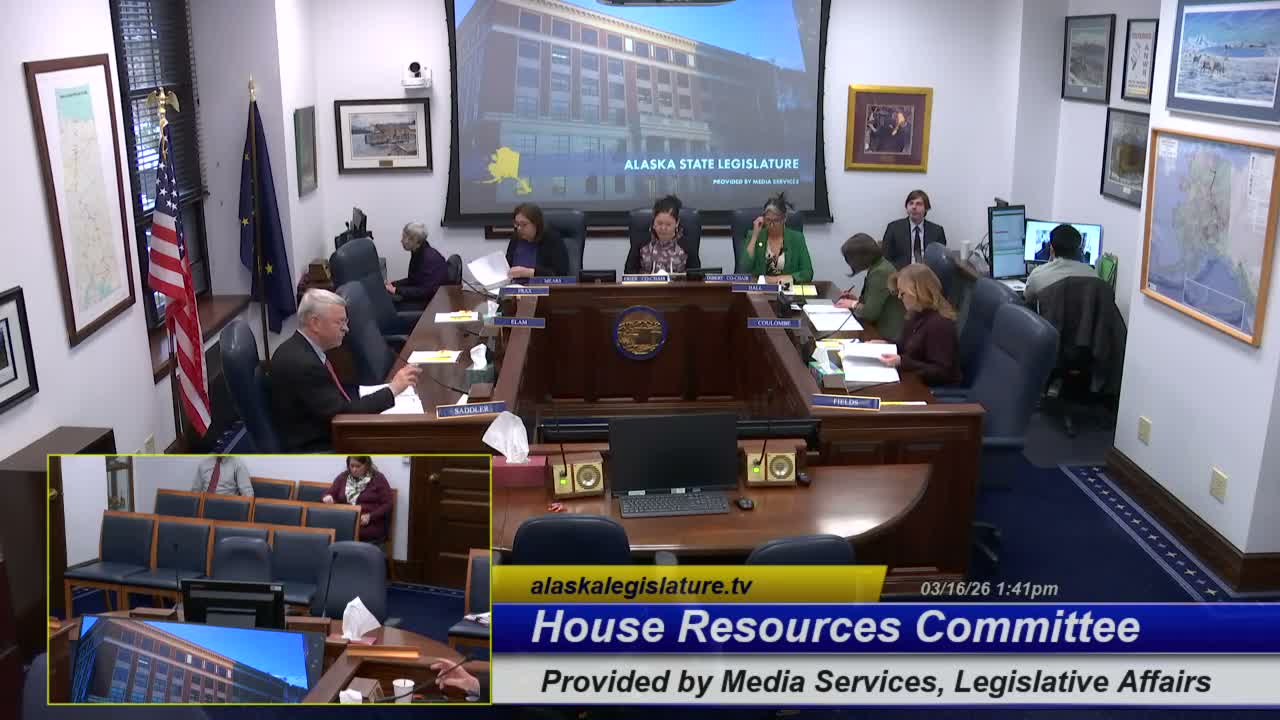
The House Resources Committee on Monday moved forward with a committee substitute for House Bill 321, a wide-ranging measure that would reorganize and clarify statutes on state wildlife refuges and expand protected areas around Homer.
Co-chair Representative Freer opened the second hearing and said the committee would consider a sponsor blank committee substitute; Co-chair Representative Divert moved to adopt the CS as the committee's working document. After an objection was lodged for purposes of discussion, staff for the bill's sponsor, Joe Meehan, walked the panel through key changes.
Meehan said the CS replaces an imprecise geographic reference with the Kamishak Bay Area and restores the phrase "natural habitats" to the bill's primary purpose statement. He said the draft also changes one regulatory directive from "shall" to "may," giving the responsible department discretion "to decide when adopting regulations was appropriate." On firearm-discharge language in the CS, Meehan said the intent is not to restrict lawful hunting, fishing or trapping but to curb target-shooting or other downrange activities in limited areas to protect public health and safety. "This is not intended to put any restrictions on the discharge of firearms for hunting, fishing, or trapping," he said.
One of the most substantive changes discussed would add parcels around the Homer Airport Critical Habitat Area and rename the unit to the Beluga Wetlands Wildlife Refuge or Beluga Wetlands Complex to reflect local usage. Meehan described map changes and ownership types: some parcels to be added are state-owned (managed by DNR or DOT), some are privately held by a conservation organization that has indicated willingness to donate land, and two municipal parcels would be included only if the respective municipality signs a written agreement. Meehan said a memo and updated maps explaining the additions, requested at the prior hearing, are being prepared.
Members asked for more precise materials. Representative Sadler pressed what the addition of "natural habitats" would mean in practice and sought legal clarity about why the draft does not name specific limited areas for firearm closures. Meehan said the language mirrors existing refuge and critical-habitat statutes and that some limits on modes of access (for example, off-road vehicle use) are typically handled in site-specific management plans.
The CS also reworks section numbers and incorporates a set of housekeeping changes across the proposed refuge statutes. After discussion, Representative Freer removed his objection and the committee substitute was adopted as the working document; the transcript does not include a roll-call vote tally.
The committee then heard invited testimony from Lynn Whitmore, president of Kachemak Moose Habitat Inc., who described decades of local land acquisition and management around the Beluga Wetlands and said state management would improve long-term stewardship. "We've been doing this probably close to 30 years," Whitmore said, describing the group's acquisitions, donor support and collaboration with US Fish and Wildlife and the City of Homer.
Committee members also flagged an isolated provision addressing personal watercraft (jet skis) in Kachemak Bay. Representative Sandler warned that the provision could reverse a long administrative and judicial history: Meehan recounted that a regulation prohibiting personal watercraft had been adopted in the late 1990s, later rescinded by a subsequent administration, and that litigation over the rescission ultimately reached the state supreme court, which — in his summary — found the state followed proper procedure in rescinding that regulation.
With no further questions, the committee set House Bill 321 aside for a future hearing and indicated it expects to invite the Department of Fish and Game, the Department of Natural Resources and other agencies to provide technical feedback at a subsequent meeting. The committee's next meeting is scheduled for Wednesday, March 18, 2026; the bill remains pending.
Co-chair Representative Freer opened the second hearing and said the committee would consider a sponsor blank committee substitute; Co-chair Representative Divert moved to adopt the CS as the committee's working document. After an objection was lodged for purposes of discussion, staff for the bill's sponsor, Joe Meehan, walked the panel through key changes.
Meehan said the CS replaces an imprecise geographic reference with the Kamishak Bay Area and restores the phrase "natural habitats" to the bill's primary purpose statement. He said the draft also changes one regulatory directive from "shall" to "may," giving the responsible department discretion "to decide when adopting regulations was appropriate." On firearm-discharge language in the CS, Meehan said the intent is not to restrict lawful hunting, fishing or trapping but to curb target-shooting or other downrange activities in limited areas to protect public health and safety. "This is not intended to put any restrictions on the discharge of firearms for hunting, fishing, or trapping," he said.
One of the most substantive changes discussed would add parcels around the Homer Airport Critical Habitat Area and rename the unit to the Beluga Wetlands Wildlife Refuge or Beluga Wetlands Complex to reflect local usage. Meehan described map changes and ownership types: some parcels to be added are state-owned (managed by DNR or DOT), some are privately held by a conservation organization that has indicated willingness to donate land, and two municipal parcels would be included only if the respective municipality signs a written agreement. Meehan said a memo and updated maps explaining the additions, requested at the prior hearing, are being prepared.
Members asked for more precise materials. Representative Sadler pressed what the addition of "natural habitats" would mean in practice and sought legal clarity about why the draft does not name specific limited areas for firearm closures. Meehan said the language mirrors existing refuge and critical-habitat statutes and that some limits on modes of access (for example, off-road vehicle use) are typically handled in site-specific management plans.
The CS also reworks section numbers and incorporates a set of housekeeping changes across the proposed refuge statutes. After discussion, Representative Freer removed his objection and the committee substitute was adopted as the working document; the transcript does not include a roll-call vote tally.
The committee then heard invited testimony from Lynn Whitmore, president of Kachemak Moose Habitat Inc., who described decades of local land acquisition and management around the Beluga Wetlands and said state management would improve long-term stewardship. "We've been doing this probably close to 30 years," Whitmore said, describing the group's acquisitions, donor support and collaboration with US Fish and Wildlife and the City of Homer.
Committee members also flagged an isolated provision addressing personal watercraft (jet skis) in Kachemak Bay. Representative Sandler warned that the provision could reverse a long administrative and judicial history: Meehan recounted that a regulation prohibiting personal watercraft had been adopted in the late 1990s, later rescinded by a subsequent administration, and that litigation over the rescission ultimately reached the state supreme court, which — in his summary — found the state followed proper procedure in rescinding that regulation.
With no further questions, the committee set House Bill 321 aside for a future hearing and indicated it expects to invite the Department of Fish and Game, the Department of Natural Resources and other agencies to provide technical feedback at a subsequent meeting. The committee's next meeting is scheduled for Wednesday, March 18, 2026; the bill remains pending.
Don't Miss a Word: See the Full Meeting!
Go beyond summaries. Unlock every video, transcript, and key insight with a Founder Membership.
✓
Get instant access to full meeting videos
✓
Search and clip any phrase from complete transcripts
✓
Receive AI-powered summaries & custom alerts
✓
Enjoy lifetime, unrestricted access to government data
30-day money-back guarantee
