Sen. Kawasaki’s bill seeks to ban hidden 'junk fees' and require upfront pricing; enforcement details to be provided
March 16, 2026 | 2026 Legislature Alaska, Alaska
This article was created by AI summarizing key points discussed. AI makes mistakes, so for full details and context, please refer to the video of the full meeting. Please report any errors so we can fix them. Report an error »
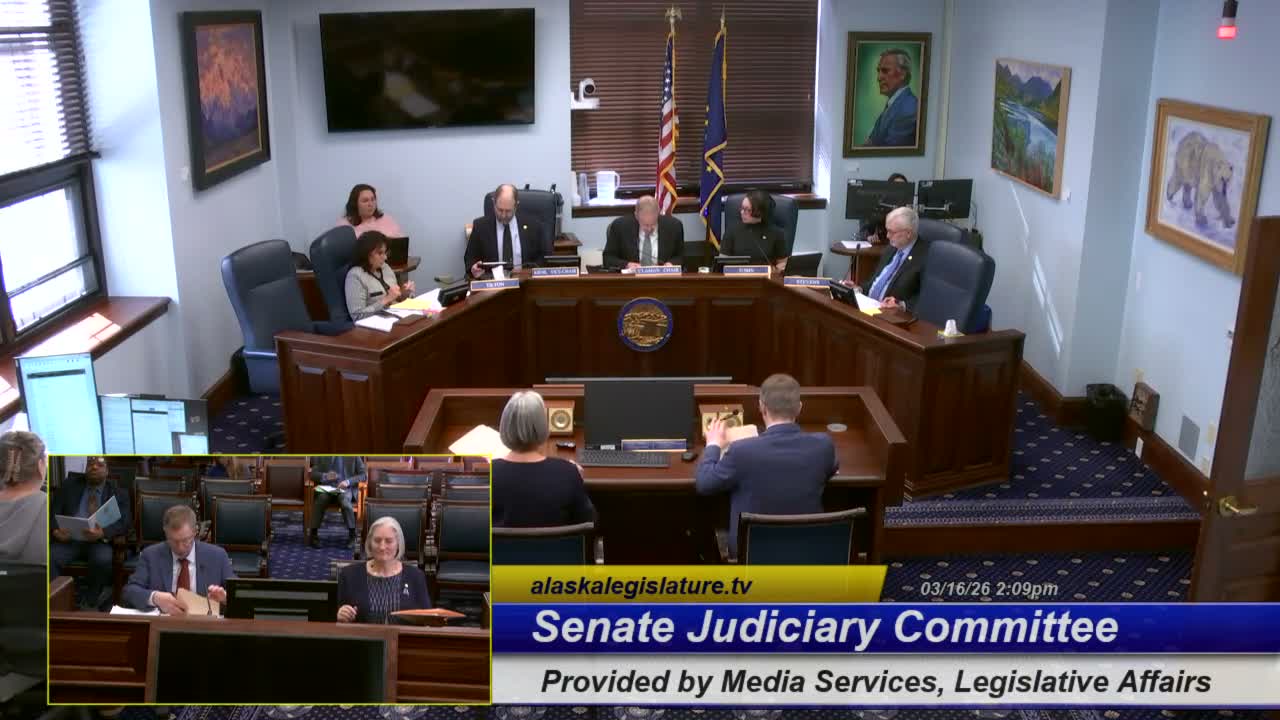
Sen. Scott Kawasaki (Fairbanks) told the Senate Judiciary Committee on March 6 that Senate Bill 241 would add a section to AS 45.50.471(b) to make it unlawful for businesses to advertise, display or offer a price for goods or services that omits mandatory fees apart from government taxes. Kawasaki framed the bill as part of a nationwide effort to limit so-called "junk fees" that are added at the end of transactions.
The sponsor said various states have pursued similar measures and cited consumer cost estimates used by advocacy groups. "Consumers have spent billions and billions of dollars on junk fees," Kawasaki said, and read an article figure estimating roughly $3,000 a year per person in inflated consumer charges.
Joe Hayes, staff to Sen. Kawasaki, walked the committee through the sectional analysis: section 1 would amend AS 45.50.471(b) and section 2 would set the bill's effective date as July 1, 2026. Using a retail example at the airport, Hayes explained that a posted cash discount would become transparent under the bill so customers would see the full cost difference (for example, $10 cash vs. $10.30 if a 3% credit-card surcharge is applied) rather than learning of extra charges only at the point of payment.
Committee members asked what counts as a "junk fee" and whether the bill would affect payment apps or commonplace processing surcharges. Hayes and the sponsor said that a disclosed fee known to the customer in advance would not be an unlawful hidden fee; the committee also heard that highly regulated industries (telecommunications regulated by the Regulatory Commission of Alaska) may already have consumer protections in place.
The committee asked staff to provide follow-up on enforcement mechanisms and penalties; Joe Hayes said he would provide that information at a later hearing. Public testimony was opened and closed with no speakers. The committee set SB241 aside for further review and adjourned.
Next steps: Sponsor and staff will provide additional testimony and details on penalties and enforcement; the committee will revisit the bill in a subsequent hearing.
The sponsor said various states have pursued similar measures and cited consumer cost estimates used by advocacy groups. "Consumers have spent billions and billions of dollars on junk fees," Kawasaki said, and read an article figure estimating roughly $3,000 a year per person in inflated consumer charges.
Joe Hayes, staff to Sen. Kawasaki, walked the committee through the sectional analysis: section 1 would amend AS 45.50.471(b) and section 2 would set the bill's effective date as July 1, 2026. Using a retail example at the airport, Hayes explained that a posted cash discount would become transparent under the bill so customers would see the full cost difference (for example, $10 cash vs. $10.30 if a 3% credit-card surcharge is applied) rather than learning of extra charges only at the point of payment.
Committee members asked what counts as a "junk fee" and whether the bill would affect payment apps or commonplace processing surcharges. Hayes and the sponsor said that a disclosed fee known to the customer in advance would not be an unlawful hidden fee; the committee also heard that highly regulated industries (telecommunications regulated by the Regulatory Commission of Alaska) may already have consumer protections in place.
The committee asked staff to provide follow-up on enforcement mechanisms and penalties; Joe Hayes said he would provide that information at a later hearing. Public testimony was opened and closed with no speakers. The committee set SB241 aside for further review and adjourned.
Next steps: Sponsor and staff will provide additional testimony and details on penalties and enforcement; the committee will revisit the bill in a subsequent hearing.
Don't Miss a Word: See the Full Meeting!
Go beyond summaries. Unlock every video, transcript, and key insight with a Founder Membership.
✓
Get instant access to full meeting videos
✓
Search and clip any phrase from complete transcripts
✓
Receive AI-powered summaries & custom alerts
✓
Enjoy lifetime, unrestricted access to government data
30-day money-back guarantee
