House committee hears testimony on HB305 to raise ride‑hail driver pay, sets bill aside for industry input
March 16, 2026 | 2026 Legislature Alaska, Alaska
This article was created by AI summarizing key points discussed. AI makes mistakes, so for full details and context, please refer to the video of the full meeting. Please report any errors so we can fix them. Report an error »
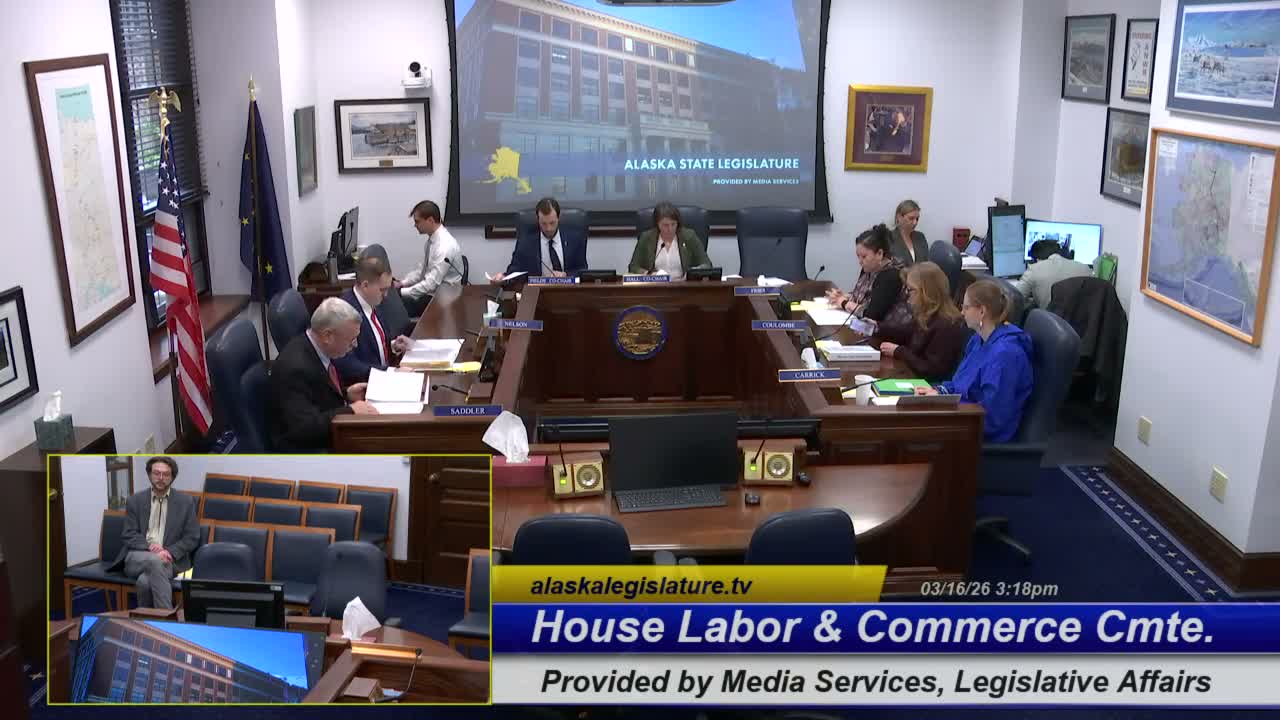
The Alaska House Labor and Commerce Committee heard detailed testimony March 16 on House Bill 305, a proposal that would require transportation network companies (TNCs) to pay drivers at least 90% of the published fare and compensate drivers for ‘‘deadheading’’ trips of 10 miles or more.
Lena Simit, senior adviser on economic justice at Human Rights Watch, told the committee platform workers face unpredictable pay, unpaid wait and travel time, and limited access to social protections. ‘‘Deadheading’’—time spent driving to pick up a rider—was described as a substantial portion of workers’ time; Simit cited survey findings indicating roughly 40% of workers’ hours are spent waiting or traveling to pickups. She said gross hourly pay in HRW’s Texas survey averaged $16.75 including tips, and after expenses and typical deductions fell to roughly the mid‑single digits per hour; accounting for employer‑style contributions reduced that estimate further. Simit said HB305 ‘‘targets and addresses two concrete and measurable sources of harm’’ by establishing a driver revenue share floor and paying for long deadhead trips.
Andrew Greenblatt, policy director for the Independent Drivers Guild, told lawmakers that raising trip pay alone can fail to increase drivers’ weekly wages because higher per‑trip pay can attract more drivers and reduce trips per driver. He described New York City’s per‑minute/per‑mile minimums and a pooled benefits model in which a small surcharge on trips funds workers’ compensation and other benefits. Greenblatt urged legislators to pair any trip‑pay floor with a mechanism to cap or limit the effective number of active drivers so higher trip pay translates to higher take‑home wages.
Committee members pressed witnesses on modeling and local impacts. Representative Sadler and others asked whether the 90% fare share had been modeled for Alaska; Simit said HRW had not modeled that specific figure and recommended deeper state‑level research. Members also questioned how tips are handled and whether drivers participate despite low earnings; witnesses said tips are inconsistent and many drivers begin with sign‑on bonuses that disappear over time, and that flexibility and sunk costs (car payments, vehicle requirements) keep drivers in the economy.
No public testimony was offered. After questions, the committee closed public comment and set HB305 aside for a future hearing to obtain input from industry representatives and additional data. The committee chair asked that invited industry witnesses be scheduled so members can pursue outstanding technical questions.
The committee did not vote on HB305; staff said the bill will return for further consideration once the committee reviews additional industry input and any Department of Revenue or regulatory implementation analysis.
Lena Simit, senior adviser on economic justice at Human Rights Watch, told the committee platform workers face unpredictable pay, unpaid wait and travel time, and limited access to social protections. ‘‘Deadheading’’—time spent driving to pick up a rider—was described as a substantial portion of workers’ time; Simit cited survey findings indicating roughly 40% of workers’ hours are spent waiting or traveling to pickups. She said gross hourly pay in HRW’s Texas survey averaged $16.75 including tips, and after expenses and typical deductions fell to roughly the mid‑single digits per hour; accounting for employer‑style contributions reduced that estimate further. Simit said HB305 ‘‘targets and addresses two concrete and measurable sources of harm’’ by establishing a driver revenue share floor and paying for long deadhead trips.
Andrew Greenblatt, policy director for the Independent Drivers Guild, told lawmakers that raising trip pay alone can fail to increase drivers’ weekly wages because higher per‑trip pay can attract more drivers and reduce trips per driver. He described New York City’s per‑minute/per‑mile minimums and a pooled benefits model in which a small surcharge on trips funds workers’ compensation and other benefits. Greenblatt urged legislators to pair any trip‑pay floor with a mechanism to cap or limit the effective number of active drivers so higher trip pay translates to higher take‑home wages.
Committee members pressed witnesses on modeling and local impacts. Representative Sadler and others asked whether the 90% fare share had been modeled for Alaska; Simit said HRW had not modeled that specific figure and recommended deeper state‑level research. Members also questioned how tips are handled and whether drivers participate despite low earnings; witnesses said tips are inconsistent and many drivers begin with sign‑on bonuses that disappear over time, and that flexibility and sunk costs (car payments, vehicle requirements) keep drivers in the economy.
No public testimony was offered. After questions, the committee closed public comment and set HB305 aside for a future hearing to obtain input from industry representatives and additional data. The committee chair asked that invited industry witnesses be scheduled so members can pursue outstanding technical questions.
The committee did not vote on HB305; staff said the bill will return for further consideration once the committee reviews additional industry input and any Department of Revenue or regulatory implementation analysis.
Don't Miss a Word: See the Full Meeting!
Go beyond summaries. Unlock every video, transcript, and key insight with a Founder Membership.
✓
Get instant access to full meeting videos
✓
Search and clip any phrase from complete transcripts
✓
Receive AI-powered summaries & custom alerts
✓
Enjoy lifetime, unrestricted access to government data
30-day money-back guarantee
