Institute for Strategic Dialogue director Catherine Canuli warns online "nihilistic" communities are increasingly targeting youth
March 13, 2026 | Board Council Commission Agencies , Executive, Washington
This article was created by AI summarizing key points discussed. AI makes mistakes, so for full details and context, please refer to the video of the full meeting. Please report any errors so we can fix them. Report an error »
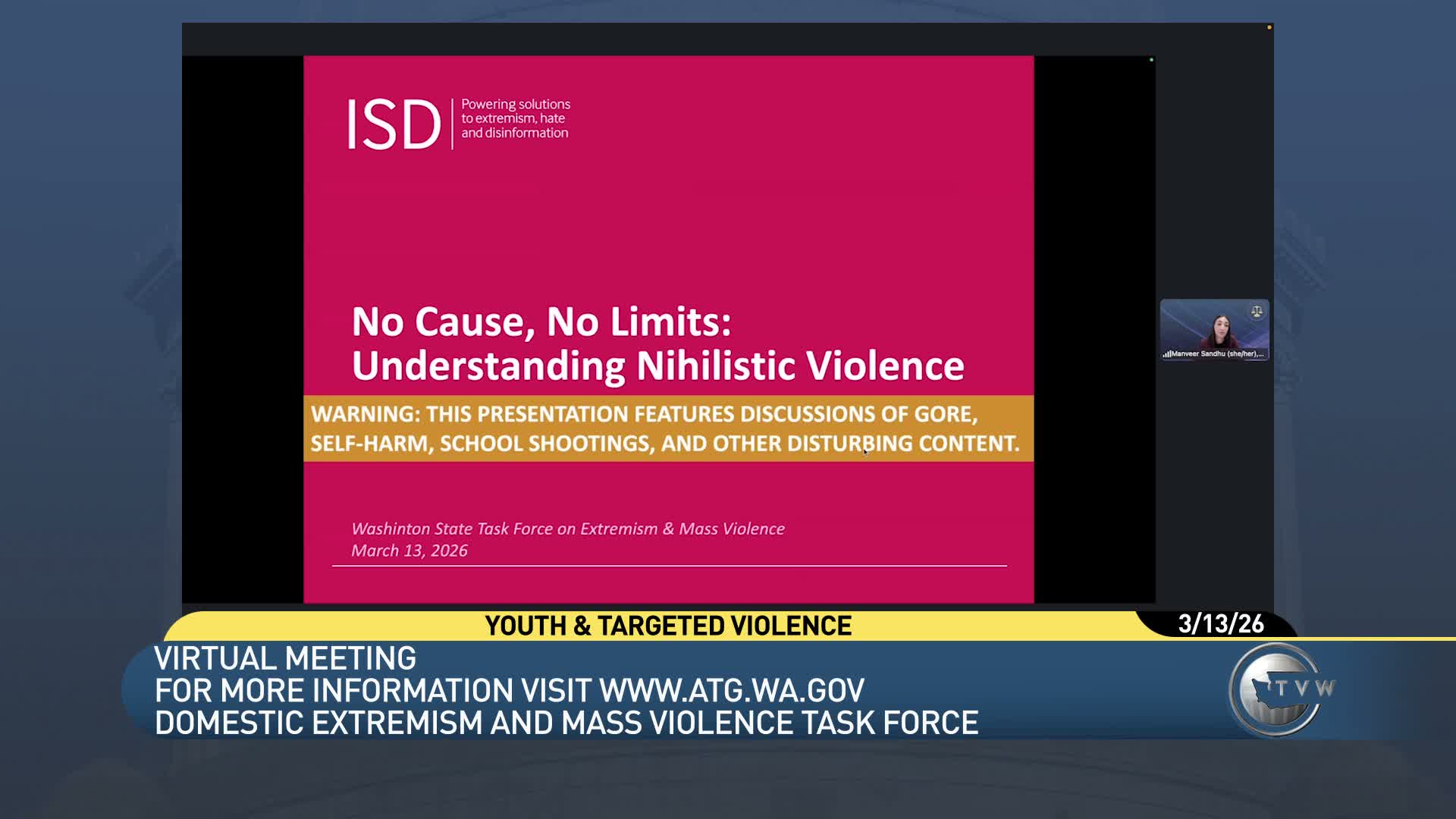
Catherine Canuli, director of threat analysis and prevention at the Institute for Strategic Dialogue, told the Domestic Extremism and Mass Violence Task Force that "nihilistic violence" networks online are increasingly targeting young people and producing a growing number of credible, preventable threats.
"Last year we submitted 41 briefs to law enforcement that were act incidents of activity that directly suggested that there was an individual or group or movement who was planning to engage in activities such as a school shooting," Canuli said. "Last year, 34 of those briefs sent to law enforcement were directly tied to nihilistic violence." She described nihilistic violence as violent acts "that lack an ideological motivation and are instead driven by a misanthropic worldview" and said its appeal is often notoriety and clout rather than political goals.
Why it matters: Canuli said the speed of recruitment and the cross-platform tactics these groups use make early detection difficult. She described a hybridized online ecosystem that uses mainstream platforms such as Instagram, TikTok and gaming platforms to identify and groom vulnerable youth, then moves them to lesser-moderated services such as Telegram or Discord for planning and, in some cases, livestreaming.
Case studies: Canuli presented two cases to illustrate the pattern. In Pierce County, analysts identified a 13-year-old who posted images of firearms and remarks indicating plans to attack; local officers searched the home and removed 23 guns. The teen was released on conditions including an ankle monitor and was later found back online and again arrested, Canuli said. In a second case she discussed an Antioch attack, in which a 17-year-old left a manifesto mixing "nihilistic" rhetoric and neo-Nazi accelerationist beliefs; Canuli noted the manifesto's content showed "violence for violence's sake" even where other ideologies were present.
Prevention and limits of takedowns: Canuli said platform takedowns help but are not a complete solution because communities relocate or reconstitute on other platforms. "They shouldn't be allowed to just operate on these platforms," she said, but added that removals must be paired with prevention, detection and support capacity. She urged greater funding for monitoring and for non-law-enforcement referral pathways so youth can get behavioral and mental-health support before criminal justice involvement.
Resources and next steps: Canuli said ISD is developing a policy-centered paper and points to ISD's resources for parents, teachers and first responders. "We have a number of resources that can be used by parents, teachers, other first frontline individuals ... to recognize the indicators," she said. The task force will consider those materials and broader prevention recommendations as it works toward its December report.
"Last year we submitted 41 briefs to law enforcement that were act incidents of activity that directly suggested that there was an individual or group or movement who was planning to engage in activities such as a school shooting," Canuli said. "Last year, 34 of those briefs sent to law enforcement were directly tied to nihilistic violence." She described nihilistic violence as violent acts "that lack an ideological motivation and are instead driven by a misanthropic worldview" and said its appeal is often notoriety and clout rather than political goals.
Why it matters: Canuli said the speed of recruitment and the cross-platform tactics these groups use make early detection difficult. She described a hybridized online ecosystem that uses mainstream platforms such as Instagram, TikTok and gaming platforms to identify and groom vulnerable youth, then moves them to lesser-moderated services such as Telegram or Discord for planning and, in some cases, livestreaming.
Case studies: Canuli presented two cases to illustrate the pattern. In Pierce County, analysts identified a 13-year-old who posted images of firearms and remarks indicating plans to attack; local officers searched the home and removed 23 guns. The teen was released on conditions including an ankle monitor and was later found back online and again arrested, Canuli said. In a second case she discussed an Antioch attack, in which a 17-year-old left a manifesto mixing "nihilistic" rhetoric and neo-Nazi accelerationist beliefs; Canuli noted the manifesto's content showed "violence for violence's sake" even where other ideologies were present.
Prevention and limits of takedowns: Canuli said platform takedowns help but are not a complete solution because communities relocate or reconstitute on other platforms. "They shouldn't be allowed to just operate on these platforms," she said, but added that removals must be paired with prevention, detection and support capacity. She urged greater funding for monitoring and for non-law-enforcement referral pathways so youth can get behavioral and mental-health support before criminal justice involvement.
Resources and next steps: Canuli said ISD is developing a policy-centered paper and points to ISD's resources for parents, teachers and first responders. "We have a number of resources that can be used by parents, teachers, other first frontline individuals ... to recognize the indicators," she said. The task force will consider those materials and broader prevention recommendations as it works toward its December report.
View the Full Meeting & All Its Details
This article offers just a summary. Unlock complete video, transcripts, and insights as a Founder Member.
✓
Watch full, unedited meeting videos
✓
Search every word spoken in unlimited transcripts
✓
AI summaries & real-time alerts (all government levels)
✓
Permanent access to expanding government content
30-day money-back guarantee
