Sponsors pitch overhaul of Alaska legislative ethics law, clarifying subpoenas and complainant protections
March 16, 2026 | 2026 Legislature Alaska, Alaska
This article was created by AI summarizing key points discussed. AI makes mistakes, so for full details and context, please refer to the video of the full meeting. Please report any errors so we can fix them. Report an error »
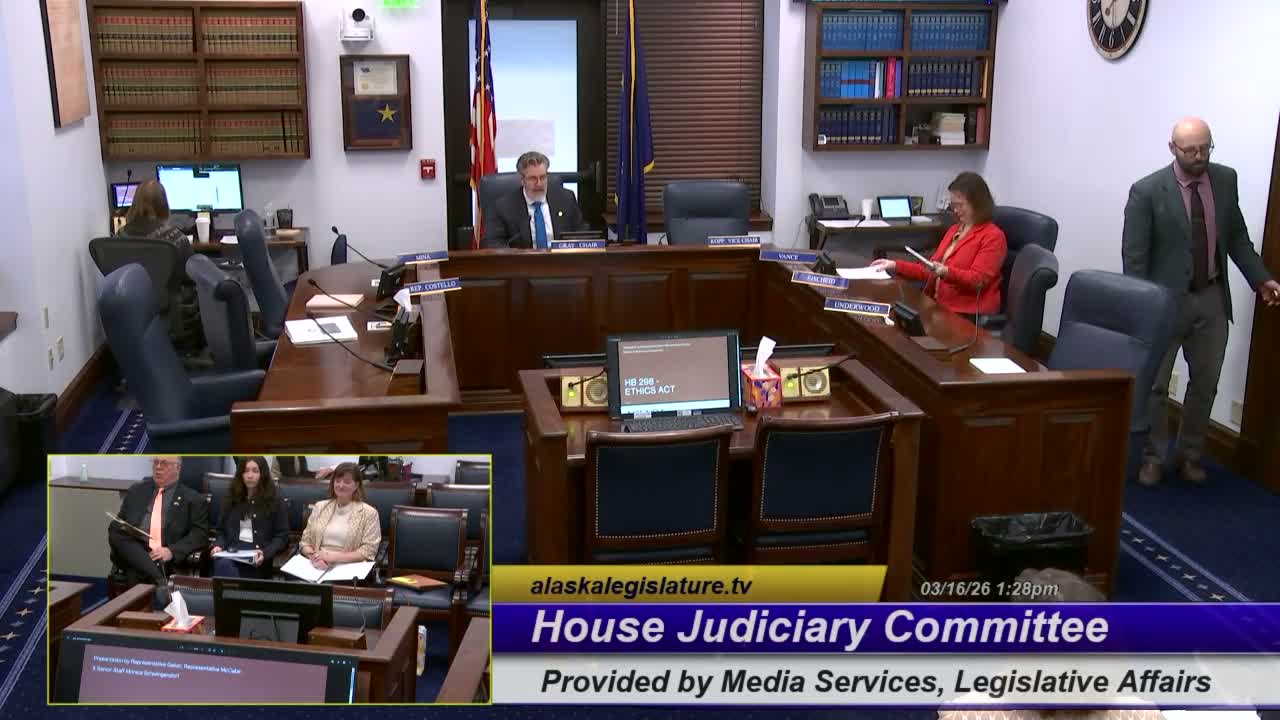
Rep. Elise Galvin and Rep. Kevin McCabe introduced HB 298 to the House Judiciary Committee on March 16, 2026, describing the measure as a comprehensive revision of Alaska’s Legislative Ethics Act intended to increase clarity and public trust.
Galvin said the bill seeks to “establish clear guidelines and consequences that legislators are expected to follow in order to act ethically and responsibly,” and told the committee the revisions are designed to provide greater certainty for legislators, staff and the public. She noted the sponsor team made the bill lengthy on purpose so readers and committee members would find detailed, statutory guidance rather than relying on informal procedures.
McCabe, who reviewed the bill’s history, said HB 298 responds to gaps in how complaints were handled and how confidentiality was protected in the past. “This change prevents that by making sure that the complainant…before the complaint is released, his name or her name is redacted,” he told the committee, describing prior episodes in which complainant names were published.
Monica Schwingendorf, staff to Rep. Galvin, walked the committee through four primary revisions. She told members the CS clarifies the Select Committee on Legislative Ethics’ authority to issue subpoenas and conduct investigations (noted in the sectional analysis as sections 1 and 8), tightens whistleblower protections (section 4), clarifies the advisory-opinion timeline (allowing extensions to the 60‑day period in section 9), and consolidates and standardizes complaint and confidentiality procedures (sections 10–26 and 27).
Committee members pressed for specifics. The chair asked whether a subject’s waiver of confidentiality would expose complainants; McCabe and Schwingendorf said the CS makes redaction explicit while a matter is under review. Joyce Anderson, a public member of the ethics committee who joined the hearing remotely, said the committee previously thought it could issue subpoenas but discovered another statute limited that authority; HB 298 would make subpoena authority explicit so investigations need not rely on the speaker or senate president to sign subpoenas.
The committee opened public testimony on HB 298; no one testified either in the room or online. The chair set the bill aside to be taken up at a later date. The sponsors said they are available for additional questions.
What’s next: HB 298 remains before the House Judiciary Committee; staff indicated the bill will be returned for further consideration and potential amendment.
Galvin said the bill seeks to “establish clear guidelines and consequences that legislators are expected to follow in order to act ethically and responsibly,” and told the committee the revisions are designed to provide greater certainty for legislators, staff and the public. She noted the sponsor team made the bill lengthy on purpose so readers and committee members would find detailed, statutory guidance rather than relying on informal procedures.
McCabe, who reviewed the bill’s history, said HB 298 responds to gaps in how complaints were handled and how confidentiality was protected in the past. “This change prevents that by making sure that the complainant…before the complaint is released, his name or her name is redacted,” he told the committee, describing prior episodes in which complainant names were published.
Monica Schwingendorf, staff to Rep. Galvin, walked the committee through four primary revisions. She told members the CS clarifies the Select Committee on Legislative Ethics’ authority to issue subpoenas and conduct investigations (noted in the sectional analysis as sections 1 and 8), tightens whistleblower protections (section 4), clarifies the advisory-opinion timeline (allowing extensions to the 60‑day period in section 9), and consolidates and standardizes complaint and confidentiality procedures (sections 10–26 and 27).
Committee members pressed for specifics. The chair asked whether a subject’s waiver of confidentiality would expose complainants; McCabe and Schwingendorf said the CS makes redaction explicit while a matter is under review. Joyce Anderson, a public member of the ethics committee who joined the hearing remotely, said the committee previously thought it could issue subpoenas but discovered another statute limited that authority; HB 298 would make subpoena authority explicit so investigations need not rely on the speaker or senate president to sign subpoenas.
The committee opened public testimony on HB 298; no one testified either in the room or online. The chair set the bill aside to be taken up at a later date. The sponsors said they are available for additional questions.
What’s next: HB 298 remains before the House Judiciary Committee; staff indicated the bill will be returned for further consideration and potential amendment.
Don't Miss a Word: See the Full Meeting!
Go beyond summaries. Unlock every video, transcript, and key insight with a Founder Membership.
✓
Get instant access to full meeting videos
✓
Search and clip any phrase from complete transcripts
✓
Receive AI-powered summaries & custom alerts
✓
Enjoy lifetime, unrestricted access to government data
30-day money-back guarantee
