Rep. Sarah Hannon says proposed ban on police face coverings would preserve transparency; panel raises preemption questions
March 16, 2026 | 2026 Legislature Alaska, Alaska
This article was created by AI summarizing key points discussed. AI makes mistakes, so for full details and context, please refer to the video of the full meeting. Please report any errors so we can fix them. Report an error »
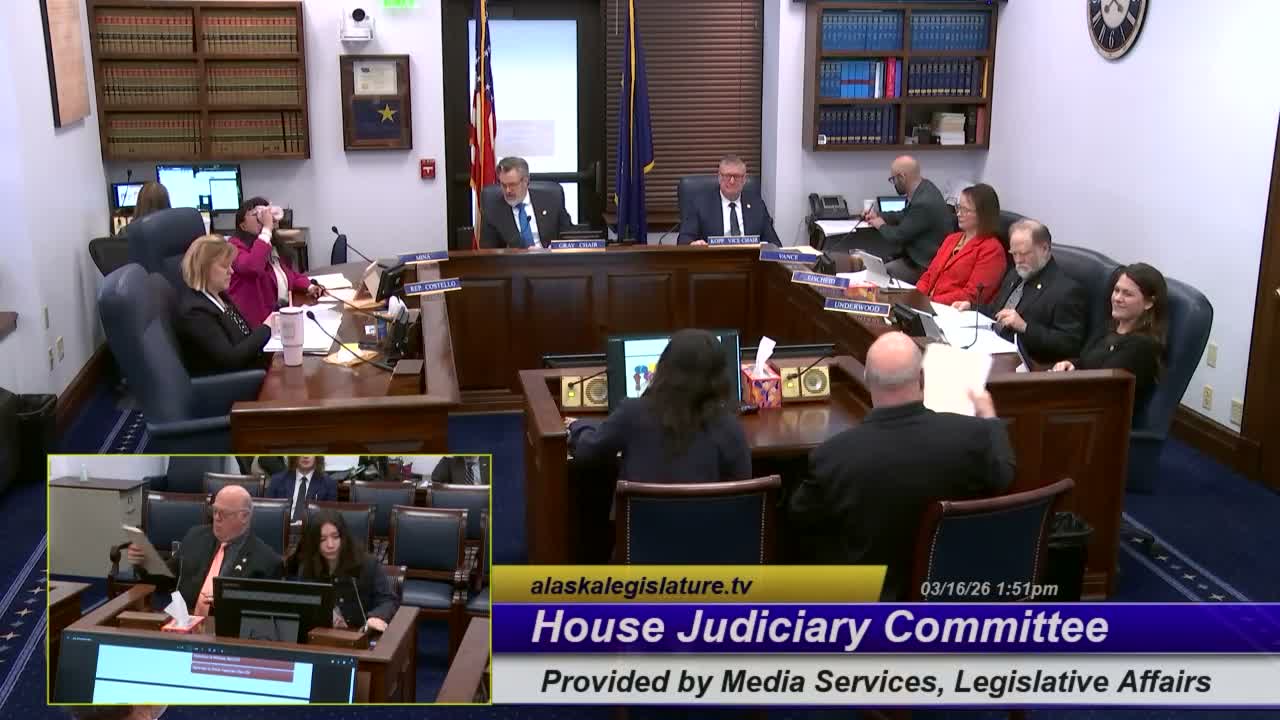
Rep. Sarah Hannon (House District 4) told the House Judiciary Committee on March 16 that HB 250 would make it a crime for peace officers in Alaska to conceal their faces while performing official duties, except in narrowly defined circumstances.
Hannon described the bill as “pro law enforcement” and said it aims to protect public trust and officer dignity by ensuring identification and nonverbal communication in tense encounters. “Masks get in the way of de escalation efforts and, communication. They do the opposite,” she said, arguing that visible facial expression aids de‑escalation and identification.
The bill as presented includes exemptions for undercover assignments, face shields that do not obscure identity, medical masks for disease or toxin protection, protective gear during hazardous operations, helmets required for vehicle operation (including snow machines), tactical operations and active SWAT duties, and an outdoor‑temperature exemption at or below 32°F.
Committee members asked whether leadership of law enforcement agencies had testified. The sponsor and her staff said Anchorage Police Department leadership has spoken in opposition in earlier committee hearings. Timothy Clark, staff to Rep. Hannon, read a short portion of Chief Case’s prior testimony: “using officer safety or doctrine as justification for masking is not valid,” he quoted, indicating Chief Case had opposed masking as a policy justification in previous remarks.
Members also asked whether a state law could be preempted or challenged if it attempted to regulate federal officers. Staff and the sponsor cited a California federal‑court ruling that struck a law aimed selectively at certain agencies but noted a court allowed broadly applicable state rules on visible identification and no‑masking under some circumstances. Committee members described some remaining ambiguity about how a federal agency’s rules or executive orders might interact with a state ban.
The committee took no final action on HB 250 and set the bill aside for future consideration.
What’s next: HB 250 will return to committee for further consideration; staff noted potential legal questions about federal preemption will require review.
Hannon described the bill as “pro law enforcement” and said it aims to protect public trust and officer dignity by ensuring identification and nonverbal communication in tense encounters. “Masks get in the way of de escalation efforts and, communication. They do the opposite,” she said, arguing that visible facial expression aids de‑escalation and identification.
The bill as presented includes exemptions for undercover assignments, face shields that do not obscure identity, medical masks for disease or toxin protection, protective gear during hazardous operations, helmets required for vehicle operation (including snow machines), tactical operations and active SWAT duties, and an outdoor‑temperature exemption at or below 32°F.
Committee members asked whether leadership of law enforcement agencies had testified. The sponsor and her staff said Anchorage Police Department leadership has spoken in opposition in earlier committee hearings. Timothy Clark, staff to Rep. Hannon, read a short portion of Chief Case’s prior testimony: “using officer safety or doctrine as justification for masking is not valid,” he quoted, indicating Chief Case had opposed masking as a policy justification in previous remarks.
Members also asked whether a state law could be preempted or challenged if it attempted to regulate federal officers. Staff and the sponsor cited a California federal‑court ruling that struck a law aimed selectively at certain agencies but noted a court allowed broadly applicable state rules on visible identification and no‑masking under some circumstances. Committee members described some remaining ambiguity about how a federal agency’s rules or executive orders might interact with a state ban.
The committee took no final action on HB 250 and set the bill aside for future consideration.
What’s next: HB 250 will return to committee for further consideration; staff noted potential legal questions about federal preemption will require review.
Don't Miss a Word: See the Full Meeting!
Go beyond summaries. Unlock every video, transcript, and key insight with a Founder Membership.
✓
Get instant access to full meeting videos
✓
Search and clip any phrase from complete transcripts
✓
Receive AI-powered summaries & custom alerts
✓
Enjoy lifetime, unrestricted access to government data
30-day money-back guarantee
