Rep. Andy Story presents bill to expand Alaska early intervention services, lower eligibility threshold
March 16, 2026 | 2026 Legislature Alaska, Alaska
This article was created by AI summarizing key points discussed. AI makes mistakes, so for full details and context, please refer to the video of the full meeting. Please report any errors so we can fix them. Report an error »
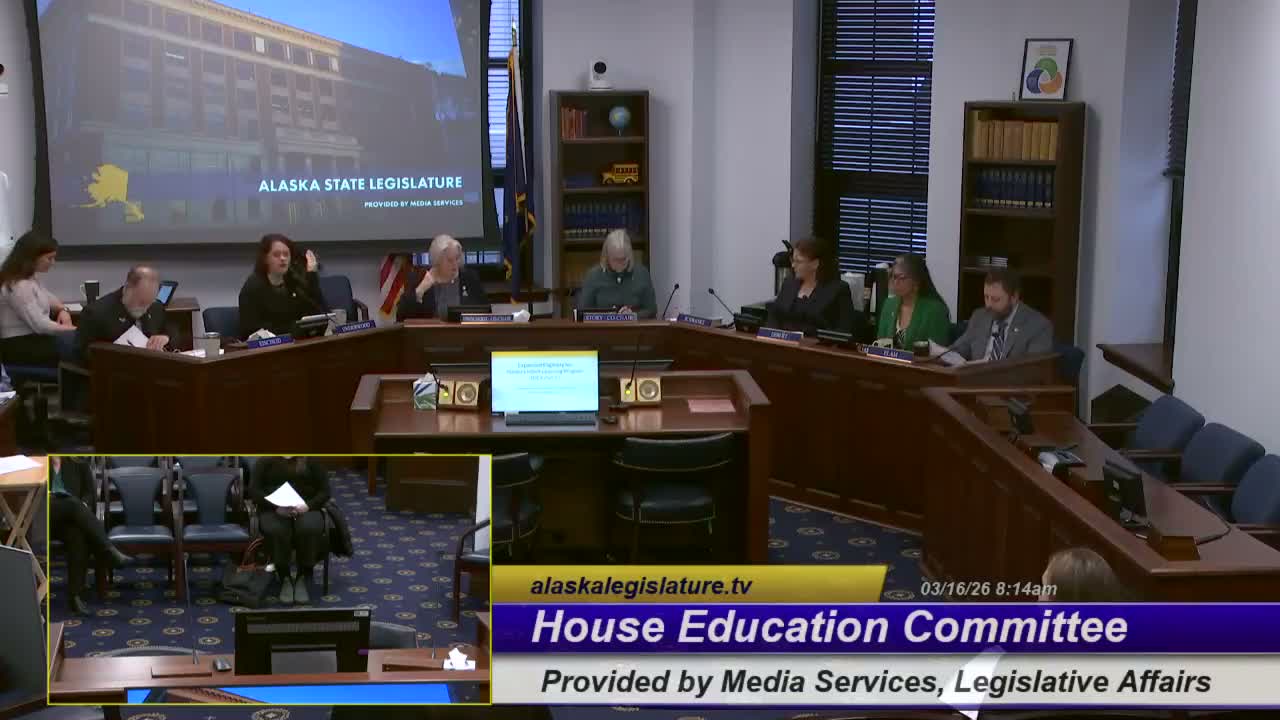
Rep. Andy Story, sponsor of House Bill 376, told the House Education Committee on March 16 that the measure would expand access to early intervention for infants and toddlers by changing state eligibility criteria and allowing Medicaid reimbursement for services currently funded mainly with state dollars. "This bill before you seeks to improve Alaska's early intervention system in three main ways," Story said, describing amendments to the Medicaid statute, a Department of Health review of qualifying conditions, and updates to eligibility that more closely align with federal standards.
Supporters said Alaska's current eligibility — a developmental delay of 50% in a domain — leaves many children without help during a critical window. "HB 3 76 allows us to act early when the brain is most ready to change and families are most desperate for help," said Niamh Dardis, program director for the regional Infant Learning Program in Juneau, describing providers' work across vast and remote parts of the state. Dardis said ILP teams serve more than 1,800 enrolled children annually and routinely encounter families who cannot qualify under the 50% threshold despite obvious concerns.
Richard Saville of the Governor's Council on Disabilities and Special Education framed the bill as the result of interagency work and an external report that recommended aligning Part C criteria with Part B. "We discovered the 50% delay was the most restrictive in the country," Saville said, noting the council and contractors reviewed other states' practices. He cited an economic study — stating that "for every dollar invested in early intervention, a state or a program can save up to $17 in future money spent" — as part of the fiscal rationale for earlier intervention.
State health officials and staff described implementation steps and fiscal implications. Kaylee Holm, staff to Rep. Story, walked the committee through the bill's sections, including a requirement in Section 9 for the Department of Health to submit a program report by July 1, 2029, and provisions that would take effect July 1, 2026 if federal approval is obtained. Pamela Burton of the Department of Health said two fiscal notes accompany the bill: one estimating additional Medicaid costs for newly billable services and another reflecting program costs such as two additional program coordination managers.
Committee members pressed for practical details about how a lower eligibility threshold would change identification patterns and service volumes. Saville and Heidi Haas (executive director, Alaska Center for Children and Adults) said the analysis shows earlier identification should shift the peak of special education identification to younger ages and reduce later high-cost service needs, though they deferred some timeline questions to state agencies negotiating a Medicaid state plan amendment. "What will drive the timeline for implementation is what it will take to negotiate with the federal government," Courtney Enright, the Department of Health's legislative liaison, said, noting state plan amendments require rate methodology, regulations and tribal consultation.
Parents and providers gave personal testimony in support. Chelsea Burke of Eagle River described early intervention's effect on her son: "He is independent, communicative, and thriving," Burke said, urging committee support. Tara Pike and Amy Simpson (an Anchorage provider who relayed a family's story about moving states to obtain Part C services) also urged the committee to pass the expansion. Testimony emphasized geographic equity, workforce capacity and the need to pair statutory change with budget support for grantees.
The committee did not take a vote on the bill but set an amendment deadline: "Please submit all amendments to my office by Monday, March 23 at 5 p.m.," Co Chair Himshoo said. Sponsors committed to circulating referenced reports, letters of support and fiscal materials to committee members. The committee also requested follow-up on which other states have restrictive 50% thresholds, detailed fiscal-note materials, and a clearer timeline for a Medicaid state plan amendment.
Next steps: the committee will consider amendments ahead of the March 23 deadline and may request additional presentations from the Department of Health and program providers to clarify implementation logistics and fiscal impacts.
Supporters said Alaska's current eligibility — a developmental delay of 50% in a domain — leaves many children without help during a critical window. "HB 3 76 allows us to act early when the brain is most ready to change and families are most desperate for help," said Niamh Dardis, program director for the regional Infant Learning Program in Juneau, describing providers' work across vast and remote parts of the state. Dardis said ILP teams serve more than 1,800 enrolled children annually and routinely encounter families who cannot qualify under the 50% threshold despite obvious concerns.
Richard Saville of the Governor's Council on Disabilities and Special Education framed the bill as the result of interagency work and an external report that recommended aligning Part C criteria with Part B. "We discovered the 50% delay was the most restrictive in the country," Saville said, noting the council and contractors reviewed other states' practices. He cited an economic study — stating that "for every dollar invested in early intervention, a state or a program can save up to $17 in future money spent" — as part of the fiscal rationale for earlier intervention.
State health officials and staff described implementation steps and fiscal implications. Kaylee Holm, staff to Rep. Story, walked the committee through the bill's sections, including a requirement in Section 9 for the Department of Health to submit a program report by July 1, 2029, and provisions that would take effect July 1, 2026 if federal approval is obtained. Pamela Burton of the Department of Health said two fiscal notes accompany the bill: one estimating additional Medicaid costs for newly billable services and another reflecting program costs such as two additional program coordination managers.
Committee members pressed for practical details about how a lower eligibility threshold would change identification patterns and service volumes. Saville and Heidi Haas (executive director, Alaska Center for Children and Adults) said the analysis shows earlier identification should shift the peak of special education identification to younger ages and reduce later high-cost service needs, though they deferred some timeline questions to state agencies negotiating a Medicaid state plan amendment. "What will drive the timeline for implementation is what it will take to negotiate with the federal government," Courtney Enright, the Department of Health's legislative liaison, said, noting state plan amendments require rate methodology, regulations and tribal consultation.
Parents and providers gave personal testimony in support. Chelsea Burke of Eagle River described early intervention's effect on her son: "He is independent, communicative, and thriving," Burke said, urging committee support. Tara Pike and Amy Simpson (an Anchorage provider who relayed a family's story about moving states to obtain Part C services) also urged the committee to pass the expansion. Testimony emphasized geographic equity, workforce capacity and the need to pair statutory change with budget support for grantees.
The committee did not take a vote on the bill but set an amendment deadline: "Please submit all amendments to my office by Monday, March 23 at 5 p.m.," Co Chair Himshoo said. Sponsors committed to circulating referenced reports, letters of support and fiscal materials to committee members. The committee also requested follow-up on which other states have restrictive 50% thresholds, detailed fiscal-note materials, and a clearer timeline for a Medicaid state plan amendment.
Next steps: the committee will consider amendments ahead of the March 23 deadline and may request additional presentations from the Department of Health and program providers to clarify implementation logistics and fiscal impacts.
View the Full Meeting & All Its Details
This article offers just a summary. Unlock complete video, transcripts, and insights as a Founder Member.
✓
Watch full, unedited meeting videos
✓
Search every word spoken in unlimited transcripts
✓
AI summaries & real-time alerts (all government levels)
✓
Permanent access to expanding government content
30-day money-back guarantee
