Lawmakers hear that pupil transportation formula leaves many rural districts covering growing costs
March 16, 2026 | 2026 Legislature Alaska, Alaska
This article was created by AI summarizing key points discussed. AI makes mistakes, so for full details and context, please refer to the video of the full meeting. Please report any errors so we can fix them. Report an error »
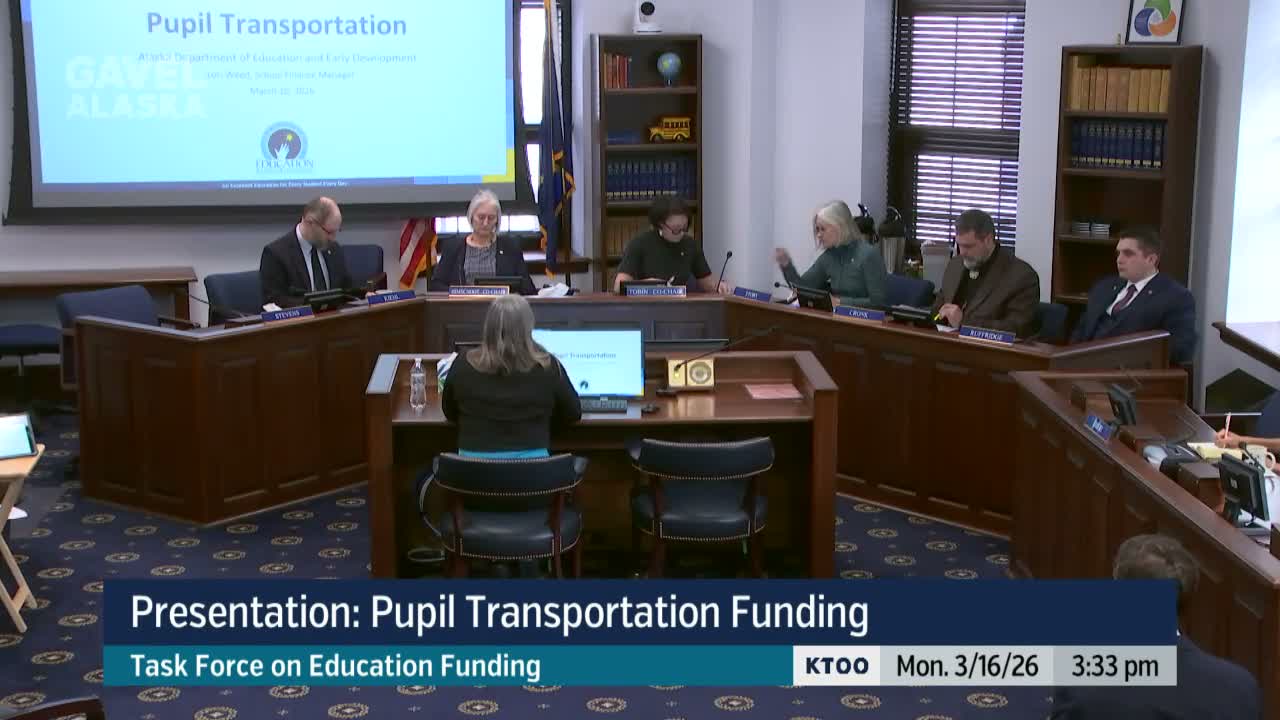
On March 16, 2026, the Joint Legislative Task Force on Education Funding heard that Alaska’s pupil transportation formula is leaving many school districts — particularly rural ones — with large, persistent cost gaps.
Laurie Weed, a school finance manager at the Alaska Department of Education and Early Development, outlined the state’s pupil transportation grant as a per‑pupil formula paid in three bulk installments (August projected ADM, a December true‑up and a March final payment based on audited counts). She said districts may accumulate special‑revenue fund balances and may use those balances for capital renewal or other transport‑related needs when they have excess funds.
"The pupil transportation grant program is based on the statutory amount per student times the district’s brick‑and‑mortar ADM," Weed said, describing how the department distributes payments.
Why it matters: Legislative Finance Division fiscal analyst Connor Bell told the task force that funding flows from the general fund to the public education fund and that, if actual transportation costs exceed estimates, additional money automatically flows from the general fund without further legislative action. Still, Bell and witnesses emphasized that the statutory per‑ADM amounts diverge widely across districts — Bristol Bay receives $3,247 per ADM under the formula — and that statewide expenditures have exceeded statutory transportation funding.
"There’s a big difference between the amounts per ADM that districts receive," Bell said, noting that several districts receive no formula funding because they do not operate a formal transportation program.
Bristol Bay superintendent Michael Robbins told the task force his district of about 86 students operates daily aircraft transportation because there is no reliable road between communities. "In our district, students fly," Robbins said. "The only reliable and safe way to ensure our students can attend school is by transporting them by aircraft every day."
Robbins described how fuel, maintenance, staffing, aircraft operations and logistics raise costs in rural districts. He told lawmakers that state transportation funding has increased roughly 20% since 2016 while transportation costs have risen nearly 40% over the same period, and he said statewide transportation expenditures have exceeded state pupil transportation funding by more than $65,000,000.
Bell presented FY24 data showing districts spent about $91.7 million on pupil transportation — roughly $15.4 million more than the state transportation funding provided — and that 30 districts had expenditures higher than their statutory funding, with 17 districts at least 20% above the state amount.
Task force members asked whether the statutory amounts have ever been reassessed against actual costs. Bell said the FY2004 amounts were based on FY2003 spending and that there was a rebalancing in FY2012–13, but he was not aware of a statewide project to reassess district costs against statutory amounts since then.
Several members pressed on program design questions: whether per‑pupil funds cover field trips or route mileage (Weed said statute does not provide additional per‑pupil adjustments for miles or route staffing); who performs required bus inspections (Weed named the contractor as Resurrection Auto); and whether districts might contract, consolidate routes or change vehicle types when enrollment declines (witnesses said those are policy decisions that may or may not yield savings and can create tradeoffs for communities).
The task force did not vote on any measures. Members asked staff to request additional research, including historical rationale for the 2004 change from reimbursement to formula, district contracting patterns, which districts operate their own fleets versus contracting, and deeper cost‑of‑service data that would account for fuel, miles and remote‑service premiums.
The task force’s next meeting is tentatively scheduled for April 10 to discuss local contributions and federal funding streams.
Sources: Department of Education and Early Development school finance manager Laurie Weed; Connor Bell, Legislative Finance Division; Michael Robbins, superintendent, Bristol Bay Borough School District.
Laurie Weed, a school finance manager at the Alaska Department of Education and Early Development, outlined the state’s pupil transportation grant as a per‑pupil formula paid in three bulk installments (August projected ADM, a December true‑up and a March final payment based on audited counts). She said districts may accumulate special‑revenue fund balances and may use those balances for capital renewal or other transport‑related needs when they have excess funds.
"The pupil transportation grant program is based on the statutory amount per student times the district’s brick‑and‑mortar ADM," Weed said, describing how the department distributes payments.
Why it matters: Legislative Finance Division fiscal analyst Connor Bell told the task force that funding flows from the general fund to the public education fund and that, if actual transportation costs exceed estimates, additional money automatically flows from the general fund without further legislative action. Still, Bell and witnesses emphasized that the statutory per‑ADM amounts diverge widely across districts — Bristol Bay receives $3,247 per ADM under the formula — and that statewide expenditures have exceeded statutory transportation funding.
"There’s a big difference between the amounts per ADM that districts receive," Bell said, noting that several districts receive no formula funding because they do not operate a formal transportation program.
Bristol Bay superintendent Michael Robbins told the task force his district of about 86 students operates daily aircraft transportation because there is no reliable road between communities. "In our district, students fly," Robbins said. "The only reliable and safe way to ensure our students can attend school is by transporting them by aircraft every day."
Robbins described how fuel, maintenance, staffing, aircraft operations and logistics raise costs in rural districts. He told lawmakers that state transportation funding has increased roughly 20% since 2016 while transportation costs have risen nearly 40% over the same period, and he said statewide transportation expenditures have exceeded state pupil transportation funding by more than $65,000,000.
Bell presented FY24 data showing districts spent about $91.7 million on pupil transportation — roughly $15.4 million more than the state transportation funding provided — and that 30 districts had expenditures higher than their statutory funding, with 17 districts at least 20% above the state amount.
Task force members asked whether the statutory amounts have ever been reassessed against actual costs. Bell said the FY2004 amounts were based on FY2003 spending and that there was a rebalancing in FY2012–13, but he was not aware of a statewide project to reassess district costs against statutory amounts since then.
Several members pressed on program design questions: whether per‑pupil funds cover field trips or route mileage (Weed said statute does not provide additional per‑pupil adjustments for miles or route staffing); who performs required bus inspections (Weed named the contractor as Resurrection Auto); and whether districts might contract, consolidate routes or change vehicle types when enrollment declines (witnesses said those are policy decisions that may or may not yield savings and can create tradeoffs for communities).
The task force did not vote on any measures. Members asked staff to request additional research, including historical rationale for the 2004 change from reimbursement to formula, district contracting patterns, which districts operate their own fleets versus contracting, and deeper cost‑of‑service data that would account for fuel, miles and remote‑service premiums.
The task force’s next meeting is tentatively scheduled for April 10 to discuss local contributions and federal funding streams.
Sources: Department of Education and Early Development school finance manager Laurie Weed; Connor Bell, Legislative Finance Division; Michael Robbins, superintendent, Bristol Bay Borough School District.
Don't Miss a Word: See the Full Meeting!
Go beyond summaries. Unlock every video, transcript, and key insight with a Founder Membership.
✓
Get instant access to full meeting videos
✓
Search and clip any phrase from complete transcripts
✓
Receive AI-powered summaries & custom alerts
✓
Enjoy lifetime, unrestricted access to government data
30-day money-back guarantee
