House committee hears bill to create Career and Technical Education Mobility Grant Program
March 16, 2026 | 2026 Legislature Alaska, Alaska
This article was created by AI summarizing key points discussed. AI makes mistakes, so for full details and context, please refer to the video of the full meeting. Please report any errors so we can fix them. Report an error »
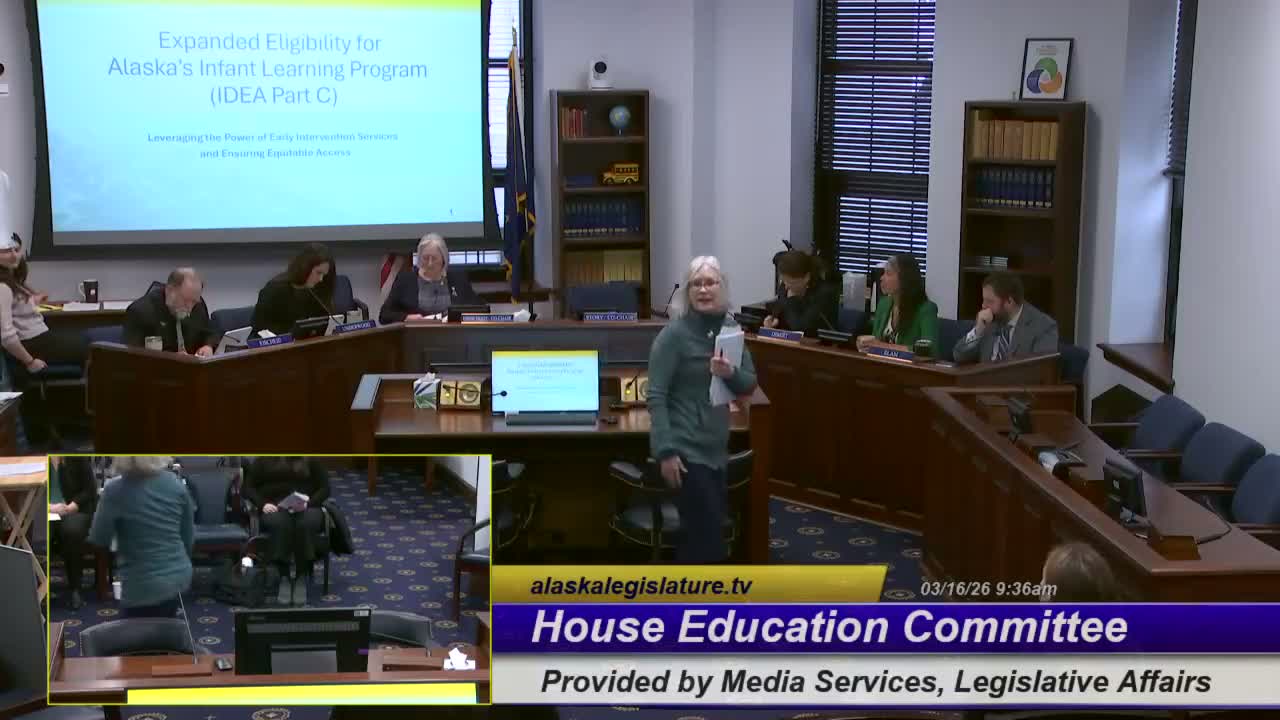
Representative Bill Elam introduced House Bill 358 as a framework to establish a Career and Technical Education Mobility Grant Program to support pre-apprenticeship and work-based learning opportunities for secondary students. "This is an aspirational bill... If someday the state has funding, we could do this. We don't have to wait to set up the program," Elam said, describing the bill as a framework for grants that would be subject to appropriation and administered by the Department of Education and Early Development (DEED).
The bill creates an administratively ready grant program intended to enable districts to host and send students for CTE programs — for example, combining cohorts from multiple smaller communities to make specialized programs viable, and covering transportation/hosting costs when appropriate. Elam said the bill prioritizes rural and remote communities and includes language allowing the department to "prioritize awarding funding" if appropriations are insufficient.
Committee members raised operational questions. Co Chair Story asked how performance grants would be measured and whether DEED would use a rubric (for example, certifications, enrollment/engagement metrics or other outcomes) to prioritize awards. Representative Story also suggested DEED and the Department of Labor be invited to a future meeting to clarify implementation and to build a statewide CTE map showing program availability and service deserts.
Members also discussed the relationship between this proposed program and existing federal Carl Perkins funding, the capital intensity of some CTE programs (equipment and safety updates), and how districts might collaborate to form cohorts. Representative Elam said appropriations would determine grant size and that the bill is designed to be flexible to support both hosting districts that invested in capital equipment and small sending districts that cannot sustain specialized programs on their own.
No vote was taken on HB 358; committee members asked the sponsor to return with more detail, suggested inviting DEED, Department of Labor and other stakeholders for follow-up, and proposed a future committee informational session focused on CTE distribution and capacity across the state. The committee adjourned at 9:57 a.m.
The bill creates an administratively ready grant program intended to enable districts to host and send students for CTE programs — for example, combining cohorts from multiple smaller communities to make specialized programs viable, and covering transportation/hosting costs when appropriate. Elam said the bill prioritizes rural and remote communities and includes language allowing the department to "prioritize awarding funding" if appropriations are insufficient.
Committee members raised operational questions. Co Chair Story asked how performance grants would be measured and whether DEED would use a rubric (for example, certifications, enrollment/engagement metrics or other outcomes) to prioritize awards. Representative Story also suggested DEED and the Department of Labor be invited to a future meeting to clarify implementation and to build a statewide CTE map showing program availability and service deserts.
Members also discussed the relationship between this proposed program and existing federal Carl Perkins funding, the capital intensity of some CTE programs (equipment and safety updates), and how districts might collaborate to form cohorts. Representative Elam said appropriations would determine grant size and that the bill is designed to be flexible to support both hosting districts that invested in capital equipment and small sending districts that cannot sustain specialized programs on their own.
No vote was taken on HB 358; committee members asked the sponsor to return with more detail, suggested inviting DEED, Department of Labor and other stakeholders for follow-up, and proposed a future committee informational session focused on CTE distribution and capacity across the state. The committee adjourned at 9:57 a.m.
View the Full Meeting & All Its Details
This article offers just a summary. Unlock complete video, transcripts, and insights as a Founder Member.
✓
Watch full, unedited meeting videos
✓
Search every word spoken in unlimited transcripts
✓
AI summaries & real-time alerts (all government levels)
✓
Permanent access to expanding government content
30-day money-back guarantee
