After‑school providers tell lawmakers demand outstrips supply; transportation and funding named key barriers
March 16, 2026 | 2026 Legislature Alaska, Alaska
This article was created by AI summarizing key points discussed. AI makes mistakes, so for full details and context, please refer to the video of the full meeting. Please report any errors so we can fix them. Report an error »
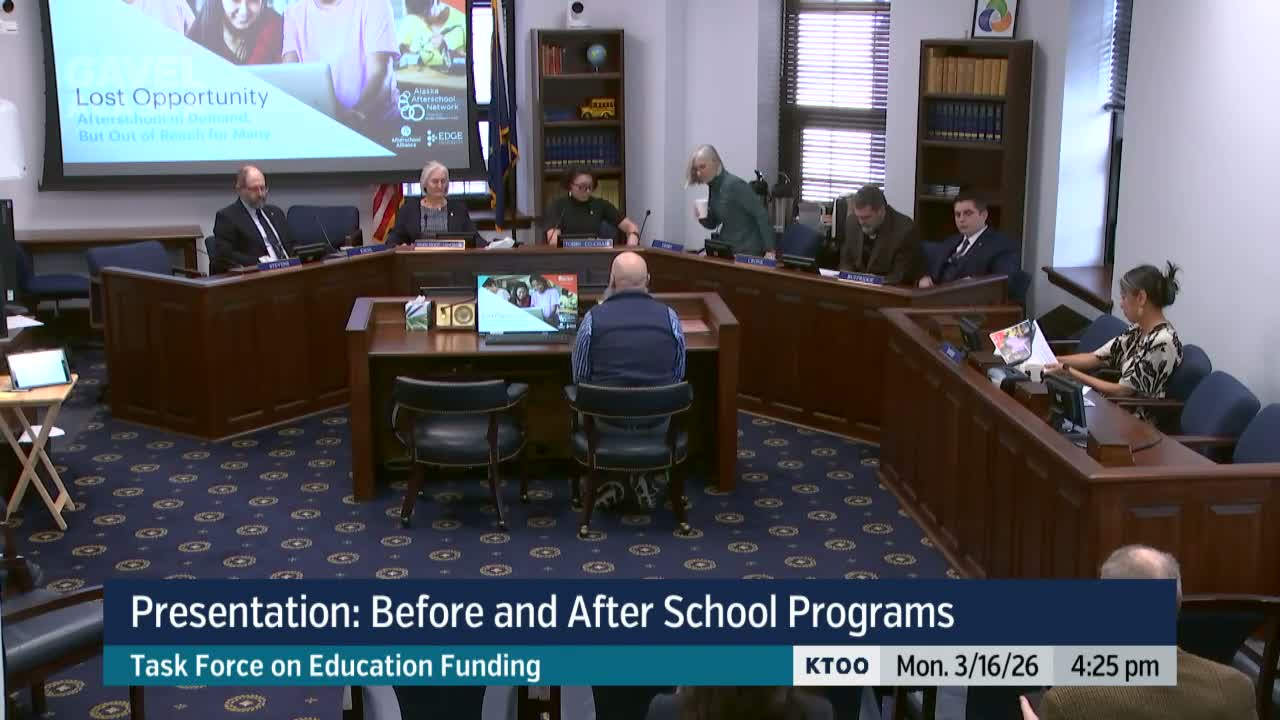
During the March 16 session of the Joint Legislative Task Force on Education Funding, Tom Sazarel, executive director of the Alaska After School Network, told lawmakers that demand for after‑school programs in Alaska far outpaces supply and that transportation and cost are major obstacles for families.
Sazarel said national survey data (America After 3PM) and state sampling indicate roughly 17,000 Alaskan children are enrolled in before‑ or after‑school programs, but that the number of children seeking such programs is much higher. "For every one child who’s able to enroll, there are several waiting," he told the task force, and he said recent program closures have removed thousands of slots in the state.
Sazarel cited the closure of some Boys and Girls Club sites and other program losses and said the Southcentral closures alone affected roughly 4,500 youth. He also noted that higher‑income households increasingly purchase private enrichment, while lower‑ and middle‑income families face cost and transportation barriers that limit participation.
"Transportation is a key part of the equation," Sazarel said, describing cases where school‑district bus turnaround times make it impractical to add stops for after‑school programs and where community partners have had to operate their own buses to get children home.
He described several policy levers: ensure state and federal funding keeps pace with inflation, reduce participation barriers such as transportation and equipment costs, invest in program staff and workforce pathways, and pursue federal streams such as 21st Century Community Learning Centers where appropriate.
Members asked clarifying questions about the definition of after‑school programming used in the survey (Sazarel said programs counted are those meeting several days per week for enrichment and that sports are treated differently in the dataset) and about geographic deserts of service (he pointed members to an interactive map on akafterschool.org and said deserts exist across the state, with significant need in Mat‑Su and many rural communities).
The task force did not take action on after‑school funding during the meeting. Members requested additional data on income brackets, program distribution by region and federal funding stability.
Sources: Tom Sazarel, Alaska After School Network; task force Q&A.
Sazarel said national survey data (America After 3PM) and state sampling indicate roughly 17,000 Alaskan children are enrolled in before‑ or after‑school programs, but that the number of children seeking such programs is much higher. "For every one child who’s able to enroll, there are several waiting," he told the task force, and he said recent program closures have removed thousands of slots in the state.
Sazarel cited the closure of some Boys and Girls Club sites and other program losses and said the Southcentral closures alone affected roughly 4,500 youth. He also noted that higher‑income households increasingly purchase private enrichment, while lower‑ and middle‑income families face cost and transportation barriers that limit participation.
"Transportation is a key part of the equation," Sazarel said, describing cases where school‑district bus turnaround times make it impractical to add stops for after‑school programs and where community partners have had to operate their own buses to get children home.
He described several policy levers: ensure state and federal funding keeps pace with inflation, reduce participation barriers such as transportation and equipment costs, invest in program staff and workforce pathways, and pursue federal streams such as 21st Century Community Learning Centers where appropriate.
Members asked clarifying questions about the definition of after‑school programming used in the survey (Sazarel said programs counted are those meeting several days per week for enrichment and that sports are treated differently in the dataset) and about geographic deserts of service (he pointed members to an interactive map on akafterschool.org and said deserts exist across the state, with significant need in Mat‑Su and many rural communities).
The task force did not take action on after‑school funding during the meeting. Members requested additional data on income brackets, program distribution by region and federal funding stability.
Sources: Tom Sazarel, Alaska After School Network; task force Q&A.
Don't Miss a Word: See the Full Meeting!
Go beyond summaries. Unlock every video, transcript, and key insight with a Founder Membership.
✓
Get instant access to full meeting videos
✓
Search and clip any phrase from complete transcripts
✓
Receive AI-powered summaries & custom alerts
✓
Enjoy lifetime, unrestricted access to government data
30-day money-back guarantee
