DOT tells committee of about $373 million deferred maintenance backlog, highlights roving 'strike teams'
March 17, 2026 | 2026 Legislature Alaska, Alaska
This article was created by AI summarizing key points discussed. AI makes mistakes, so for full details and context, please refer to the video of the full meeting. Please report any errors so we can fix them. Report an error »
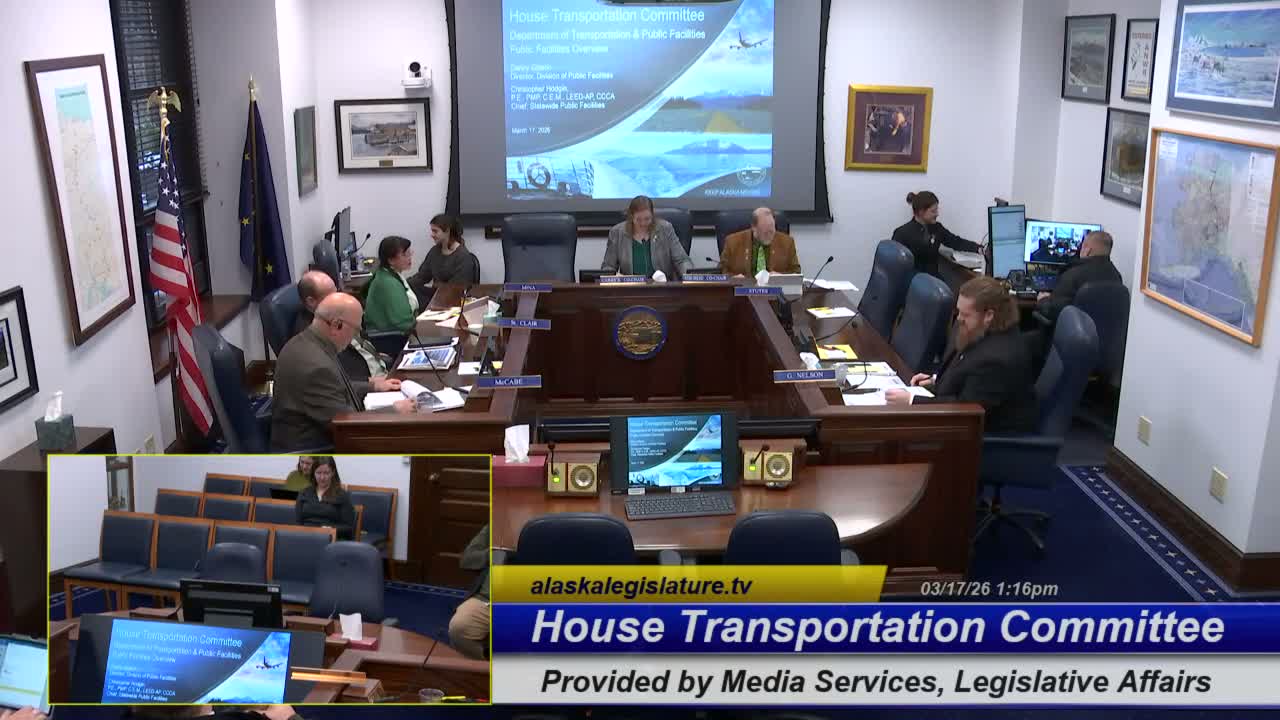
Department of Transportation and Public Facilities officials briefed the House Transportation Committee on March 17 on the agency’s deferred maintenance portfolio and efforts to prioritize and deliver repairs.
Christopher Hodgen, chief of statewide public facilities, told the committee the department’s current deferred maintenance backlog is approximately $373,000,000, split about $210,000,000 in the public building fund portfolio and $163,000,000 in DOT/DFS programmatic buildings. Hodgen said recent facility condition assessments at 28 facilities identified more than $200 million in five-year needs for those sites and that assessments will expand to cover more than 1,000,000 square feet this year.
Danny Gibson, director of the Division of Facility Services (DFS), described an internal approach begun in 2025 emphasizing in-house ‘‘roving strike teams’’ whose flexible schedules and statewide availability have allowed DFS to complete repairs efficiently and stabilize key assets while capital funding remains limited. Gibson cited recent in-house projects including a renovation of the Thompson Pass bunkhouse and a comprehensive revitalization of the Haines maintenance shop as examples of targeted work yielding operational benefit.
How projects are prioritized: Hodgen and Gibson described a rubric that creates a project index value from factors including mission alignment, the system factor for the facility being improved, and urgency/need; higher index values receive higher ranking. The State Facilities Council (representatives of executive-branch agencies that own buildings) reviews and ranks projects and forwards that ranked list to the Office of Management and Budget for allocation decisions. Hodgen said DFS stores assessment results in a computerized maintenance management system to inform prioritization.
Committee members pressed for clarity on reorganization and disposal plans. Cochair Eisheide and others asked whether DOT planned broad disposal or consolidation; Andy Mills, legislative liaison for the department, said the only building identified for disposal at this time was identified in the transcript as the Kibata Building and that a wholesale consolidation of facilities was not underway, though personnel and hub adjustments were being made.
The presenters said DFS operates roughly 706 facilities across about 233 locations and noted assessed building values exceed $2 billion; the transcript’s square-footage figure was garbled and is not reported here. Gibson and Hodgen told legislators that when funding is available, projects typically proceed from the top of the ranked list down until funds are exhausted, and that some work is completed via capital design and construction while other work uses internal maintenance forces.
Next steps and context: the committee thanked the presenters, and the committee’s next meeting was set for March 19 for a preconstruction briefing. Members asked officials to provide additional detail on how many ranked projects are completed each year; officials said they would provide that number after the hearing.
Key quotes from the hearing included Hodgen’s summary of the backlog: "the current present backlog of deferred maintenance in these facilities that we've been presenting to you is approximately 373,000,000," and Gibson describing strike teams as an approach that "made it possible to complete major facility repairs and upgrades efficiently."
Christopher Hodgen, chief of statewide public facilities, told the committee the department’s current deferred maintenance backlog is approximately $373,000,000, split about $210,000,000 in the public building fund portfolio and $163,000,000 in DOT/DFS programmatic buildings. Hodgen said recent facility condition assessments at 28 facilities identified more than $200 million in five-year needs for those sites and that assessments will expand to cover more than 1,000,000 square feet this year.
Danny Gibson, director of the Division of Facility Services (DFS), described an internal approach begun in 2025 emphasizing in-house ‘‘roving strike teams’’ whose flexible schedules and statewide availability have allowed DFS to complete repairs efficiently and stabilize key assets while capital funding remains limited. Gibson cited recent in-house projects including a renovation of the Thompson Pass bunkhouse and a comprehensive revitalization of the Haines maintenance shop as examples of targeted work yielding operational benefit.
How projects are prioritized: Hodgen and Gibson described a rubric that creates a project index value from factors including mission alignment, the system factor for the facility being improved, and urgency/need; higher index values receive higher ranking. The State Facilities Council (representatives of executive-branch agencies that own buildings) reviews and ranks projects and forwards that ranked list to the Office of Management and Budget for allocation decisions. Hodgen said DFS stores assessment results in a computerized maintenance management system to inform prioritization.
Committee members pressed for clarity on reorganization and disposal plans. Cochair Eisheide and others asked whether DOT planned broad disposal or consolidation; Andy Mills, legislative liaison for the department, said the only building identified for disposal at this time was identified in the transcript as the Kibata Building and that a wholesale consolidation of facilities was not underway, though personnel and hub adjustments were being made.
The presenters said DFS operates roughly 706 facilities across about 233 locations and noted assessed building values exceed $2 billion; the transcript’s square-footage figure was garbled and is not reported here. Gibson and Hodgen told legislators that when funding is available, projects typically proceed from the top of the ranked list down until funds are exhausted, and that some work is completed via capital design and construction while other work uses internal maintenance forces.
Next steps and context: the committee thanked the presenters, and the committee’s next meeting was set for March 19 for a preconstruction briefing. Members asked officials to provide additional detail on how many ranked projects are completed each year; officials said they would provide that number after the hearing.
Key quotes from the hearing included Hodgen’s summary of the backlog: "the current present backlog of deferred maintenance in these facilities that we've been presenting to you is approximately 373,000,000," and Gibson describing strike teams as an approach that "made it possible to complete major facility repairs and upgrades efficiently."
Don't Miss a Word: See the Full Meeting!
Go beyond summaries. Unlock every video, transcript, and key insight with a Founder Membership.
✓
Get instant access to full meeting videos
✓
Search and clip any phrase from complete transcripts
✓
Receive AI-powered summaries & custom alerts
✓
Enjoy lifetime, unrestricted access to government data
30-day money-back guarantee
