Task force hears pupil‑transportation funding lags actual costs, especially in rural districts
March 16, 2026 | 2026 Legislature Alaska, Alaska
This article was created by AI summarizing key points discussed. AI makes mistakes, so for full details and context, please refer to the video of the full meeting. Please report any errors so we can fix them. Report an error »
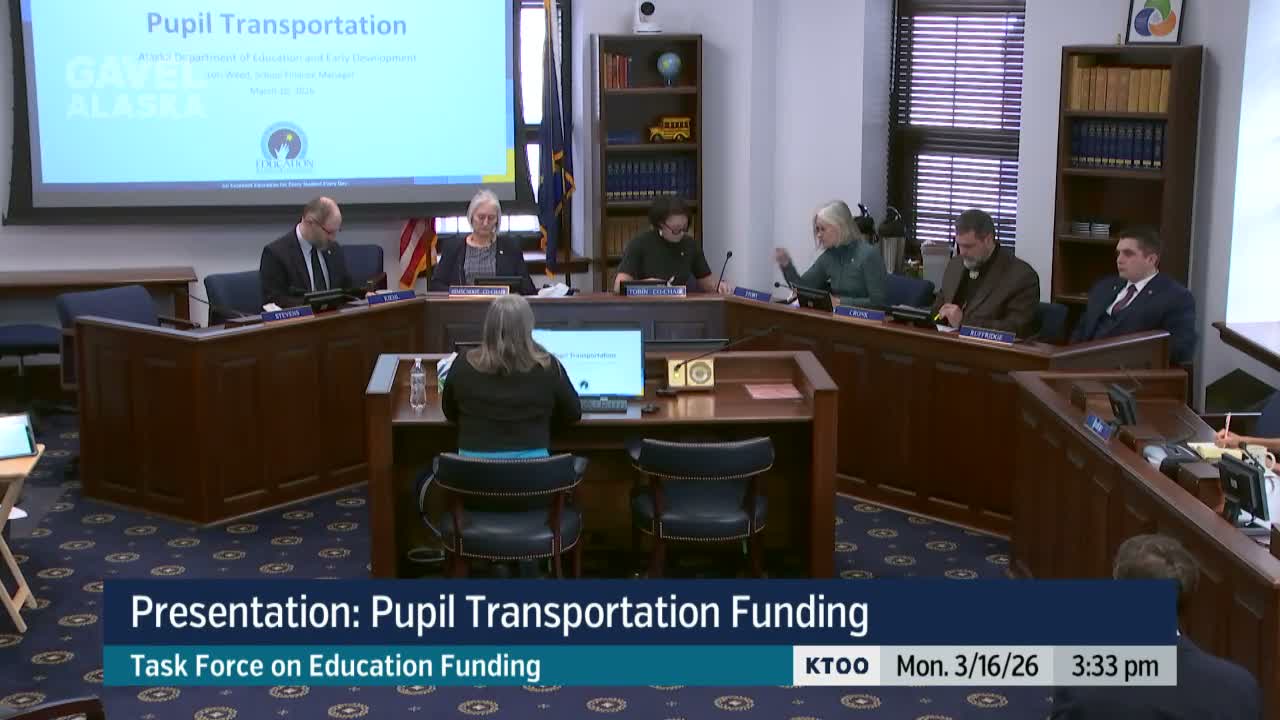
Senator Tobin convened the Joint Legislative Task Force on Education Funding on March 16 in Juneau to review state pupil transportation funding and hear invited testimony from district leaders and fiscal staff.
Laurie Weed, school finance manager at the Alaska Department of Education and Early Development, told the task force the pupil transportation grant is a statutory per‑student amount multiplied by a district’s brick‑and‑mortar average daily membership (ADM). "We do an August payment based on the projected ADM, we true it up in December after the preliminary count, and then we issue the final payment based on audited March data," Weed said, describing the three‑step payment schedule and how grants are reconciled to audited counts.
Weed and Legislative Finance Division fiscal analyst Connor Bell reviewed the program’s history: before FY2004 the program reimbursed districts for documented expenses; the state moved to a formula in 2004 based on prior audited costs. Bell said there was a rebalancing in FY2012 and assorted statutory changes since then, and noted a 10% statutory per‑student increase effective in FY2026. He emphasized large variation across districts in per‑ADM support, saying, "Bristol Bay has the highest funding rate at $3,247 per average daily membership," and that several districts receive no transportation funding because they lack an established program.
Bell also walked members through funding flows: pupil transportation amounts are tied to the public education fund and, under current statutory language, additional money flows from the general fund if actual transportation costs exceed the estimate; conversely, reductions are prorated across districts.
Superintendent Michael Robbins of Bristol Bay Borough School District testified about the practical costs of serving remote communities. "In our district our students fly," Robbins said, explaining that daily aircraft trips move students across a river where no reliable road exists. He described higher local fuel prices and logistics costs and said statewide transportation expenditures have exceeded state pupil transportation funding by more than $65 million, forcing some districts to divert classroom dollars to cover transportation. "Transportation in rural Alaska is not optional," Robbins said. He also told the panel his district serves 86 students and that transportation requirements and costs do not necessarily fall when enrollment declines because routes still must cover geographic distances.
Committee members pressed staff on the origin and currency of the statutory per‑ADM amounts, asking whether the FY2004 reimbursement had been a full reimbursement or cost‑shared and whether the amounts had been reassessed since the FY2012 rebalancing. Bell said the FY2004 figures were based on FY2003 spending and that he was not aware of a statewide reassessment since the FY2012 changes; he recommended any rebalancing account for year‑to‑year volatility and suggested multi‑year averaging as a possible technical approach.
Weed described other department responsibilities: setting bus equipment standards, contracting a twice‑yearly inspection team (Resurrection Auto), maintaining accident records, and supporting school bus driver training through AVTEC. She said districts with persistent program nonoperation have had initial payments reclaimed after reporting no eligible activity.
Members discussed policy options such as targeted hold‑harmless provisions for sparsely populated routes, reassessing per‑ADM amounts to better reflect geographic and inflationary costs, and collecting more granular data on miles, fuel, and contracting practices. Bell and Weed pledged to provide procurement documents, historical rebalancing details, and additional district expenditure data to the task force for follow‑up.
The task force did not take any formal action during this meeting; members scheduled further research and document requests and signaled they will continue deliberations at the next meeting.
Laurie Weed, school finance manager at the Alaska Department of Education and Early Development, told the task force the pupil transportation grant is a statutory per‑student amount multiplied by a district’s brick‑and‑mortar average daily membership (ADM). "We do an August payment based on the projected ADM, we true it up in December after the preliminary count, and then we issue the final payment based on audited March data," Weed said, describing the three‑step payment schedule and how grants are reconciled to audited counts.
Weed and Legislative Finance Division fiscal analyst Connor Bell reviewed the program’s history: before FY2004 the program reimbursed districts for documented expenses; the state moved to a formula in 2004 based on prior audited costs. Bell said there was a rebalancing in FY2012 and assorted statutory changes since then, and noted a 10% statutory per‑student increase effective in FY2026. He emphasized large variation across districts in per‑ADM support, saying, "Bristol Bay has the highest funding rate at $3,247 per average daily membership," and that several districts receive no transportation funding because they lack an established program.
Bell also walked members through funding flows: pupil transportation amounts are tied to the public education fund and, under current statutory language, additional money flows from the general fund if actual transportation costs exceed the estimate; conversely, reductions are prorated across districts.
Superintendent Michael Robbins of Bristol Bay Borough School District testified about the practical costs of serving remote communities. "In our district our students fly," Robbins said, explaining that daily aircraft trips move students across a river where no reliable road exists. He described higher local fuel prices and logistics costs and said statewide transportation expenditures have exceeded state pupil transportation funding by more than $65 million, forcing some districts to divert classroom dollars to cover transportation. "Transportation in rural Alaska is not optional," Robbins said. He also told the panel his district serves 86 students and that transportation requirements and costs do not necessarily fall when enrollment declines because routes still must cover geographic distances.
Committee members pressed staff on the origin and currency of the statutory per‑ADM amounts, asking whether the FY2004 reimbursement had been a full reimbursement or cost‑shared and whether the amounts had been reassessed since the FY2012 rebalancing. Bell said the FY2004 figures were based on FY2003 spending and that he was not aware of a statewide reassessment since the FY2012 changes; he recommended any rebalancing account for year‑to‑year volatility and suggested multi‑year averaging as a possible technical approach.
Weed described other department responsibilities: setting bus equipment standards, contracting a twice‑yearly inspection team (Resurrection Auto), maintaining accident records, and supporting school bus driver training through AVTEC. She said districts with persistent program nonoperation have had initial payments reclaimed after reporting no eligible activity.
Members discussed policy options such as targeted hold‑harmless provisions for sparsely populated routes, reassessing per‑ADM amounts to better reflect geographic and inflationary costs, and collecting more granular data on miles, fuel, and contracting practices. Bell and Weed pledged to provide procurement documents, historical rebalancing details, and additional district expenditure data to the task force for follow‑up.
The task force did not take any formal action during this meeting; members scheduled further research and document requests and signaled they will continue deliberations at the next meeting.
View the Full Meeting & All Its Details
This article offers just a summary. Unlock complete video, transcripts, and insights as a Founder Member.
✓
Watch full, unedited meeting videos
✓
Search every word spoken in unlimited transcripts
✓
AI summaries & real-time alerts (all government levels)
✓
Permanent access to expanding government content
30-day money-back guarantee
