After‑school providers tell task force demand far outstrips supply as programs close
March 16, 2026 | 2026 Legislature Alaska, Alaska
This article was created by AI summarizing key points discussed. AI makes mistakes, so for full details and context, please refer to the video of the full meeting. Please report any errors so we can fix them. Report an error »
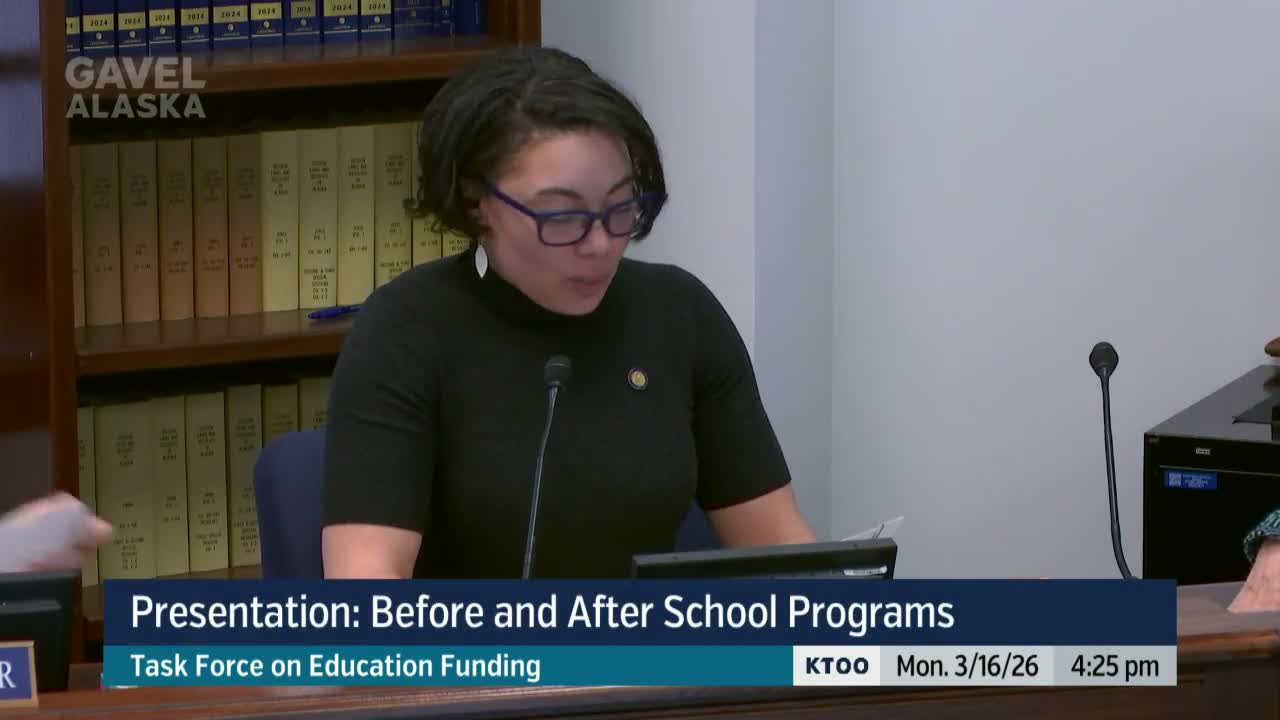
Tom Azarella, executive director of the Alaska After School Network, told the Joint Legislative Task Force on Education Funding that after‑school programs fill a critical gap for families and that demand in Alaska has grown substantially.
Azarella said the national America After 3PM survey results for Alaska show high unmet need: about 17,000 children were enrolled in after‑school programs at the time of the survey, and program reductions this year removed roughly 4,500 slots. "In Alaska, for every one child in an after‑school program there are three to five waiting," he said, and warned that closures in urban and rural areas alike are worsening access.
He described program quality as high — families engaged in after‑school rated satisfaction and program quality strongly — but noted affordability, transportation and limited provider capacity are the primary barriers for low‑ and middle‑income families. Azarella said transportation frequently prevents children from attending community programs that are not co‑located with schools and that districts cannot always insert after‑school drop‑offs into tight bus schedules.
Azarella reviewed federal and state funding streams used by after‑school programs, including 21st Century Community Learning Center grants administered by the Department of Education and Early Development and state after‑school grants administered by the Department of Health. He said those funding streams have largely remained flat while program operating costs have risen, and urged policymakers to consider funding that keeps pace with inflation and addresses transportation barriers and workforce capacity.
Committee members asked for geographic data and program maps; Azarella noted an interactive map on the Alaska After School Network website and agreed to follow up with more detailed regional breakdowns and income‑bracket data.
The presentation closed with policy observations: members signaled interest in whether after‑school investments can be leveraged to improve attendance, provide workforce supports for families, and expand access in program deserts, particularly in rural areas.
Azarella said the national America After 3PM survey results for Alaska show high unmet need: about 17,000 children were enrolled in after‑school programs at the time of the survey, and program reductions this year removed roughly 4,500 slots. "In Alaska, for every one child in an after‑school program there are three to five waiting," he said, and warned that closures in urban and rural areas alike are worsening access.
He described program quality as high — families engaged in after‑school rated satisfaction and program quality strongly — but noted affordability, transportation and limited provider capacity are the primary barriers for low‑ and middle‑income families. Azarella said transportation frequently prevents children from attending community programs that are not co‑located with schools and that districts cannot always insert after‑school drop‑offs into tight bus schedules.
Azarella reviewed federal and state funding streams used by after‑school programs, including 21st Century Community Learning Center grants administered by the Department of Education and Early Development and state after‑school grants administered by the Department of Health. He said those funding streams have largely remained flat while program operating costs have risen, and urged policymakers to consider funding that keeps pace with inflation and addresses transportation barriers and workforce capacity.
Committee members asked for geographic data and program maps; Azarella noted an interactive map on the Alaska After School Network website and agreed to follow up with more detailed regional breakdowns and income‑bracket data.
The presentation closed with policy observations: members signaled interest in whether after‑school investments can be leveraged to improve attendance, provide workforce supports for families, and expand access in program deserts, particularly in rural areas.
View the Full Meeting & All Its Details
This article offers just a summary. Unlock complete video, transcripts, and insights as a Founder Member.
✓
Watch full, unedited meeting videos
✓
Search every word spoken in unlimited transcripts
✓
AI summaries & real-time alerts (all government levels)
✓
Permanent access to expanding government content
30-day money-back guarantee
