AOGCC commissioners outline oversight role, data upgrade and production outlook
March 17, 2026 | 2026 Legislature Alaska, Alaska
This article was created by AI summarizing key points discussed. AI makes mistakes, so for full details and context, please refer to the video of the full meeting. Please report any errors so we can fix them. Report an error »
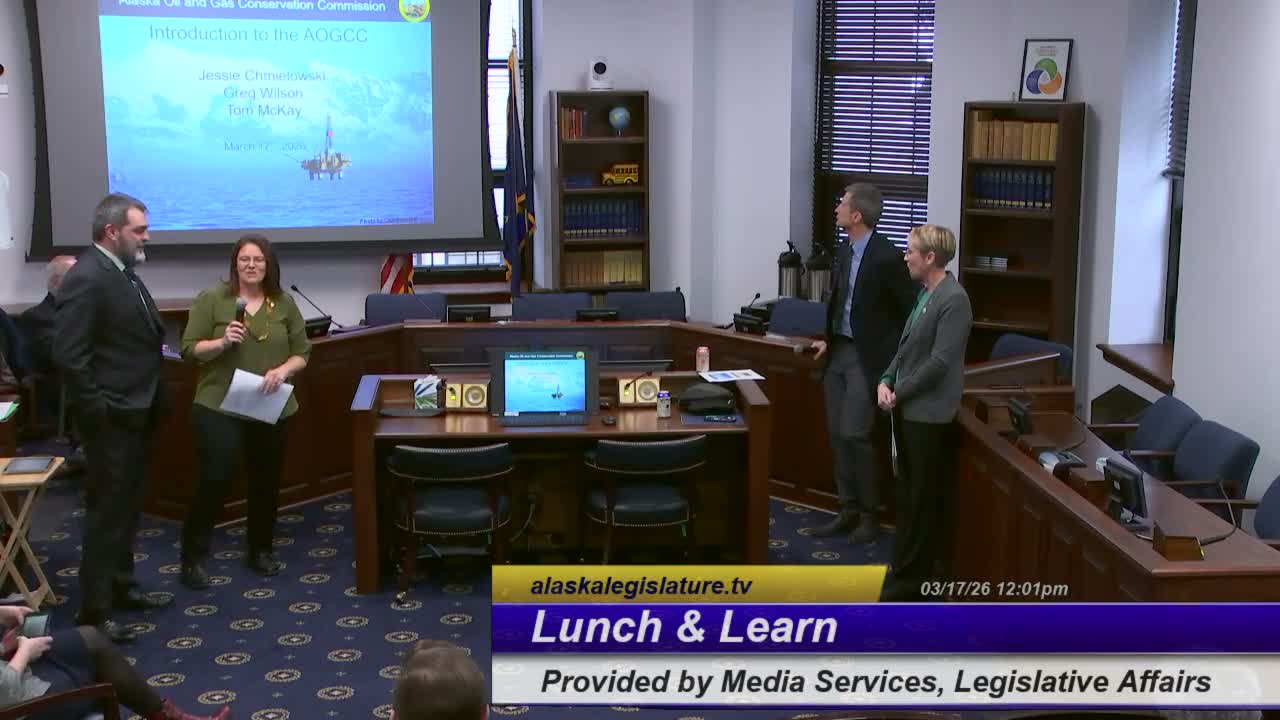
The Alaska Oil and Gas Conservation Commission told attendees at a noon "lunch-and-learn" that its mission is to prevent waste, protect underground sources of fresh water and adjudicate disputes while promoting maximum recovery of oil, gas and geothermal resources. "We are not involved in policy or politics," Commissioner Jessie Chmielewski said, describing the commission as independent and quasi-judicial.
Chmielewski and Geology Commissioner Greg Wilson outlined the commission's core duties: reviewing drilling permits and sundry applications, overseeing monthly venting and flaring reports, and issuing conservation orders that govern injection and reservoir management. Chmielewski said staff engineers and geologists vet permits to ensure proper mechanical construction and casing placement to protect groundwater.
Wilson reviewed recent well activity and operator trends. He presented a 2025 breakdown showing 133 wells represented in the agency's dataset, with 73 producers drilled on the North Slope and additional service and Cook Inlet wells. "Out of 133 wells represented in that pie, 73 were drilled on the North Slope," Wilson said. He described a decade-long trend of changing operator shares and said forecasted projects including Pikka and Willow should raise development well counts in coming years and improve flow through the pipeline, lengthening legacy-field life.
The commission also described a planned multi-year upgrade to its Risk-Based Data Management System (RBDMS). The modernization will be paid largely by operators and is intended to streamline electronic permitting, improve production and injection data tracking and provide a modern map-based front end so users can draw an area and retrieve all data in that area.
Commissioners emphasized field oversight. Chmielewski said AOGCC has eight field-based petroleum inspectors (average ~28 years' experience) who perform more than 6,000 inspections a year and witness mechanical integrity tests, safety-valve tests, meter proofs and plugging operations. The commission also said it maintains both public data (paper records scanned into Laserfiche and an online data miner) and confidential well data.
Thomas McKay, the commission's public commissioner, said the agency keeps close oversight on well control and crew training to avoid incidents as activity potentially expands. The panel closed by offering to answer follow-up questions and directing attendees to agency staff for data inquiries.
Chmielewski and Geology Commissioner Greg Wilson outlined the commission's core duties: reviewing drilling permits and sundry applications, overseeing monthly venting and flaring reports, and issuing conservation orders that govern injection and reservoir management. Chmielewski said staff engineers and geologists vet permits to ensure proper mechanical construction and casing placement to protect groundwater.
Wilson reviewed recent well activity and operator trends. He presented a 2025 breakdown showing 133 wells represented in the agency's dataset, with 73 producers drilled on the North Slope and additional service and Cook Inlet wells. "Out of 133 wells represented in that pie, 73 were drilled on the North Slope," Wilson said. He described a decade-long trend of changing operator shares and said forecasted projects including Pikka and Willow should raise development well counts in coming years and improve flow through the pipeline, lengthening legacy-field life.
The commission also described a planned multi-year upgrade to its Risk-Based Data Management System (RBDMS). The modernization will be paid largely by operators and is intended to streamline electronic permitting, improve production and injection data tracking and provide a modern map-based front end so users can draw an area and retrieve all data in that area.
Commissioners emphasized field oversight. Chmielewski said AOGCC has eight field-based petroleum inspectors (average ~28 years' experience) who perform more than 6,000 inspections a year and witness mechanical integrity tests, safety-valve tests, meter proofs and plugging operations. The commission also said it maintains both public data (paper records scanned into Laserfiche and an online data miner) and confidential well data.
Thomas McKay, the commission's public commissioner, said the agency keeps close oversight on well control and crew training to avoid incidents as activity potentially expands. The panel closed by offering to answer follow-up questions and directing attendees to agency staff for data inquiries.
Don't Miss a Word: See the Full Meeting!
Go beyond summaries. Unlock every video, transcript, and key insight with a Founder Membership.
✓
Get instant access to full meeting videos
✓
Search and clip any phrase from complete transcripts
✓
Receive AI-powered summaries & custom alerts
✓
Enjoy lifetime, unrestricted access to government data
30-day money-back guarantee
