Public testimony and fiscal questions mark committee session on marijuana tax bill
March 17, 2026 | 2026 Legislature Alaska, Alaska
This article was created by AI summarizing key points discussed. AI makes mistakes, so for full details and context, please refer to the video of the full meeting. Please report any errors so we can fix them. Report an error »
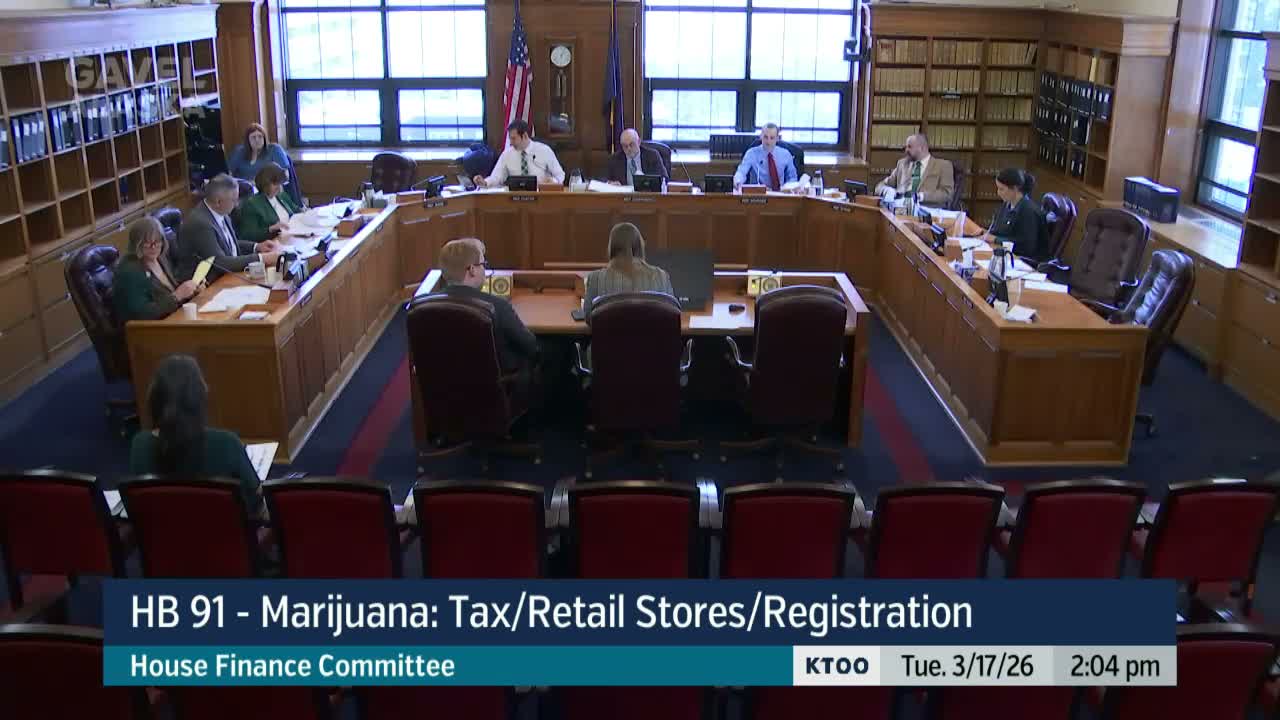
The Alaska House Finance Committee on March 17 heard extensive public testimony and member questions on House Bill 91, which would lower the cultivator excise tax and transition the marijuana industry to a 6% retail sales tax after a transitional period.
Sponsor Representative Ashley Kerrick told the committee HB91 would immediately reduce the current excise to $12.50 per ounce and, after a transition, move to a 6% sales tax applied to marijuana and marijuana products. Kerrick said the bill aims to "strike a balance between reduction of revenue and continuing to collect revenue" while stabilizing an industry that has seen declining receipts.
Kerrick and staff cited FY24 industry figures: approximately $27.2 million in total industry sales, with the Marijuana Education and Treatment (MET) Fund receiving about $6.7 million, the recidivism reduction fund $13.5 million, and $6.9 million to the unrestricted general fund. She and Department of Revenue staff said the fiscal note projects an initial approximate $4.04 million reduction in total industry revenue under the bill’s structure, and Department of Revenue staff outlined a possible 18‑month transition interval recommended by an advisory task force to allow implementation.
Public testimony illustrated divergent stakeholder concerns. Thomas Azarella of the Alaska After School Network and Alaska Children’s Trust warned that MET‑funded prevention grants matter to local programs and said the Positive Youth Development After School grant currently provides $1.8 million to nine grantees across more than 30 communities; he urged maintaining and increasing prevention funding. George Pierce, a consumer, said high combined excise and local taxes push consumers back to illicit markets and urged tax relief. Lacey Wilcox of the Alaska Marijuana Industry Association said the industry appreciates regulatory fixes in HB91 but does not support the tax provisions as written and recommended pairing HB91’s regulatory relief with targeted tax reductions (for example SB73/HB94’s proposed reduction of the excise tax) to stabilize the regulated market.
Committee members probed the mechanics and effects of the proposed sales tax, asking whether the sales tax would include paraphernalia (staff said the bill targets marijuana and marijuana products, not standalone paraphernalia), how municipal retail taxes could stack with a state sales tax and price legal product out of the market in areas with high local levies, and whether enforcement against illicit growers is sufficient to restore market share to licensed operators. Industry witnesses emphasized that enforcement is fragmented and that AMCO’s jurisdiction is limited to licensed operators.
Chair Foster set an amendment deadline for HB91 of Wednesday, March 25 at 12:00 p.m., and then the committee set the bill aside for further work. No final vote on the bill was taken at the hearing.
The committee record includes Department of Revenue fiscal projections and multiple stakeholders urging either protection of prevention funding or more targeted excise relief to stabilize the industry.
Sponsor Representative Ashley Kerrick told the committee HB91 would immediately reduce the current excise to $12.50 per ounce and, after a transition, move to a 6% sales tax applied to marijuana and marijuana products. Kerrick said the bill aims to "strike a balance between reduction of revenue and continuing to collect revenue" while stabilizing an industry that has seen declining receipts.
Kerrick and staff cited FY24 industry figures: approximately $27.2 million in total industry sales, with the Marijuana Education and Treatment (MET) Fund receiving about $6.7 million, the recidivism reduction fund $13.5 million, and $6.9 million to the unrestricted general fund. She and Department of Revenue staff said the fiscal note projects an initial approximate $4.04 million reduction in total industry revenue under the bill’s structure, and Department of Revenue staff outlined a possible 18‑month transition interval recommended by an advisory task force to allow implementation.
Public testimony illustrated divergent stakeholder concerns. Thomas Azarella of the Alaska After School Network and Alaska Children’s Trust warned that MET‑funded prevention grants matter to local programs and said the Positive Youth Development After School grant currently provides $1.8 million to nine grantees across more than 30 communities; he urged maintaining and increasing prevention funding. George Pierce, a consumer, said high combined excise and local taxes push consumers back to illicit markets and urged tax relief. Lacey Wilcox of the Alaska Marijuana Industry Association said the industry appreciates regulatory fixes in HB91 but does not support the tax provisions as written and recommended pairing HB91’s regulatory relief with targeted tax reductions (for example SB73/HB94’s proposed reduction of the excise tax) to stabilize the regulated market.
Committee members probed the mechanics and effects of the proposed sales tax, asking whether the sales tax would include paraphernalia (staff said the bill targets marijuana and marijuana products, not standalone paraphernalia), how municipal retail taxes could stack with a state sales tax and price legal product out of the market in areas with high local levies, and whether enforcement against illicit growers is sufficient to restore market share to licensed operators. Industry witnesses emphasized that enforcement is fragmented and that AMCO’s jurisdiction is limited to licensed operators.
Chair Foster set an amendment deadline for HB91 of Wednesday, March 25 at 12:00 p.m., and then the committee set the bill aside for further work. No final vote on the bill was taken at the hearing.
The committee record includes Department of Revenue fiscal projections and multiple stakeholders urging either protection of prevention funding or more targeted excise relief to stabilize the industry.
View the Full Meeting & All Its Details
This article offers just a summary. Unlock complete video, transcripts, and insights as a Founder Member.
✓
Watch full, unedited meeting videos
✓
Search every word spoken in unlimited transcripts
✓
AI summaries & real-time alerts (all government levels)
✓
Permanent access to expanding government content
30-day money-back guarantee
