Gov. Bob Ferguson, regional leaders pledge to replace I-5 bridge; construction targeted for 2028
March 17, 2026 | Governor's Office - Boards & Commissions, Executive, Washington
This article was created by AI summarizing key points discussed. AI makes mistakes, so for full details and context, please refer to the video of the full meeting. Please report any errors so we can fix them. Report an error »
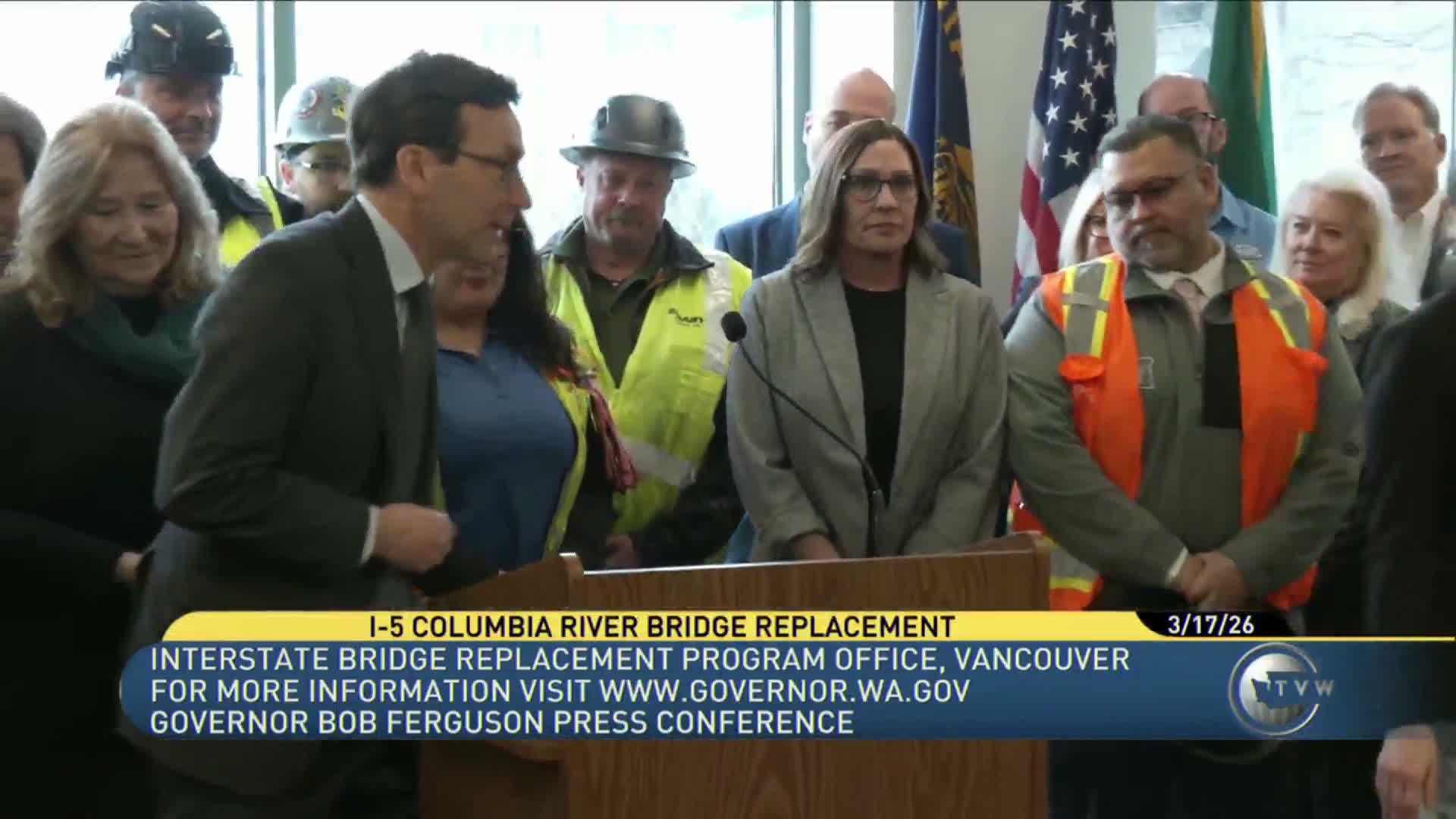
Gov. Bob Ferguson announced a plan to replace the 109-year-old Interstate Bridge that links Portland and Vancouver, saying the state will pursue a fixed-span replacement and that construction is expected to start in 2028.
"We're gonna build this bridge. That's gonna happen," Governor Bob Ferguson said, framing the replacement as essential for public safety, the region's economy and thousands of jobs. He cited the program's updated cost estimate of $7,650,000,000 and said the Interstate Bridge Replacement (IBR) program currently has about $5,500,000,000 in state and federal funding available while pursuing an additional $1,000,000,000 through the Federal Transit Administration's capital investment grant program.
Why it matters: Officials said the current structure is vulnerable to seismic events because supporting timber piles sit in loose sand, a condition the environmental impact statement flagged as creating collapse risk. The U.S. Coast Guard's recent approval of a fixed-span design — instead of a movable lift span — was described by Ferguson as "a huge step forward" that reduces complexity and cost; he said a movable span would have cost about $1,700,000,000 more.
Project scope and schedule: Ferguson said the core plan is to replace the northbound and southbound spans, connect the new bridges to Interstate 5 and extend light rail into Vancouver. The IBR program also includes corridor improvements on both sides of the river, including seven interchanges and replacement of the North Portland Harbor Bridge. Officials said they expect to select a contractor in 2027 under a progressive design-build process and begin construction in 2028, with final schedule details to be refined with the selected contractor.
Permits and next steps: Carly Francis, interim program administrator, said the final supplemental environmental impact statement (FSEIS) is being finalized with the federal government and that a record of decision is expected by midyear. Officials emphasized the work will be phased as funding becomes available and said operations-and-maintenance estimates for the planned light-rail extension will continue to evolve as design advances.
Funding and tolling: Rep. Jake Fye, chair of the state House Transportation Committee, noted legislative backing, including $1,000,000,000 each from Washington and Oregon on the legislative side. On potential tolls, Ferguson said it is "too soon to say" and that treasury teams from both states are modeling scenarios; he declined to commit to specific toll levels at the briefing.
Transit, jobs and workforce: Sam Desu, general manager of TriMet, described the light-rail extension as a one-seat ride connecting Evergreen and downtown Portland and highlighted a recent federal investment of $100,000,000 in support of light-rail work. Union leaders urged rapid movement on the project to create employment; Robert Camarillo of the Oregon State Building Trades and Heather Kurtenbach of the Washington State Building Trades emphasized hundreds-to-thousands of jobs and supported a project labor agreement to ensure pay, benefits and apprenticeship pathways. Camarillo said Oregon's contribution has been structured as four installments of $250,000,000 totaling $1,000,000,000.
Safety question from the public: A Vancouver resident asked whether it was safe to keep driving on the existing bridge until replacement work begins. Ferguson said the bridge is vulnerable and needs replacement but did not advise immediate avoidance; he stressed urgency to move forward.
What happens next: Officials reiterated the near-term milestones—publication of the FSEIS and an expected record of decision by midyear, contractor selection targeted in 2027 and construction starting in 2028—and said design and cost details will be refined during progressive design-build phases.
Sources and attributions: The reporting in this article is based on remarks at a press briefing where Gov. Bob Ferguson, Vancouver Mayor Anne McInerney Ogle, Rep. Jake Fye, TriMet General Manager Sam Desu, Robert Camarillo (Oregon State Building Trades), Heather Kurtenbach (Washington State Building Trades) and interim program administrator Carly Francis spoke. Direct quotations and program figures were provided by those speakers during the briefing.
"We're gonna build this bridge. That's gonna happen," Governor Bob Ferguson said, framing the replacement as essential for public safety, the region's economy and thousands of jobs. He cited the program's updated cost estimate of $7,650,000,000 and said the Interstate Bridge Replacement (IBR) program currently has about $5,500,000,000 in state and federal funding available while pursuing an additional $1,000,000,000 through the Federal Transit Administration's capital investment grant program.
Why it matters: Officials said the current structure is vulnerable to seismic events because supporting timber piles sit in loose sand, a condition the environmental impact statement flagged as creating collapse risk. The U.S. Coast Guard's recent approval of a fixed-span design — instead of a movable lift span — was described by Ferguson as "a huge step forward" that reduces complexity and cost; he said a movable span would have cost about $1,700,000,000 more.
Project scope and schedule: Ferguson said the core plan is to replace the northbound and southbound spans, connect the new bridges to Interstate 5 and extend light rail into Vancouver. The IBR program also includes corridor improvements on both sides of the river, including seven interchanges and replacement of the North Portland Harbor Bridge. Officials said they expect to select a contractor in 2027 under a progressive design-build process and begin construction in 2028, with final schedule details to be refined with the selected contractor.
Permits and next steps: Carly Francis, interim program administrator, said the final supplemental environmental impact statement (FSEIS) is being finalized with the federal government and that a record of decision is expected by midyear. Officials emphasized the work will be phased as funding becomes available and said operations-and-maintenance estimates for the planned light-rail extension will continue to evolve as design advances.
Funding and tolling: Rep. Jake Fye, chair of the state House Transportation Committee, noted legislative backing, including $1,000,000,000 each from Washington and Oregon on the legislative side. On potential tolls, Ferguson said it is "too soon to say" and that treasury teams from both states are modeling scenarios; he declined to commit to specific toll levels at the briefing.
Transit, jobs and workforce: Sam Desu, general manager of TriMet, described the light-rail extension as a one-seat ride connecting Evergreen and downtown Portland and highlighted a recent federal investment of $100,000,000 in support of light-rail work. Union leaders urged rapid movement on the project to create employment; Robert Camarillo of the Oregon State Building Trades and Heather Kurtenbach of the Washington State Building Trades emphasized hundreds-to-thousands of jobs and supported a project labor agreement to ensure pay, benefits and apprenticeship pathways. Camarillo said Oregon's contribution has been structured as four installments of $250,000,000 totaling $1,000,000,000.
Safety question from the public: A Vancouver resident asked whether it was safe to keep driving on the existing bridge until replacement work begins. Ferguson said the bridge is vulnerable and needs replacement but did not advise immediate avoidance; he stressed urgency to move forward.
What happens next: Officials reiterated the near-term milestones—publication of the FSEIS and an expected record of decision by midyear, contractor selection targeted in 2027 and construction starting in 2028—and said design and cost details will be refined during progressive design-build phases.
Sources and attributions: The reporting in this article is based on remarks at a press briefing where Gov. Bob Ferguson, Vancouver Mayor Anne McInerney Ogle, Rep. Jake Fye, TriMet General Manager Sam Desu, Robert Camarillo (Oregon State Building Trades), Heather Kurtenbach (Washington State Building Trades) and interim program administrator Carly Francis spoke. Direct quotations and program figures were provided by those speakers during the briefing.
Don't Miss a Word: See the Full Meeting!
Go beyond summaries. Unlock every video, transcript, and key insight with a Founder Membership.
✓
Get instant access to full meeting videos
✓
Search and clip any phrase from complete transcripts
✓
Receive AI-powered summaries & custom alerts
✓
Enjoy lifetime, unrestricted access to government data
30-day money-back guarantee
