Commission recommends MF-6 rezoning for former Rosedale school site despite neighborhood opposition
March 17, 2026 | Austin, Travis County, Texas
This article was created by AI summarizing key points discussed. AI makes mistakes, so for full details and context, please refer to the video of the full meeting. Please report any errors so we can fix them. Report an error »
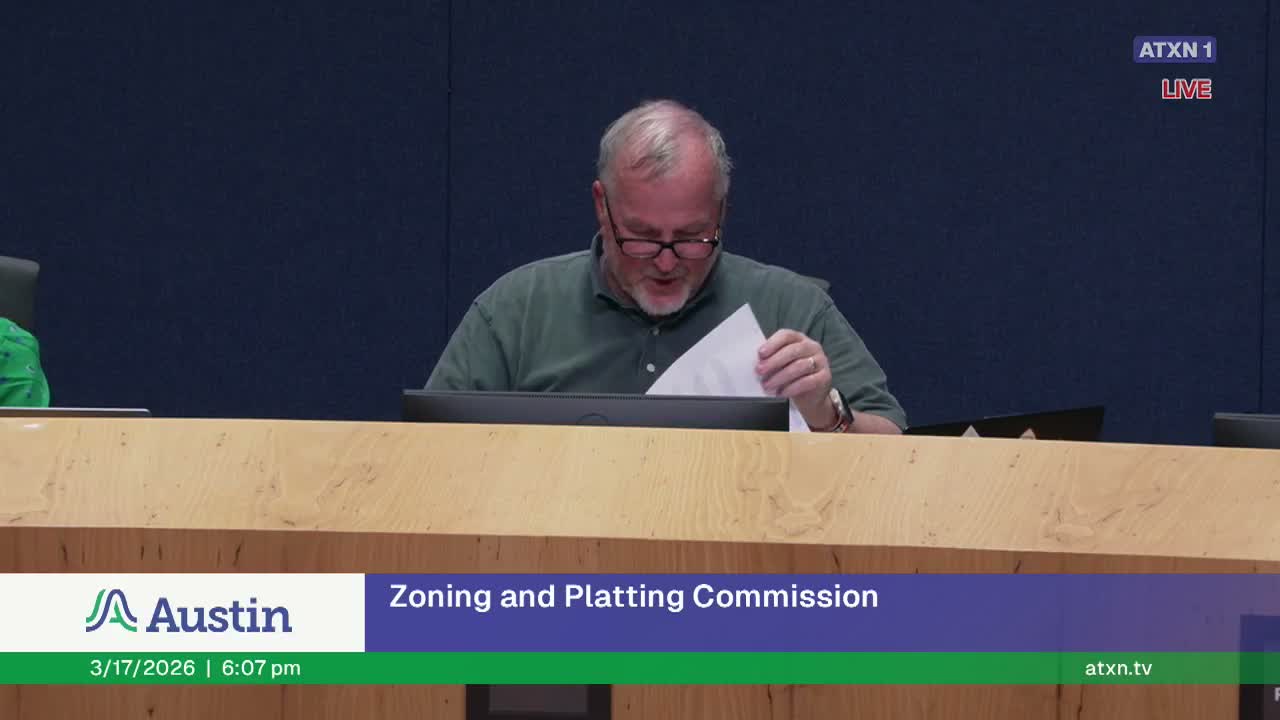
The Zoning and Planning Commission voted 9–2 on March 17 to recommend that City Council rezone the former Rosedale Elementary School site (2117 West 49th Street and 4709 Rosedale Avenue) from single‑family (SF‑3) to multifamily (MF‑6‑CO) with a conditional overlay limiting height to 75 feet.
The vote followed a staff presentation, an applicant presentation and more than three hours of public testimony that was split but heavily attended. Cynthia Hadry of Austin Planning told the commission the 4.62‑acre property is currently zoned SF‑3 and that staff recommends MF‑6‑CO because the request is consistent with the base district intent, adds housing options near transit and includes a conditional overlay limiting height. Hadry said the Historic Landmark Commission had unanimously approved preservation of portions of the historic Rosedale School facade and encouraged adaptive reuse.
David Hartman, speaking for the applicant, summarized the project’s planned features: preservation of the school façade, dedication of roughly a half‑acre of on‑site parkland, sidewalk and right‑of‑way dedications, in‑garage stormwater detention and a voluntary affordability commitment implemented through a recorded restrictive covenant with Homebase (a Habitat for Humanity affiliate). Hartman said the development would add about 435 multifamily units and estimated it would generate more than $10 million in tax revenue for the city over the next decade. "We're dedicating on‑site public parkland, which will be increased to a half acre," he said, and asked the commission to support staff’s recommendation.
Supporters who signed up to speak said higher housing capacity near bus and bike routes was needed. Zach Faddis, a nearby resident, urged the commission to "say yes to housing," citing walkability and transit access. Greg Anderson and other supporters said new housing would help Austin Independent School District (AISD) finances and transit ridership.
Opponents, led in the public record by architects, long‑time residents and neighborhood association leaders, focused on process, scale and infrastructure. Chris Allen, an architect who said he has advised Rosedale land‑use efforts for decades, called the timing "totally inappropriate" because of ongoing litigation between AISD and neighbors and urged commissioners to postpone. He said the case risks turning a "community asset" into a permanent loss for neighbors.
Many residents contested the traffic analysis and the project's assumed trip generation. Civil engineer Kathy Fretwell questioned the neighborhood traffic analysis (NTA), arguing the traffic counts and origin points were not representative and that the study mischaracterized prior uses of the property; she recommended requiring a full traffic impact analysis and 100% stormwater detention. Daryl Azar and others said the developer's application originally included no explicit affordability and that a verbal commitment is insufficient without clear recorded guarantees.
Austin Transportation and Public Works staff responded to those technical concerns. Curtis Beatty said the NTA was triggered under the Land Development Code because projected net new trips at the property frontage exceeded the NTA threshold; TPW estimated a net increase of roughly 1,000–1,100 daily vehicle trips. Beatty explained that a full Traffic Impact Analysis (TIA) is required only when net new daily trips exceed the city's ~2,000‑trip threshold, and that required sidewalk improvements are generally limited to the property frontage unless off‑site work is negotiated or paid for through fees. "It looks like this is going to have a net new of approximately 1,000 daily trips, 1,100 daily trips," Beatty told commissioners.
Commissioners debated postponement to allow more neighborhood–applicant collaboration versus forwarding the application with conditions. Concerns raised in deliberations included the scale of density relative to neighboring single‑family lots, the adequacy of infrastructure (water, wastewater, stormwater and electrical) and clarity about the scope of affordability commitments. Commissioners also noted that site‑plan level infrastructure requirements and mitigation (including parking, drainage and sidewalk construction) would be worked out later in the review and permitting process.
A substitute motion to postpone the item to April 21 was proposed but did not receive the support needed. A later motion to approve staff’s recommendation — rezoning from SF‑3 to MF‑6 with a CO limiting height to 75 feet — passed on a 9–2 voice vote and will now advance to City Council for three readings. Chair Hank Smith urged the applicant and AISD to continue meeting with neighbors before the council hearings to clarify affordability and mitigation commitments.
What happens next: the commission’s recommendation goes to City Council, which will consider the rezoning in a three‑reading process. The site plan, site‑level infrastructure work and any recorded affordability covenants are separate processes that will follow and require additional approvals.
Votes at a glance: Commission recommendation to approve rezoning SF‑3 → MF‑6‑CO (75 ft limit): passed, 9 yes, 2 no.
Public record highlights: opponents asked for a postponement and a full traffic impact analysis; the applicant committed to a recorded restrictive covenant for affordable units and on‑site parkland dedication; TPW reported an estimated ~1,000–1,100 net new daily trips and said a TIA threshold was not met based on current LDC triggers.
The commission adjourned at 8:57 p.m. with the item set to move forward to City Council for final action.
The vote followed a staff presentation, an applicant presentation and more than three hours of public testimony that was split but heavily attended. Cynthia Hadry of Austin Planning told the commission the 4.62‑acre property is currently zoned SF‑3 and that staff recommends MF‑6‑CO because the request is consistent with the base district intent, adds housing options near transit and includes a conditional overlay limiting height. Hadry said the Historic Landmark Commission had unanimously approved preservation of portions of the historic Rosedale School facade and encouraged adaptive reuse.
David Hartman, speaking for the applicant, summarized the project’s planned features: preservation of the school façade, dedication of roughly a half‑acre of on‑site parkland, sidewalk and right‑of‑way dedications, in‑garage stormwater detention and a voluntary affordability commitment implemented through a recorded restrictive covenant with Homebase (a Habitat for Humanity affiliate). Hartman said the development would add about 435 multifamily units and estimated it would generate more than $10 million in tax revenue for the city over the next decade. "We're dedicating on‑site public parkland, which will be increased to a half acre," he said, and asked the commission to support staff’s recommendation.
Supporters who signed up to speak said higher housing capacity near bus and bike routes was needed. Zach Faddis, a nearby resident, urged the commission to "say yes to housing," citing walkability and transit access. Greg Anderson and other supporters said new housing would help Austin Independent School District (AISD) finances and transit ridership.
Opponents, led in the public record by architects, long‑time residents and neighborhood association leaders, focused on process, scale and infrastructure. Chris Allen, an architect who said he has advised Rosedale land‑use efforts for decades, called the timing "totally inappropriate" because of ongoing litigation between AISD and neighbors and urged commissioners to postpone. He said the case risks turning a "community asset" into a permanent loss for neighbors.
Many residents contested the traffic analysis and the project's assumed trip generation. Civil engineer Kathy Fretwell questioned the neighborhood traffic analysis (NTA), arguing the traffic counts and origin points were not representative and that the study mischaracterized prior uses of the property; she recommended requiring a full traffic impact analysis and 100% stormwater detention. Daryl Azar and others said the developer's application originally included no explicit affordability and that a verbal commitment is insufficient without clear recorded guarantees.
Austin Transportation and Public Works staff responded to those technical concerns. Curtis Beatty said the NTA was triggered under the Land Development Code because projected net new trips at the property frontage exceeded the NTA threshold; TPW estimated a net increase of roughly 1,000–1,100 daily vehicle trips. Beatty explained that a full Traffic Impact Analysis (TIA) is required only when net new daily trips exceed the city's ~2,000‑trip threshold, and that required sidewalk improvements are generally limited to the property frontage unless off‑site work is negotiated or paid for through fees. "It looks like this is going to have a net new of approximately 1,000 daily trips, 1,100 daily trips," Beatty told commissioners.
Commissioners debated postponement to allow more neighborhood–applicant collaboration versus forwarding the application with conditions. Concerns raised in deliberations included the scale of density relative to neighboring single‑family lots, the adequacy of infrastructure (water, wastewater, stormwater and electrical) and clarity about the scope of affordability commitments. Commissioners also noted that site‑plan level infrastructure requirements and mitigation (including parking, drainage and sidewalk construction) would be worked out later in the review and permitting process.
A substitute motion to postpone the item to April 21 was proposed but did not receive the support needed. A later motion to approve staff’s recommendation — rezoning from SF‑3 to MF‑6 with a CO limiting height to 75 feet — passed on a 9–2 voice vote and will now advance to City Council for three readings. Chair Hank Smith urged the applicant and AISD to continue meeting with neighbors before the council hearings to clarify affordability and mitigation commitments.
What happens next: the commission’s recommendation goes to City Council, which will consider the rezoning in a three‑reading process. The site plan, site‑level infrastructure work and any recorded affordability covenants are separate processes that will follow and require additional approvals.
Votes at a glance: Commission recommendation to approve rezoning SF‑3 → MF‑6‑CO (75 ft limit): passed, 9 yes, 2 no.
Public record highlights: opponents asked for a postponement and a full traffic impact analysis; the applicant committed to a recorded restrictive covenant for affordable units and on‑site parkland dedication; TPW reported an estimated ~1,000–1,100 net new daily trips and said a TIA threshold was not met based on current LDC triggers.
The commission adjourned at 8:57 p.m. with the item set to move forward to City Council for final action.
Don't Miss a Word: See the Full Meeting!
Go beyond summaries. Unlock every video, transcript, and key insight with a Founder Membership.
✓
Get instant access to full meeting videos
✓
Search and clip any phrase from complete transcripts
✓
Receive AI-powered summaries & custom alerts
✓
Enjoy lifetime, unrestricted access to government data
30-day money-back guarantee
