Alief ISD weighs virtual school options as enrollment falls, eyes staffing and budget shifts
February 07, 2026 | ALIEF ISD, School Districts, Texas
This article was created by AI summarizing key points discussed. AI makes mistakes, so for full details and context, please refer to the video of the full meeting. Please report any errors so we can fix them. Report an error »
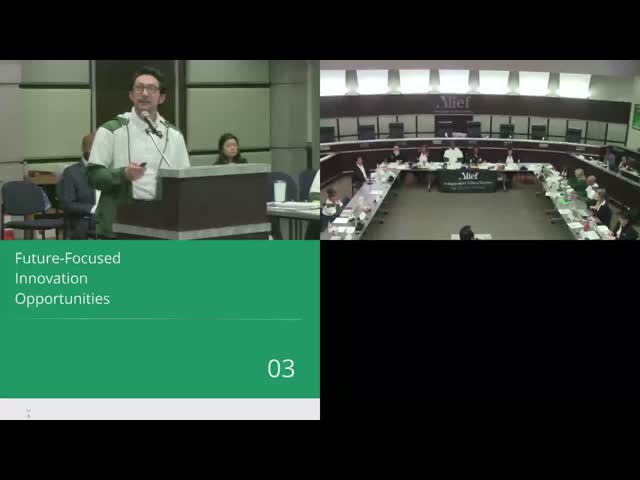
Alief ISD officials told the board on Feb. 7 they are exploring virtual-school models and budget strategies to respond to declining enrollment and shifting family demand. Presenter (staff) said the district is negotiating vendor agreements, redirecting funds and pursuing efficiencies to stabilize staffing and sustain innovation.
The district reported about 55% of survey respondents expressed interest in a virtual school option, while 45% were not interested. Presenter said district planners are considering both hybrid models (partial on-campus time) and fully virtual schools, and that either synchronous or asynchronous instruction could be used depending on the model approved and the technical assistance required by the state.
"It's not about the amount of students we have today, but where are we anticipating and then being able to have some cost savings," Presenter said, describing contract negotiations tied to expected enrollment. Presenter added that district leaders must stabilize staffing and budget before launching new delivery models.
Board members and staff discussed how outsourcing a virtual program affects average daily attendance (ADA) revenue. "From the state's perspective, the ADA is still the same. It still counts. We still get $62.15 per kid for just a regular education," said Staff member (speaker 4), noting district revenue depends on the model and whether the district runs its own program or contracts with an outside provider.
District staff explained two basic approaches: outsource core services to a provider that would retain most program revenue, or build and operate the virtual school in-district to retain funding and curricular control. Outsourcing can reduce upfront district costs but often leaves the district with a small portion of ADA dollars; growing the district's own program requires investment in personnel, a principal and curriculum but retains revenue.
Trustees asked about enrollment impacts, staffing capacity and legal vetting of vendor agreements. Presenter said the legal department will review contracts and any data-sharing arrangements before the board considers formal approvals. No formal decision was taken; staff said exploration and community input will continue.
The district plans further analysis of projected costs and potential savings and will return to the board with more specific design recommendations and fiscal estimates.
The district reported about 55% of survey respondents expressed interest in a virtual school option, while 45% were not interested. Presenter said district planners are considering both hybrid models (partial on-campus time) and fully virtual schools, and that either synchronous or asynchronous instruction could be used depending on the model approved and the technical assistance required by the state.
"It's not about the amount of students we have today, but where are we anticipating and then being able to have some cost savings," Presenter said, describing contract negotiations tied to expected enrollment. Presenter added that district leaders must stabilize staffing and budget before launching new delivery models.
Board members and staff discussed how outsourcing a virtual program affects average daily attendance (ADA) revenue. "From the state's perspective, the ADA is still the same. It still counts. We still get $62.15 per kid for just a regular education," said Staff member (speaker 4), noting district revenue depends on the model and whether the district runs its own program or contracts with an outside provider.
District staff explained two basic approaches: outsource core services to a provider that would retain most program revenue, or build and operate the virtual school in-district to retain funding and curricular control. Outsourcing can reduce upfront district costs but often leaves the district with a small portion of ADA dollars; growing the district's own program requires investment in personnel, a principal and curriculum but retains revenue.
Trustees asked about enrollment impacts, staffing capacity and legal vetting of vendor agreements. Presenter said the legal department will review contracts and any data-sharing arrangements before the board considers formal approvals. No formal decision was taken; staff said exploration and community input will continue.
The district plans further analysis of projected costs and potential savings and will return to the board with more specific design recommendations and fiscal estimates.
Don't Miss a Word: See the Full Meeting!
Go beyond summaries. Unlock every video, transcript, and key insight with a Founder Membership.
✓
Get instant access to full meeting videos
✓
Search and clip any phrase from complete transcripts
✓
Receive AI-powered summaries & custom alerts
✓
Enjoy lifetime, unrestricted access to government data
30-day money-back guarantee
