Alief ISD announces University of Houston dual‑credit public health pathway and K–12 curriculum shifts
February 07, 2026 | ALIEF ISD, School Districts, Texas
This article was created by AI summarizing key points discussed. AI makes mistakes, so for full details and context, please refer to the video of the full meeting. Please report any errors so we can fix them. Report an error »
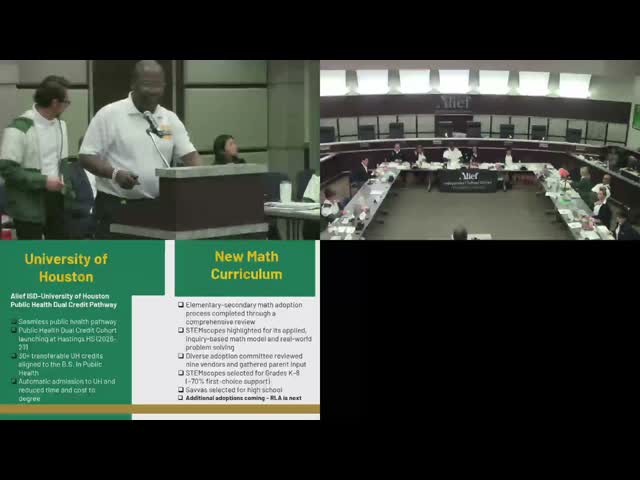
Alief ISD on Feb. 7 announced a multiyear plan to expand college and career pathways and to standardize curriculum across the district. Andre Osagie, executive director for secondary curriculum and instruction, described a dual-credit public health pathway with the University of Houston that is planned to begin in the 2026–27 school year and will offer automatic admission to UH after students complete roughly 30 college credit hours while enrolled in the pathway.
"This program is going to start out... at Hastings High School," Osagie said, adding that the district expects an initial cohort of about 50 ninth-grade students. Osagie estimated the 30 credit hours could represent nearly $26,000 in tuition savings for families who complete the pathway while in high school.
Osagie also said the district will recommend adopting STEMScopes for K–8 mathematics and a Savas curriculum at the high-school level; the recommendation will be presented to the board for review on Jan. 17 (date cited in the presentation). The district intends to invest in teacher training for any new curriculum and said the Texas Performance Standards Project (TPSP) curriculum will be recommended to standardize the gifted-and-talented program across campuses.
"We will begin to recruit and identify those students within the ninth-grade cohort," Osagie said of the dual-credit pathway. He added University of Houston professors will teach some courses, and students who remain in the pathway could transfer about 30 credit hours into UH's public-health program.
Board members asked about consistency of GT experiences, data-sharing implications and staffing to deliver accelerated math and GT services. Osagie said the TPSP curriculum is state-provided and free; the district must budget for teacher training which Region 4 will support. Presenter said the district will vet agreements through its legal department.
The district also outlined an accelerated math pathway beginning in sixth grade so that many students may take Algebra I by eighth grade starting in 2026–27, and an advanced science pathway that would allow students to reach high‑school science coursework by eighth grade. Final approvals and detailed implementation plans will be presented to the board in upcoming meetings.
"This program is going to start out... at Hastings High School," Osagie said, adding that the district expects an initial cohort of about 50 ninth-grade students. Osagie estimated the 30 credit hours could represent nearly $26,000 in tuition savings for families who complete the pathway while in high school.
Osagie also said the district will recommend adopting STEMScopes for K–8 mathematics and a Savas curriculum at the high-school level; the recommendation will be presented to the board for review on Jan. 17 (date cited in the presentation). The district intends to invest in teacher training for any new curriculum and said the Texas Performance Standards Project (TPSP) curriculum will be recommended to standardize the gifted-and-talented program across campuses.
"We will begin to recruit and identify those students within the ninth-grade cohort," Osagie said of the dual-credit pathway. He added University of Houston professors will teach some courses, and students who remain in the pathway could transfer about 30 credit hours into UH's public-health program.
Board members asked about consistency of GT experiences, data-sharing implications and staffing to deliver accelerated math and GT services. Osagie said the TPSP curriculum is state-provided and free; the district must budget for teacher training which Region 4 will support. Presenter said the district will vet agreements through its legal department.
The district also outlined an accelerated math pathway beginning in sixth grade so that many students may take Algebra I by eighth grade starting in 2026–27, and an advanced science pathway that would allow students to reach high‑school science coursework by eighth grade. Final approvals and detailed implementation plans will be presented to the board in upcoming meetings.
View the Full Meeting & All Its Details
This article offers just a summary. Unlock complete video, transcripts, and insights as a Founder Member.
✓
Watch full, unedited meeting videos
✓
Search every word spoken in unlimited transcripts
✓
AI summaries & real-time alerts (all government levels)
✓
Permanent access to expanding government content
30-day money-back guarantee
