Alief ISD trustees hear innovation update on arts, STEM and new academies; board presses for sustainability details
February 07, 2026 | ALIEF ISD, School Districts, Texas
This article was created by AI summarizing key points discussed. AI makes mistakes, so for full details and context, please refer to the video of the full meeting. Please report any errors so we can fix them. Report an error »
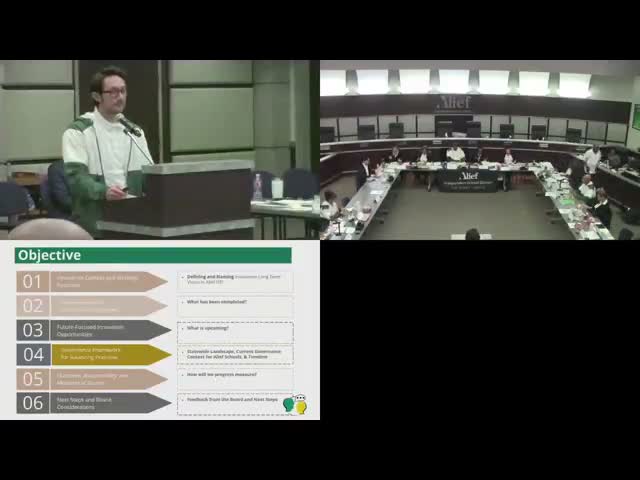
Alief ISD trustees reconvened Feb. 7 to receive an innovation update that outlined expansion of arts pathways, STEM conversion schools and new academy models intended to boost student outcomes and stabilize enrollment.
Dr. Charles Garcia, deputy superintendent for curriculum, framed the district's charge as preparing for layered and continuous change in K–12 education and said the plan emphasizes maintaining instructional quality even amid budget and enrollment shifts. "What we're going to have in front of you is taking the baton... and we're going to talk about innovation and the context and the strategy behind that piece," Garcia said.
The presentation said the district will pursue three models: conversion schools (whole-campus adoption), start-up schools (new campuses built from the ground up) and academy models (pathways within comprehensive campuses). Angela Mylan, associate superintendent for secondary schools, said those options are designed to give families more in‑district choice and to interrupt patterns of underperformance. "Innovation is not optional," Mylan said, adding that early evidence shows higher participation and family engagement at participating campuses.
Presenters highlighted the K–12 performing and visual arts (PVAA) pathway and partnerships with Performing Arts Houston, Jones Hall, the Houston Symphony and the Houston Ballet as examples of work already underway. Renford Joseph, director of fine arts, described mobile concert trucks, master classes and donated costume programs that brought professional experiences to students at low or no cost.
Officials cited early indicators they said support the strategy: several PVAA campuses reported attendance (ADA) near 95 percent and survey responses signaling greater family engagement compared with the prior year. The district also pointed to established programs—ALIEF Early College and Kerr High School—as models of sustained success.
Administrators outlined other initiatives, including Horn STEM Elementary (a conversion model intended to seed a K–12 STEM pathway), the Young Innovators Summer Academy and the OLLI Citgo Innovation Academy at the middle‑school level, which this year added a LOTC option and expanded robotics and extracurricular STEM opportunities.
Trustees asked for specifics on outcomes and funding. A trustee pressed Garcia on a slide that said comparable all‑girls schools in Texas had "100% college readiness;" Garcia replied that those schools report very high college‑going rates and emphasized follow‑through support via a preparatory network. Another trustee voiced concern that earlier district arts programs had faded when funding or staffing changed and asked how the new initiatives would be sustained long term. "I'm excited about this, but from a budget point of view, how can we sustain it?" the trustee said.
Superintendent Mays and staff said sustainability was central to planning. They said Alief is working with external partners (named in the presentation as GoodReason Houston) to standardize operations and create playbooks so programs are not dependent on a single staff member or principal. A staff presenter described the funding trade-offs in the context of flat or declining enrollment and said the team is reviewing low‑enrollment courses and master‑schedule efficiencies to free capacity for high‑impact programs.
Board members asked for clearer financial detail. A slide discussed multi‑year cost projections through 2029; during the meeting staff alternately referred to figures near "$3,000,000" and to a separate "million dollars" allocation described as spread "over the course of 4 years," producing ambiguity about the program-scale cost and timing. Trustees asked staff to provide a consolidated spreadsheet of all programs (new and existing), participating campuses, MOUs/agreements and which programs receive federal funding so the board can track sustainability and accountability; staff agreed to provide that information.
The presentation concluded without a formal vote. Trustees said they supported innovation in principle but asked administration to return with clarified funding figures, written standard operating procedures for program implementation and the requested program/MOU inventory.
What's next: staff committed to sending the program inventory and clarifying the multi‑year cost figures; trustees indicated they will review those materials before taking further action.
Dr. Charles Garcia, deputy superintendent for curriculum, framed the district's charge as preparing for layered and continuous change in K–12 education and said the plan emphasizes maintaining instructional quality even amid budget and enrollment shifts. "What we're going to have in front of you is taking the baton... and we're going to talk about innovation and the context and the strategy behind that piece," Garcia said.
The presentation said the district will pursue three models: conversion schools (whole-campus adoption), start-up schools (new campuses built from the ground up) and academy models (pathways within comprehensive campuses). Angela Mylan, associate superintendent for secondary schools, said those options are designed to give families more in‑district choice and to interrupt patterns of underperformance. "Innovation is not optional," Mylan said, adding that early evidence shows higher participation and family engagement at participating campuses.
Presenters highlighted the K–12 performing and visual arts (PVAA) pathway and partnerships with Performing Arts Houston, Jones Hall, the Houston Symphony and the Houston Ballet as examples of work already underway. Renford Joseph, director of fine arts, described mobile concert trucks, master classes and donated costume programs that brought professional experiences to students at low or no cost.
Officials cited early indicators they said support the strategy: several PVAA campuses reported attendance (ADA) near 95 percent and survey responses signaling greater family engagement compared with the prior year. The district also pointed to established programs—ALIEF Early College and Kerr High School—as models of sustained success.
Administrators outlined other initiatives, including Horn STEM Elementary (a conversion model intended to seed a K–12 STEM pathway), the Young Innovators Summer Academy and the OLLI Citgo Innovation Academy at the middle‑school level, which this year added a LOTC option and expanded robotics and extracurricular STEM opportunities.
Trustees asked for specifics on outcomes and funding. A trustee pressed Garcia on a slide that said comparable all‑girls schools in Texas had "100% college readiness;" Garcia replied that those schools report very high college‑going rates and emphasized follow‑through support via a preparatory network. Another trustee voiced concern that earlier district arts programs had faded when funding or staffing changed and asked how the new initiatives would be sustained long term. "I'm excited about this, but from a budget point of view, how can we sustain it?" the trustee said.
Superintendent Mays and staff said sustainability was central to planning. They said Alief is working with external partners (named in the presentation as GoodReason Houston) to standardize operations and create playbooks so programs are not dependent on a single staff member or principal. A staff presenter described the funding trade-offs in the context of flat or declining enrollment and said the team is reviewing low‑enrollment courses and master‑schedule efficiencies to free capacity for high‑impact programs.
Board members asked for clearer financial detail. A slide discussed multi‑year cost projections through 2029; during the meeting staff alternately referred to figures near "$3,000,000" and to a separate "million dollars" allocation described as spread "over the course of 4 years," producing ambiguity about the program-scale cost and timing. Trustees asked staff to provide a consolidated spreadsheet of all programs (new and existing), participating campuses, MOUs/agreements and which programs receive federal funding so the board can track sustainability and accountability; staff agreed to provide that information.
The presentation concluded without a formal vote. Trustees said they supported innovation in principle but asked administration to return with clarified funding figures, written standard operating procedures for program implementation and the requested program/MOU inventory.
What's next: staff committed to sending the program inventory and clarifying the multi‑year cost figures; trustees indicated they will review those materials before taking further action.
Don't Miss a Word: See the Full Meeting!
Go beyond summaries. Unlock every video, transcript, and key insight with a Founder Membership.
✓
Get instant access to full meeting videos
✓
Search and clip any phrase from complete transcripts
✓
Receive AI-powered summaries & custom alerts
✓
Enjoy lifetime, unrestricted access to government data
30-day money-back guarantee
