Senate finance panel backs temporary reconformity to federal tax code for 2025 after heated debate
March 17, 2026 | 2026 Legislative Meetings, South Carolina
This article was created by AI summarizing key points discussed. AI makes mistakes, so for full details and context, please refer to the video of the full meeting. Please report any errors so we can fix them. Report an error »
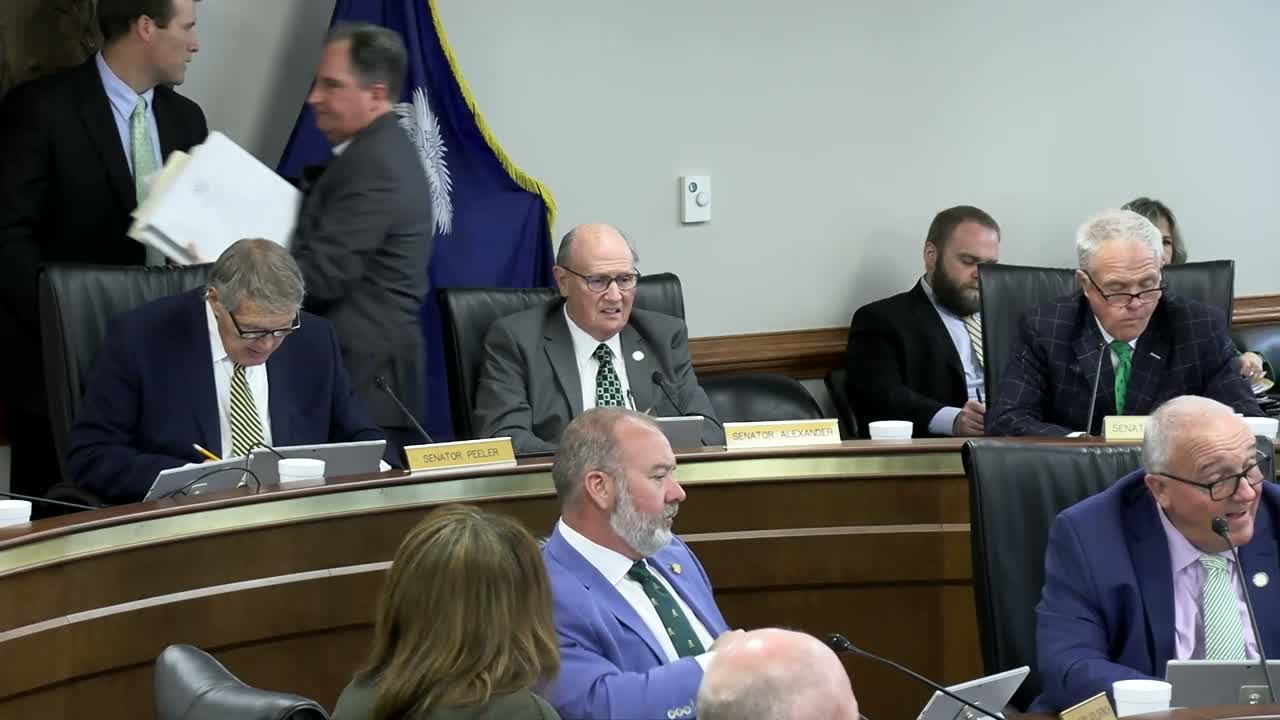
The Senate Finance Committee voted 17–2 to report favorably a bill updating South Carolina’s tax code to conform to the federal Internal Revenue Code through Dec. 31, 2025.
Chairman Graham said the bill "calls for political subdivisions of this state to purchase only US flags or state flags, made in The United States," introducing technical housekeeping language before committee discussion widened to tax conformity questions. The core legislation, a strike-and-insert amendment to H3368, updates the state’s reference date to Dec. 31, 2025, effectively adopting federal changes made in 2024 for purposes of state income tax.
Opponents argued the decision undercuts the General Assembly’s recent move toward decoupling from the federal code. A senator from Dorchester said that decoupling was a deliberate move "to take control of our tax policy," and called reconformity this year "not the right thing for us to do." The senator argued that relying on the federal government — ‘‘an entity that hasn't balanced the budget since 2001’’ — risks forcing the state to follow federal fiscal policy rather than its own priorities.
Supporters said reconformity is necessary for the current tax filing year. Gibson, presenting the bill, explained the technical purpose: "This bill... updates South Carolina's conformity to the IRS code through 12/31/2025." He noted many taxpayers and CPAs are confused about the state’s stance and that reconformity would reduce uncertainty for returns filed this season.
A central implementation question was whether the Department of Revenue should be authorized to auto-amend returns already filed if the law changes. One senator warned that allowing DOR to alter a signed return could conflict with the filer’s sworn statement under penalty of perjury: "When you sign your... state 1040, you're testifying... and to somehow put an amendment to require the DOR to autocorrect means that you're now changing the number where a tax filer swore under penalty of perjury that that number... is correct." Others suggested technical safeguards could limit auto-corrections to only those changes that benefit taxpayers.
Despite concerns, the committee moved the bill forward. The committee chair urged colleagues to act quickly so taxpayers and preparers have certainty before April 15. The measure was given a favorable report, 17 in favor and 2 opposed.
What happens next: The bill will move to the Senate floor, where senators said further adjustments could be made.
Chairman Graham said the bill "calls for political subdivisions of this state to purchase only US flags or state flags, made in The United States," introducing technical housekeeping language before committee discussion widened to tax conformity questions. The core legislation, a strike-and-insert amendment to H3368, updates the state’s reference date to Dec. 31, 2025, effectively adopting federal changes made in 2024 for purposes of state income tax.
Opponents argued the decision undercuts the General Assembly’s recent move toward decoupling from the federal code. A senator from Dorchester said that decoupling was a deliberate move "to take control of our tax policy," and called reconformity this year "not the right thing for us to do." The senator argued that relying on the federal government — ‘‘an entity that hasn't balanced the budget since 2001’’ — risks forcing the state to follow federal fiscal policy rather than its own priorities.
Supporters said reconformity is necessary for the current tax filing year. Gibson, presenting the bill, explained the technical purpose: "This bill... updates South Carolina's conformity to the IRS code through 12/31/2025." He noted many taxpayers and CPAs are confused about the state’s stance and that reconformity would reduce uncertainty for returns filed this season.
A central implementation question was whether the Department of Revenue should be authorized to auto-amend returns already filed if the law changes. One senator warned that allowing DOR to alter a signed return could conflict with the filer’s sworn statement under penalty of perjury: "When you sign your... state 1040, you're testifying... and to somehow put an amendment to require the DOR to autocorrect means that you're now changing the number where a tax filer swore under penalty of perjury that that number... is correct." Others suggested technical safeguards could limit auto-corrections to only those changes that benefit taxpayers.
Despite concerns, the committee moved the bill forward. The committee chair urged colleagues to act quickly so taxpayers and preparers have certainty before April 15. The measure was given a favorable report, 17 in favor and 2 opposed.
What happens next: The bill will move to the Senate floor, where senators said further adjustments could be made.
View the Full Meeting & All Its Details
This article offers just a summary. Unlock complete video, transcripts, and insights as a Founder Member.
✓
Watch full, unedited meeting videos
✓
Search every word spoken in unlimited transcripts
✓
AI summaries & real-time alerts (all government levels)
✓
Permanent access to expanding government content
30-day money-back guarantee
