House passes employment-verification bill expanding use of E-Verify and SAVE (SF 2218)
March 17, 2026 | 2026 House of Representatives, Legislative, Iowa
This article was created by AI summarizing key points discussed. AI makes mistakes, so for full details and context, please refer to the video of the full meeting. Please report any errors so we can fix them. Report an error »
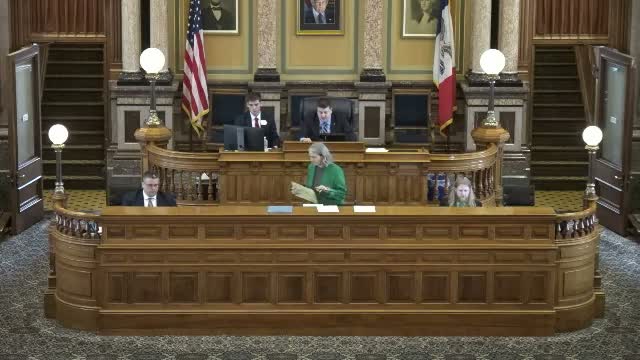
Senate File 2218 was presented on the floor as an employment-verification measure that would require state agencies, regents institutions and certain licensing boards to use federal verification systems (E-Verify and SAVE) to confirm work eligibility for taxpayer-funded jobs and some professional licenses.
Representative Bowden (sponsor) described the bill as establishing centralized verification to confirm lawful presence for applicants to state employment and certain provisional licenses. Proponents argued the measure strengthens safeguards around hiring and licensing and reinforces legal requirements for voting and certain professional privileges.
Opponents including Representative Ramirez and Representative Levin urged a no vote on the amendments that were adopted on the floor, arguing the bill as amended goes beyond its original education-related intent, creates fiscal and constitutional risks, and relies on verification systems that have produced error rates in some contexts. Representative Ramirez expressed concern that inaccurate results could wrongly deny jobs or licenses and that the bill lacked protections to pause denials during appeals.
The House adopted amendments (including H8221 and H8220) on the floor following recorded votes and debate, then moved to final passage. The clerk announced the final tally as 78 ayes, 16 no, and 6 absent; the House declared a constitutional majority and the bill will be transmitted to the Senate.
The transcript records floor amendment activity and policy arguments; it does not include detailed fiscal notes or administrative implementation plans on the floor for the amended bill.
Representative Bowden (sponsor) described the bill as establishing centralized verification to confirm lawful presence for applicants to state employment and certain provisional licenses. Proponents argued the measure strengthens safeguards around hiring and licensing and reinforces legal requirements for voting and certain professional privileges.
Opponents including Representative Ramirez and Representative Levin urged a no vote on the amendments that were adopted on the floor, arguing the bill as amended goes beyond its original education-related intent, creates fiscal and constitutional risks, and relies on verification systems that have produced error rates in some contexts. Representative Ramirez expressed concern that inaccurate results could wrongly deny jobs or licenses and that the bill lacked protections to pause denials during appeals.
The House adopted amendments (including H8221 and H8220) on the floor following recorded votes and debate, then moved to final passage. The clerk announced the final tally as 78 ayes, 16 no, and 6 absent; the House declared a constitutional majority and the bill will be transmitted to the Senate.
The transcript records floor amendment activity and policy arguments; it does not include detailed fiscal notes or administrative implementation plans on the floor for the amended bill.
View the Full Meeting & All Its Details
This article offers just a summary. Unlock complete video, transcripts, and insights as a Founder Member.
✓
Watch full, unedited meeting videos
✓
Search every word spoken in unlimited transcripts
✓
AI summaries & real-time alerts (all government levels)
✓
Permanent access to expanding government content
30-day money-back guarantee
