Senate committee tables ADU bill after debate over coastal exemptions and implementation dates
March 17, 2026 | 2026 Legislature ME, Maine
This article was created by AI summarizing key points discussed. AI makes mistakes, so for full details and context, please refer to the video of the full meeting. Please report any errors so we can fix them. Report an error »
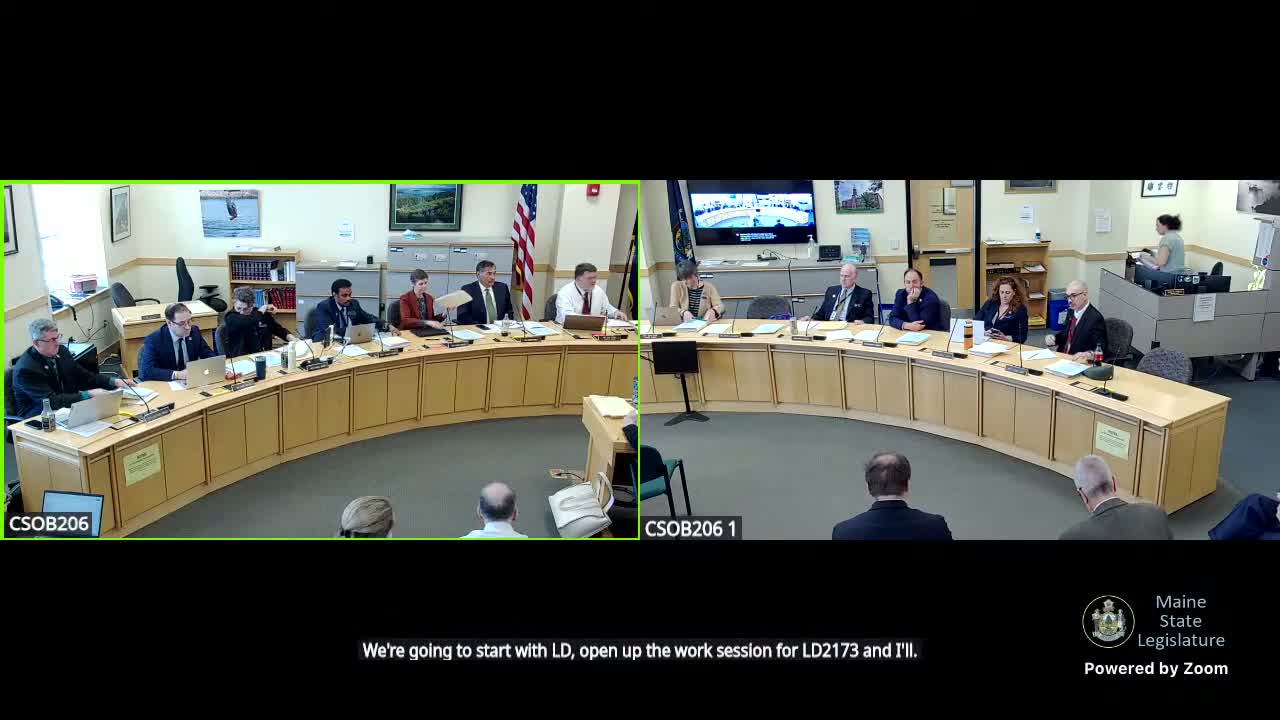
Sen. Chip Curry, chair of the Committee on Housing and Economic Development, opened a work session on LD 2173 and asked analyst Lynn Westfall to summarize an amendment packet that would update state law on accessory dwelling units and related municipal ordinances.
Westfall told the committee the amendment includes technical cross‑reference fixes and fire‑safety adjustments recommended by the State Fire Marshal, keeps the current 105% growth‑rate percentage, and adds language that would allow municipalities to exempt certain mapped areas — "coastal barrier resource areas, special flood hazard areas, coastal sand dune systems and erosion hazard areas" — if a municipality identifies those areas in a comprehensive plan or duly adopted ordinance. "If the erosion hazard area is actually identifiable in the floodplain maps, that is preferable to referencing a DEP rule," Westfall said, noting the committee could add or refine sources if members asked.
Members focused on a pair of consequential policy issues: lot‑size and density changes, and implementation timing. The amendment raises some minimum lot size limits from previous drafts (for example, language referencing a 5,000‑square‑foot minimum was adjusted toward a 15,000‑square‑foot cap in certain places) and clarifies that projects establishing four or fewer dwelling units in a single structure were not intended to trigger planning‑board review when that would be the only applicable trigger. "So that is what that additional language is," Westfall said, explaining the drafting change.
The committee also debated whether the bill's emergency preamble conflicted with a later effective date in the text. Members noted prior LD 1829 set implementation milestones (with a July 1, 2026 compliance date for many municipal obligations), and asked whether the amendment would delay those requirements to July 1, 2027. Westfall said the amendment as drafted does not exempt municipalities from the 07/01/2026 obligations created by LD 1829; rather, certain new provisions in the current amendment would not take effect until 07/01/2027. "This new stuff, you don't have to do until 07/01/2027," Westfall told the committee, while others said the drafting should be clarified so the intent is unambiguous.
The committee also heard technical testimony from Peter Slominski, marine geologist with the Maine Geological Survey, who said erosion hazard areas (EHAs) are subsets of statutorily mapped coastal sand dune systems and are identified in rule as areas expected to experience dynamic erosion over the next 100 years. Slominski highlighted that FEMA flood‑insurance maps define a 1% (100‑year) flood under current conditions and do not account for erosion or future sea‑level rise; he recommended using the statutory dune maps and, where desired, the state's sea‑level‑rise viewer (the Maine Climate Council guidance scenario maps call for planning around roughly 3.9–4 feet of rise by 2100).
After discussion and a brief caucus, Representative Tracy Geer moved to table LD 2173 so staff can incorporate clarifying changes and follow up on maps and implementation language; the motion carried. The committee asked members to send suggested amendments and questions to analyst Lynn Westfall for incorporation before the bill returns to the calendar.
The work session closed with the bill tabled for further language review and outreach.
Westfall told the committee the amendment includes technical cross‑reference fixes and fire‑safety adjustments recommended by the State Fire Marshal, keeps the current 105% growth‑rate percentage, and adds language that would allow municipalities to exempt certain mapped areas — "coastal barrier resource areas, special flood hazard areas, coastal sand dune systems and erosion hazard areas" — if a municipality identifies those areas in a comprehensive plan or duly adopted ordinance. "If the erosion hazard area is actually identifiable in the floodplain maps, that is preferable to referencing a DEP rule," Westfall said, noting the committee could add or refine sources if members asked.
Members focused on a pair of consequential policy issues: lot‑size and density changes, and implementation timing. The amendment raises some minimum lot size limits from previous drafts (for example, language referencing a 5,000‑square‑foot minimum was adjusted toward a 15,000‑square‑foot cap in certain places) and clarifies that projects establishing four or fewer dwelling units in a single structure were not intended to trigger planning‑board review when that would be the only applicable trigger. "So that is what that additional language is," Westfall said, explaining the drafting change.
The committee also debated whether the bill's emergency preamble conflicted with a later effective date in the text. Members noted prior LD 1829 set implementation milestones (with a July 1, 2026 compliance date for many municipal obligations), and asked whether the amendment would delay those requirements to July 1, 2027. Westfall said the amendment as drafted does not exempt municipalities from the 07/01/2026 obligations created by LD 1829; rather, certain new provisions in the current amendment would not take effect until 07/01/2027. "This new stuff, you don't have to do until 07/01/2027," Westfall told the committee, while others said the drafting should be clarified so the intent is unambiguous.
The committee also heard technical testimony from Peter Slominski, marine geologist with the Maine Geological Survey, who said erosion hazard areas (EHAs) are subsets of statutorily mapped coastal sand dune systems and are identified in rule as areas expected to experience dynamic erosion over the next 100 years. Slominski highlighted that FEMA flood‑insurance maps define a 1% (100‑year) flood under current conditions and do not account for erosion or future sea‑level rise; he recommended using the statutory dune maps and, where desired, the state's sea‑level‑rise viewer (the Maine Climate Council guidance scenario maps call for planning around roughly 3.9–4 feet of rise by 2100).
After discussion and a brief caucus, Representative Tracy Geer moved to table LD 2173 so staff can incorporate clarifying changes and follow up on maps and implementation language; the motion carried. The committee asked members to send suggested amendments and questions to analyst Lynn Westfall for incorporation before the bill returns to the calendar.
The work session closed with the bill tabled for further language review and outreach.
View the Full Meeting & All Its Details
This article offers just a summary. Unlock complete video, transcripts, and insights as a Founder Member.
✓
Watch full, unedited meeting videos
✓
Search every word spoken in unlimited transcripts
✓
AI summaries & real-time alerts (all government levels)
✓
Permanent access to expanding government content
30-day money-back guarantee
