Committee advances bill extending tax exemption for large distribution projects after debate over corporate benefit
March 12, 2026 | 2026 Legislature TN, Tennessee
This article was created by AI summarizing key points discussed. AI makes mistakes, so for full details and context, please refer to the video of the full meeting. Please report any errors so we can fix them. Report an error »
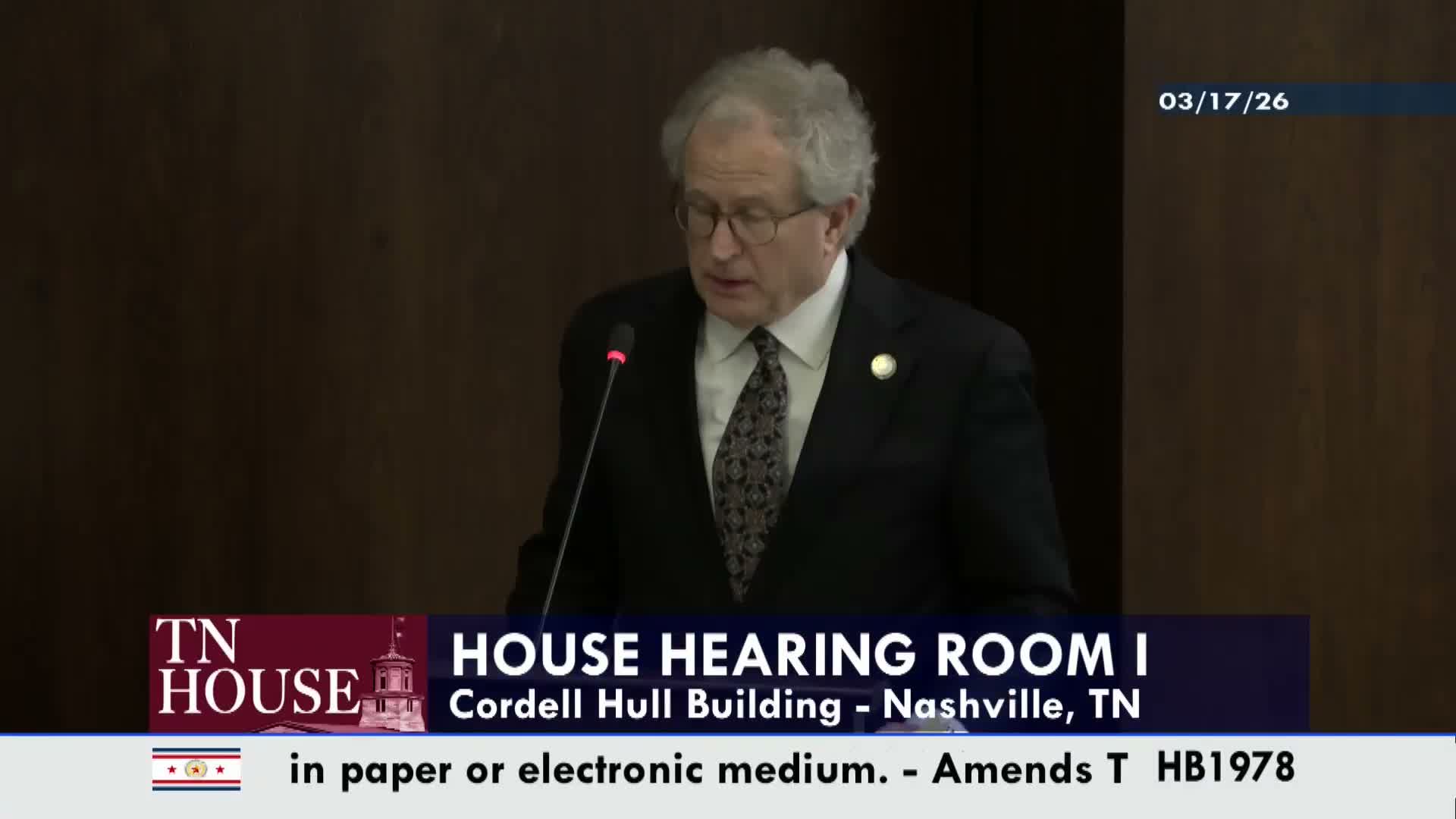
The Tennessee House Finance, Ways and Means Committee voted 17–9 on March 17 to advance House Bill 19-78, which would extend a sales-and-use tax exemption for qualified building materials for large distribution and warehouse projects from 2026 to 2032.
Representative (Chairman) White, sponsor of the measure, said the extension preserves a tax incentive that has helped large employers continue to expand in Tennessee. “As they spend money, the tangible personal property, they can continue to get this tax exemption,” White said, citing ongoing investment in his district and saying he carries the bill for FedEx in Memphis.
Several members pushed back, arguing the benefit appears concentrated and that the state should be cautious about extending foregone revenue indefinitely. “If we do this for one, we should do it for all,” Chairman Williams said, arguing that special treatment creates competitive advantages and noting the committee has debated similar incentives for years.
Joel Hayes of the Office of Legal Services clarified application mechanics: an application for the exemption must be filed with the Department of Revenue prior to October 1, 2026, and the committee recorded that the program targets expansions or renovations of warehouse or distribution facilities with a capital investment threshold discussed by legal staff (clarified in committee as $1,000,000,000). “It allows for an application up until 10/01/2026,” Hayes said, adding it is conceivable more than one entity could apply before that deadline.
Opponents questioned the fiscal impact, disputing a cited estimate of $7 million in foregone revenue and warning about broader revenue implications if many projects claim the exemption. White acknowledged the concern but said the exemption helps retain major employers and attract new investment.
The committee approved an amendment and voted to move the bill to calendar and rules, 17 ayes to 9 nos. The measure will advance to the next stage in the legislative process.
Representative (Chairman) White, sponsor of the measure, said the extension preserves a tax incentive that has helped large employers continue to expand in Tennessee. “As they spend money, the tangible personal property, they can continue to get this tax exemption,” White said, citing ongoing investment in his district and saying he carries the bill for FedEx in Memphis.
Several members pushed back, arguing the benefit appears concentrated and that the state should be cautious about extending foregone revenue indefinitely. “If we do this for one, we should do it for all,” Chairman Williams said, arguing that special treatment creates competitive advantages and noting the committee has debated similar incentives for years.
Joel Hayes of the Office of Legal Services clarified application mechanics: an application for the exemption must be filed with the Department of Revenue prior to October 1, 2026, and the committee recorded that the program targets expansions or renovations of warehouse or distribution facilities with a capital investment threshold discussed by legal staff (clarified in committee as $1,000,000,000). “It allows for an application up until 10/01/2026,” Hayes said, adding it is conceivable more than one entity could apply before that deadline.
Opponents questioned the fiscal impact, disputing a cited estimate of $7 million in foregone revenue and warning about broader revenue implications if many projects claim the exemption. White acknowledged the concern but said the exemption helps retain major employers and attract new investment.
The committee approved an amendment and voted to move the bill to calendar and rules, 17 ayes to 9 nos. The measure will advance to the next stage in the legislative process.
View the Full Meeting & All Its Details
This article offers just a summary. Unlock complete video, transcripts, and insights as a Founder Member.
✓
Watch full, unedited meeting videos
✓
Search every word spoken in unlimited transcripts
✓
AI summaries & real-time alerts (all government levels)
✓
Permanent access to expanding government content
30-day money-back guarantee
