Committee approves county dangerous-dog registry after victim testimony
March 17, 2026 | 2026 Legislature TN, Tennessee
This article was created by AI summarizing key points discussed. AI makes mistakes, so for full details and context, please refer to the video of the full meeting. Please report any errors so we can fix them. Report an error »
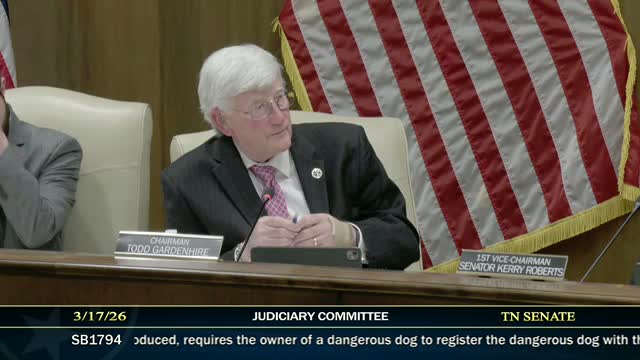
A county-level dangerous-dog registry won committee approval after emotional testimony from a childhood attack survivor and his mother.
Senator Reeves, the bill sponsor, said the registry is intended as a public-safety tool: after an investigation and probable cause finding, a county would list a dog with limited public information and require owners to follow restrictions such as mandatory training, microchipping, confinement standards and liability insurance. Noncompliance could be prosecuted as a Class C misdemeanor and dogs could be seized for persistent violations; animals would be removed from the registry after 18 months with no subsequent incidents.
Brooks Colwell, who testified that he was mauled in March 2024, described long‑term trauma and financial burdens and asked lawmakers to enable future victims to receive accountability he said he did not get. His mother, Alicia Caldwell, added county bite statistics and argued a registry could help families avoid unexpected danger and limit the financial burden on victims by requiring owners to carry liability insurance.
Committee members asked about thresholds for listing and whether vaccination information would be required; the sponsor and language in the bill clarified that “dangerous dog” status is based on injuries and behavior—not breed—and that the registry includes procedural guardrails such as a 60‑day animal control investigation timeline if probable cause is found. The bill specifically exempts service animals and working dogs and forbids listing based solely on breed.
Following the testimony and discussion, the committee voted to advance the bill to the calendar with eight ayes and one no.
Outcome: passed out of committee to calendar; proponents highlighted public safety and information for residents, while opponents cautioned about administrative authority and the role of humane societies in enforcement.
Senator Reeves, the bill sponsor, said the registry is intended as a public-safety tool: after an investigation and probable cause finding, a county would list a dog with limited public information and require owners to follow restrictions such as mandatory training, microchipping, confinement standards and liability insurance. Noncompliance could be prosecuted as a Class C misdemeanor and dogs could be seized for persistent violations; animals would be removed from the registry after 18 months with no subsequent incidents.
Brooks Colwell, who testified that he was mauled in March 2024, described long‑term trauma and financial burdens and asked lawmakers to enable future victims to receive accountability he said he did not get. His mother, Alicia Caldwell, added county bite statistics and argued a registry could help families avoid unexpected danger and limit the financial burden on victims by requiring owners to carry liability insurance.
Committee members asked about thresholds for listing and whether vaccination information would be required; the sponsor and language in the bill clarified that “dangerous dog” status is based on injuries and behavior—not breed—and that the registry includes procedural guardrails such as a 60‑day animal control investigation timeline if probable cause is found. The bill specifically exempts service animals and working dogs and forbids listing based solely on breed.
Following the testimony and discussion, the committee voted to advance the bill to the calendar with eight ayes and one no.
Outcome: passed out of committee to calendar; proponents highlighted public safety and information for residents, while opponents cautioned about administrative authority and the role of humane societies in enforcement.
Don't Miss a Word: See the Full Meeting!
Go beyond summaries. Unlock every video, transcript, and key insight with a Founder Membership.
✓
Get instant access to full meeting videos
✓
Search and clip any phrase from complete transcripts
✓
Receive AI-powered summaries & custom alerts
✓
Enjoy lifetime, unrestricted access to government data
30-day money-back guarantee
