Tennessee committee backs bill to regulate subterranean transit, amid safety and indemnity concerns
March 17, 2026 | 2026 Legislature TN, Tennessee
This article was created by AI summarizing key points discussed. AI makes mistakes, so for full details and context, please refer to the video of the full meeting. Please report any errors so we can fix them. Report an error »
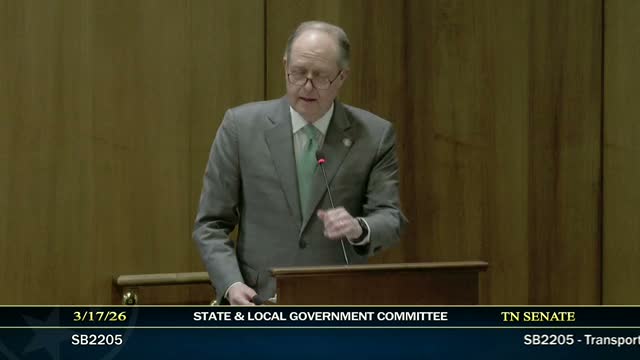
A Tennessee Senate committee on March 17 voted 7–2 to advance legislation that would create a statewide framework for planning, permitting and resolving disputes over subterranean transportation projects such as passenger or freight tunnels using electric or autonomous vehicles. The amendment that makes the bill splits responsibilities between a governor's infrastructure coordination council and a separate Subterranean Transportation Infrastructure Coordination Authority.
Supporters, led on the floor by Leader Johnson, said the measure fills a regulatory gap by centralizing review and establishing timelines and appeal paths for projects that cross multiple local jurisdictions or involve utilities. "This bill will ... allow state agencies to review projects through a single organized framework with defined procedures and timelines," Johnson said, adding the policy aims to limit fragmented permitting and delays.
Opponents and some committee members pressed sponsors on concrete protections for local interests and public safety. Senator Yarbrough asked whether indemnification covers not only property damage but broader economic losses if a disruption — such as utility outages — causes loss of business or conventions; sponsor and staff said the legislative intent is broad indemnification but that specific remediation and bond requirements are currently negotiated in lease agreements administered by state agencies (for example, Department of Transportation agreements used in an existing Nashville–airport project). "That would certainly be the legislative intent," the sponsor said, while acknowledging that remediation language was placed in related lease agreements rather than spelled out in the bill text.
Committee members also raised emergency-response authority and sovereignty concerns after the bill's language appeared to grant operators primary authority for initial responses inside tunnels. Sponsor representatives said the state fire marshal retains oversight on safety protocols, and that operators typically enter interlocal agreements with local emergency-response teams; they pointed to existing examples where coordinated emergency plans were in place.
The sponsor said a revised fiscal note reduced a prior $5 million annual cost estimate and instead projects net positive revenue exceeding $1 million annually from taxation of facilities, with initial one-time costs (reported in the amendment) of roughly $500,000 in year one and $887,000 in subsequent years. The bill now moves to the Finance Committee.
What happens next: The measure advances to Finance, where members said they expect additional debate and possible amendments to tighten indemnification, bonding and emergency-response language.
Supporters, led on the floor by Leader Johnson, said the measure fills a regulatory gap by centralizing review and establishing timelines and appeal paths for projects that cross multiple local jurisdictions or involve utilities. "This bill will ... allow state agencies to review projects through a single organized framework with defined procedures and timelines," Johnson said, adding the policy aims to limit fragmented permitting and delays.
Opponents and some committee members pressed sponsors on concrete protections for local interests and public safety. Senator Yarbrough asked whether indemnification covers not only property damage but broader economic losses if a disruption — such as utility outages — causes loss of business or conventions; sponsor and staff said the legislative intent is broad indemnification but that specific remediation and bond requirements are currently negotiated in lease agreements administered by state agencies (for example, Department of Transportation agreements used in an existing Nashville–airport project). "That would certainly be the legislative intent," the sponsor said, while acknowledging that remediation language was placed in related lease agreements rather than spelled out in the bill text.
Committee members also raised emergency-response authority and sovereignty concerns after the bill's language appeared to grant operators primary authority for initial responses inside tunnels. Sponsor representatives said the state fire marshal retains oversight on safety protocols, and that operators typically enter interlocal agreements with local emergency-response teams; they pointed to existing examples where coordinated emergency plans were in place.
The sponsor said a revised fiscal note reduced a prior $5 million annual cost estimate and instead projects net positive revenue exceeding $1 million annually from taxation of facilities, with initial one-time costs (reported in the amendment) of roughly $500,000 in year one and $887,000 in subsequent years. The bill now moves to the Finance Committee.
What happens next: The measure advances to Finance, where members said they expect additional debate and possible amendments to tighten indemnification, bonding and emergency-response language.
Don't Miss a Word: See the Full Meeting!
Go beyond summaries. Unlock every video, transcript, and key insight with a Founder Membership.
✓
Get instant access to full meeting videos
✓
Search and clip any phrase from complete transcripts
✓
Receive AI-powered summaries & custom alerts
✓
Enjoy lifetime, unrestricted access to government data
30-day money-back guarantee
