Senate committee advances two measures aimed at easing Tennessee's childcare crisis
March 17, 2026 | 2026 Legislature TN, Tennessee
This article was created by AI summarizing key points discussed. AI makes mistakes, so for full details and context, please refer to the video of the full meeting. Please report any errors so we can fix them. Report an error »
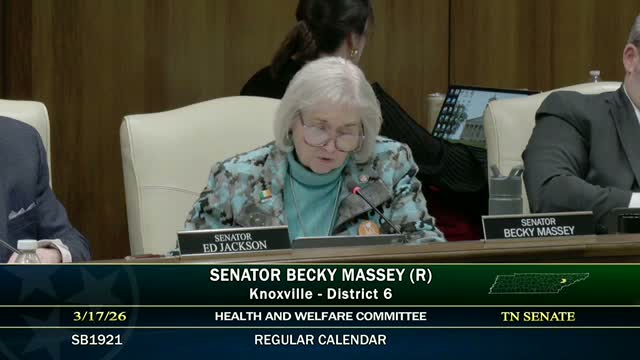
The Senate Health and Welfare Committee advanced multiple bills this session aimed at expanding access to affordable childcare and addressing workforce shortages.
TANF transfer to clear the wait list: Senator Massey's SB 1921 (as amended) would prioritize up to $25 million in TANF funds transferred to the Child Care and Development Fund (CCDF) to reduce the Smart Steps wait list. Callen Baggett, assistant commissioner for the Department of Human Services, told the committee Tennessee received about a $44 million reduction in federal CCDF funding due to formula changes and said the proposed transfer is an eligible use of TANF-to-CCDF funds. Baggett explained the transfer triggers a federal administrative cap of 15%, which could require about $3.5 million of administrative spending if the full transfer is used. Committee members asked whether shifting TANF funds would harm existing TANF services; Baggett said the transfer would prioritize childcare while complying with federal requirements and reporting safeguards.
Promising Futures pilot fund: Senator Watson presented SB 2062 to create the Promising Futures fund and two three-year pilot programs: a childcare workforce scholarship to support recruitment and retention (allocated $5 million) and a "Care Share Tennessee" tri-share pilot (allocated $5 million) where the participant, employer and state each pay roughly a third of childcare costs. Watson said a third-party administrator would contract with DHS to manage employer recruitment and program administration; committee members asked how employers would contribute and how funds would be distributed.
Committee action and fiscal questions: The committee adopted amendments and advanced the measures to finance/ways and means for further consideration. Members pressed DHS on eligibility distinctions, fiscal notes, and program safeguards; questions included whether the transfer could risk federal penalties and how administrative costs would be covered. DHS testified that TANF-to-CCDF transfers are an eligible use and that safeguards in the amendment and a $25 million cap are intended to comply with federal rules.
Next steps: Both measures were moved to the finance committee for fiscal review and further deliberation.
TANF transfer to clear the wait list: Senator Massey's SB 1921 (as amended) would prioritize up to $25 million in TANF funds transferred to the Child Care and Development Fund (CCDF) to reduce the Smart Steps wait list. Callen Baggett, assistant commissioner for the Department of Human Services, told the committee Tennessee received about a $44 million reduction in federal CCDF funding due to formula changes and said the proposed transfer is an eligible use of TANF-to-CCDF funds. Baggett explained the transfer triggers a federal administrative cap of 15%, which could require about $3.5 million of administrative spending if the full transfer is used. Committee members asked whether shifting TANF funds would harm existing TANF services; Baggett said the transfer would prioritize childcare while complying with federal requirements and reporting safeguards.
Promising Futures pilot fund: Senator Watson presented SB 2062 to create the Promising Futures fund and two three-year pilot programs: a childcare workforce scholarship to support recruitment and retention (allocated $5 million) and a "Care Share Tennessee" tri-share pilot (allocated $5 million) where the participant, employer and state each pay roughly a third of childcare costs. Watson said a third-party administrator would contract with DHS to manage employer recruitment and program administration; committee members asked how employers would contribute and how funds would be distributed.
Committee action and fiscal questions: The committee adopted amendments and advanced the measures to finance/ways and means for further consideration. Members pressed DHS on eligibility distinctions, fiscal notes, and program safeguards; questions included whether the transfer could risk federal penalties and how administrative costs would be covered. DHS testified that TANF-to-CCDF transfers are an eligible use and that safeguards in the amendment and a $25 million cap are intended to comply with federal rules.
Next steps: Both measures were moved to the finance committee for fiscal review and further deliberation.
Don't Miss a Word: See the Full Meeting!
Go beyond summaries. Unlock every video, transcript, and key insight with a Founder Membership.
✓
Get instant access to full meeting videos
✓
Search and clip any phrase from complete transcripts
✓
Receive AI-powered summaries & custom alerts
✓
Enjoy lifetime, unrestricted access to government data
30-day money-back guarantee
