Committee holds over PBM ownership restriction bill after witnesses outline large, uncertain fiscal effects
March 17, 2026 | 2026 Legislature TN, Tennessee
This article was created by AI summarizing key points discussed. AI makes mistakes, so for full details and context, please refer to the video of the full meeting. Please report any errors so we can fix them. Report an error »
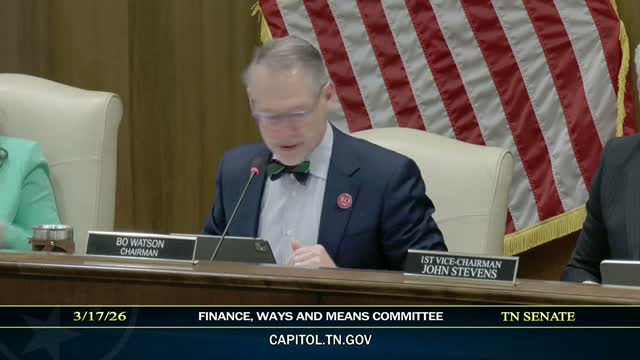
Senate Bill 2040, introduced to the Senate Finance, Ways and Means Committee on March 17, would bar an entity from directly or indirectly owning both a pharmacy and a pharmacy benefit manager (PBM) or health insurer when ownership exceeds 5%, with an effective date of Jan. 1, 2028, and specified exclusions for hospital/system pharmacies, certain orphan/REMS distribution, employer-operated plans and federal contracts.
TennCare Director Steven Smith and Commissioner Jim Bryson told the committee available data indicate the bill could increase state pharmacy spending by tens of millions of dollars. Smith cited a 16% acquisition-cost advantage at certain specialty pharmacies that TennCare's analysis equates to roughly $38 million (about one-third state share) and additional physician-administered specialty impacts of about $6.5 million, plus dispensing-fee shifts estimated at $18 million, resulting in a combined TennCare estimate near $66 million in total fiscal effect and roughly $24 million for the state.
Boyant Savidge, executive director of the Fiscal Review Committee, disputed the underlying assumptions used to reach TennCare's projections. Fiscal Review staff said their fiscal note assumes many PBM-owned pharmacies would not simply close; instead, pharmacies could divest or restructure and remain in-network. Savidge also argued the 16% purchasing-disadvantage assumption is static in TennCare's analysis but procurement advantages and network composition would likely adjust over time, meaning dispensing-fee and acquisition-cost impacts require a dynamic reassessment.
Committee members pressed witnesses on specific details: the current dispensing-fee split (high-volume $9.02; low-volume $13.16) and the high/low-volume pharmacy mix (roughly 68% high volume, 32% low volume), the scope and participation of TennCare's pharmacy cost surveys (about 1,700 pharmacies with ~64% participation), and whether state reimbursement policy and an appeals process would mitigate short-term losses for pharmacists. TennCare said it pays uniformly based on average acquisition cost but has an appeals process for pharmacies to demonstrate atypical market costs.
Members also raised transparency concerns about the state's PBM contract; one senator said a prior exception to open-records rules restricted access to contract details and described difficulty obtaining the document. The sponsor said the bill's effective date and a transition period (including an extension to Dec. 31, 2028, if bona fide sales occur) mean businesses and market structures could change before the law takes effect, complicating precise fiscal forecasting.
After testimony and questioning, the committee agreed, without objection, to hold Senate Bill 2040 over to next week's calendar so members and staff can review fiscal assumptions and proposed amendments. Sponsor said he intends to move two amendments (014996 and 015927) when the bill returns for discussion.
TennCare Director Steven Smith and Commissioner Jim Bryson told the committee available data indicate the bill could increase state pharmacy spending by tens of millions of dollars. Smith cited a 16% acquisition-cost advantage at certain specialty pharmacies that TennCare's analysis equates to roughly $38 million (about one-third state share) and additional physician-administered specialty impacts of about $6.5 million, plus dispensing-fee shifts estimated at $18 million, resulting in a combined TennCare estimate near $66 million in total fiscal effect and roughly $24 million for the state.
Boyant Savidge, executive director of the Fiscal Review Committee, disputed the underlying assumptions used to reach TennCare's projections. Fiscal Review staff said their fiscal note assumes many PBM-owned pharmacies would not simply close; instead, pharmacies could divest or restructure and remain in-network. Savidge also argued the 16% purchasing-disadvantage assumption is static in TennCare's analysis but procurement advantages and network composition would likely adjust over time, meaning dispensing-fee and acquisition-cost impacts require a dynamic reassessment.
Committee members pressed witnesses on specific details: the current dispensing-fee split (high-volume $9.02; low-volume $13.16) and the high/low-volume pharmacy mix (roughly 68% high volume, 32% low volume), the scope and participation of TennCare's pharmacy cost surveys (about 1,700 pharmacies with ~64% participation), and whether state reimbursement policy and an appeals process would mitigate short-term losses for pharmacists. TennCare said it pays uniformly based on average acquisition cost but has an appeals process for pharmacies to demonstrate atypical market costs.
Members also raised transparency concerns about the state's PBM contract; one senator said a prior exception to open-records rules restricted access to contract details and described difficulty obtaining the document. The sponsor said the bill's effective date and a transition period (including an extension to Dec. 31, 2028, if bona fide sales occur) mean businesses and market structures could change before the law takes effect, complicating precise fiscal forecasting.
After testimony and questioning, the committee agreed, without objection, to hold Senate Bill 2040 over to next week's calendar so members and staff can review fiscal assumptions and proposed amendments. Sponsor said he intends to move two amendments (014996 and 015927) when the bill returns for discussion.
Don't Miss a Word: See the Full Meeting!
Go beyond summaries. Unlock every video, transcript, and key insight with a Founder Membership.
✓
Get instant access to full meeting videos
✓
Search and clip any phrase from complete transcripts
✓
Receive AI-powered summaries & custom alerts
✓
Enjoy lifetime, unrestricted access to government data
30-day money-back guarantee
