Joint committee hears push to let Committee for Public Counsel Services staff seek collective bargaining under H.5009
March 16, 2026 | 2026 Legislature MA, Massachusetts
This article was created by AI summarizing key points discussed. AI makes mistakes, so for full details and context, please refer to the video of the full meeting. Please report any errors so we can fix them. Report an error »
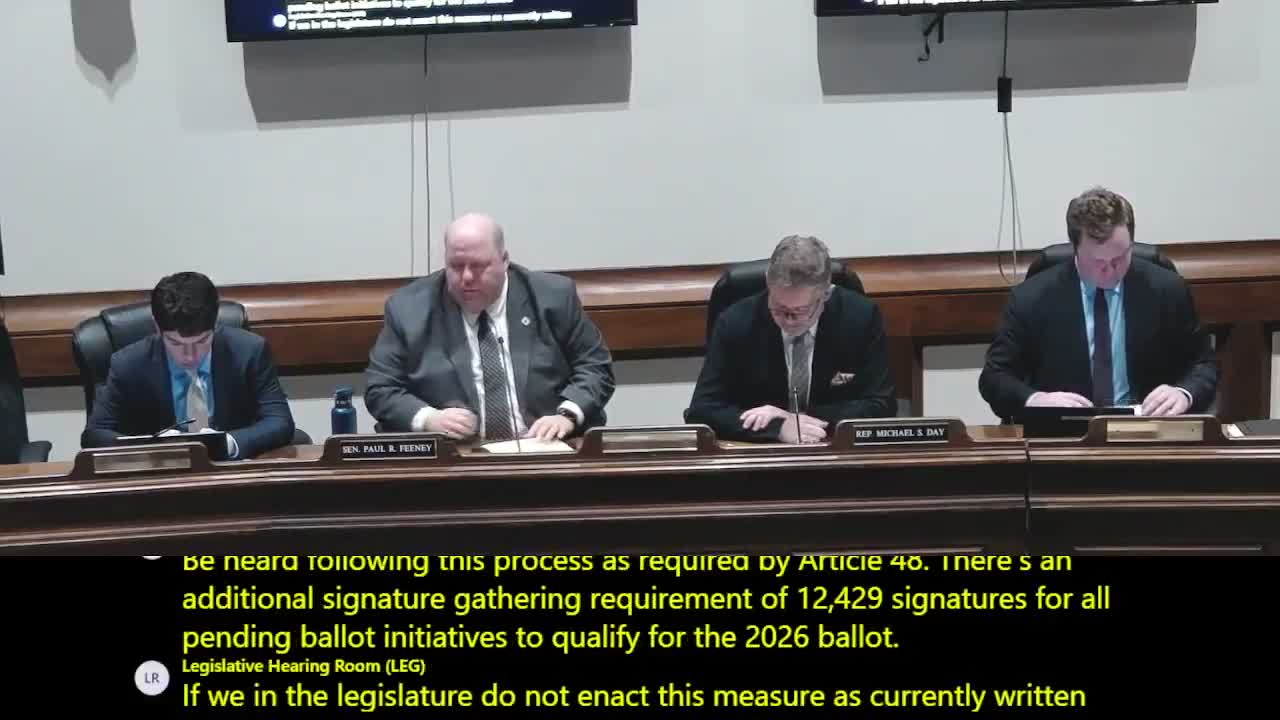
A Special Joint Committee on Initiative Petitions on March 18 examined H.5009 (initiative petition 2522), which would change statutory language to treat the Committee for Public Counsel Services as a public employer for purposes of Massachusetts collective-bargaining law.
The hearing opened with Chair Michael Day and Senate co-chair Paul Feeney laying out the committee's charge under Article 48 of the Massachusetts Constitution and noting petition logistics, including the 12,429 additional signatures required for a 2026 ballot if the legislature does not enact the measure.
"At this hearing, we will accept and hear testimony on initiative petition number 2522, H5009," Day said as the committee opened the record.
Nut graf: Proponents, agency counsel and labor experts agreed the change would open a legal pathway for CPCS staff to pursue recognition through the Department of Labor Relations (DLR), but differed on likely operational impacts. Department of Labor Relations officials said passage would not automatically unionize CPCS employees; proponents argued access to collective bargaining is needed now to address staffing, supervision and retention problems that they say threaten client services.
DLR director Philip Roberts told the committee that the DLR administers public-sector collective-bargaining statutes and would oversee any election or majority-authorization verification if H.5009 were enacted. "Passage of this initiative would not automatically result in the unionization of any or all of the CPCS employees," Roberts said, explaining that unions would still have to demonstrate majority support in an appropriate bargaining unit for a certification to follow.
Marjorie Whitner, special counsel to the DLR and former chair of the Commonwealth Employment Relations Board, summarized three earlier organizing efforts (1978, 1993 and 2015) that were dismissed because tribunals found CPCS or its predecessor did not fall within the statutory definition of a public employer under the applicable chapters of state law (chapter 150E and, in one filing, chapter 150A). Whitner noted prior rulings turned on statutory language and the extent to which the judiciary and executive branch could be treated as an employer for bargaining purposes.
Anthony Benedetti, chief counsel for CPCS, described the agency's statutory role under chapter 211D and the changes the agency is implementing after recent crises in the public defense system. He said CPCS employs roughly 864 people, including about 425 attorneys working in 42 offices across 17 locations, and emphasized that the agency's statutory duties (case-load standards, appointment and compensation procedures) raise operational questions about how collective bargaining would interact with those responsibilities.
Proponents and employees made the case for giving staff access to the bargaining process. Tom McKeever, president of SEIU Local 888, said the measure would simply allow CPCS employees to pursue a bargaining unit and an election under DLR procedures; it would not by itself place a union into statute. McKeever acknowledged that the campaign used paid signature gatherers and said volunteers also contributed to collecting the petitions.
"This would not automatically create a bargaining unit," McKeever said. "It would simply allow CPCS employees access to the same legal process that many other public employees use to determine whether they wish to organize." He told members the proponents' short signature window required professional assistance in parts of the drive.
Several CPCS attorneys described difficult working conditions. "Our caseloads have exploded," said Tanvi Verma, a trial attorney in the Boston public defender division, recounting rapid expansion following the summer crisis and saying junior attorneys and support staff are stretched thin. James Vita, a trial attorney in Fall River, said turnover and insufficient supervision risk undermining the $40 million the legislature has directed to expand CPCS capacity unless retention and workplace conditions improve.
Committee members pressed proponents and agency witnesses on implementation details: how bargaining units would be drawn, whether supervisors or contract (private) attorneys would be included, and what sequence of steps would follow enactment. DLR and proponents agreed the DLR would determine appropriate unit composition before any certification; proponents emphasized a majority-authorization or election process would still be required.
Chair Day raised concerns about paid signature gathering after noting OCPF filings indicating significant spending on some petition drives; proponents acknowledged using paid gatherers and said volunteer support was also substantial.
No opponents had preregistered to testify at the oral hearing. The committee will accept written testimony through Friday, March 20 at 5 p.m. before it closes the record. The hearing adjourned following a motion and unanimous voice vote to close.
The committee did not take formal legislative action on H.5009 at the hearing; committee members asked staff and witnesses for clarification on statutory interactions and implementation steps that would follow any enactment or ballot passage.
The hearing opened with Chair Michael Day and Senate co-chair Paul Feeney laying out the committee's charge under Article 48 of the Massachusetts Constitution and noting petition logistics, including the 12,429 additional signatures required for a 2026 ballot if the legislature does not enact the measure.
"At this hearing, we will accept and hear testimony on initiative petition number 2522, H5009," Day said as the committee opened the record.
Nut graf: Proponents, agency counsel and labor experts agreed the change would open a legal pathway for CPCS staff to pursue recognition through the Department of Labor Relations (DLR), but differed on likely operational impacts. Department of Labor Relations officials said passage would not automatically unionize CPCS employees; proponents argued access to collective bargaining is needed now to address staffing, supervision and retention problems that they say threaten client services.
DLR director Philip Roberts told the committee that the DLR administers public-sector collective-bargaining statutes and would oversee any election or majority-authorization verification if H.5009 were enacted. "Passage of this initiative would not automatically result in the unionization of any or all of the CPCS employees," Roberts said, explaining that unions would still have to demonstrate majority support in an appropriate bargaining unit for a certification to follow.
Marjorie Whitner, special counsel to the DLR and former chair of the Commonwealth Employment Relations Board, summarized three earlier organizing efforts (1978, 1993 and 2015) that were dismissed because tribunals found CPCS or its predecessor did not fall within the statutory definition of a public employer under the applicable chapters of state law (chapter 150E and, in one filing, chapter 150A). Whitner noted prior rulings turned on statutory language and the extent to which the judiciary and executive branch could be treated as an employer for bargaining purposes.
Anthony Benedetti, chief counsel for CPCS, described the agency's statutory role under chapter 211D and the changes the agency is implementing after recent crises in the public defense system. He said CPCS employs roughly 864 people, including about 425 attorneys working in 42 offices across 17 locations, and emphasized that the agency's statutory duties (case-load standards, appointment and compensation procedures) raise operational questions about how collective bargaining would interact with those responsibilities.
Proponents and employees made the case for giving staff access to the bargaining process. Tom McKeever, president of SEIU Local 888, said the measure would simply allow CPCS employees to pursue a bargaining unit and an election under DLR procedures; it would not by itself place a union into statute. McKeever acknowledged that the campaign used paid signature gatherers and said volunteers also contributed to collecting the petitions.
"This would not automatically create a bargaining unit," McKeever said. "It would simply allow CPCS employees access to the same legal process that many other public employees use to determine whether they wish to organize." He told members the proponents' short signature window required professional assistance in parts of the drive.
Several CPCS attorneys described difficult working conditions. "Our caseloads have exploded," said Tanvi Verma, a trial attorney in the Boston public defender division, recounting rapid expansion following the summer crisis and saying junior attorneys and support staff are stretched thin. James Vita, a trial attorney in Fall River, said turnover and insufficient supervision risk undermining the $40 million the legislature has directed to expand CPCS capacity unless retention and workplace conditions improve.
Committee members pressed proponents and agency witnesses on implementation details: how bargaining units would be drawn, whether supervisors or contract (private) attorneys would be included, and what sequence of steps would follow enactment. DLR and proponents agreed the DLR would determine appropriate unit composition before any certification; proponents emphasized a majority-authorization or election process would still be required.
Chair Day raised concerns about paid signature gathering after noting OCPF filings indicating significant spending on some petition drives; proponents acknowledged using paid gatherers and said volunteer support was also substantial.
No opponents had preregistered to testify at the oral hearing. The committee will accept written testimony through Friday, March 20 at 5 p.m. before it closes the record. The hearing adjourned following a motion and unanimous voice vote to close.
The committee did not take formal legislative action on H.5009 at the hearing; committee members asked staff and witnesses for clarification on statutory interactions and implementation steps that would follow any enactment or ballot passage.
Don't Miss a Word: See the Full Meeting!
Go beyond summaries. Unlock every video, transcript, and key insight with a Founder Membership.
✓
Get instant access to full meeting videos
✓
Search and clip any phrase from complete transcripts
✓
Receive AI-powered summaries & custom alerts
✓
Enjoy lifetime, unrestricted access to government data
30-day money-back guarantee
