Joint committee hears sharp debate over ballot measure to allow single‑family homes on 5,000‑sq‑ft lots (H.5000)
March 16, 2026 | 2026 Legislature MA, Massachusetts
This article was created by AI summarizing key points discussed. AI makes mistakes, so for full details and context, please refer to the video of the full meeting. Please report any errors so we can fix them. Report an error »
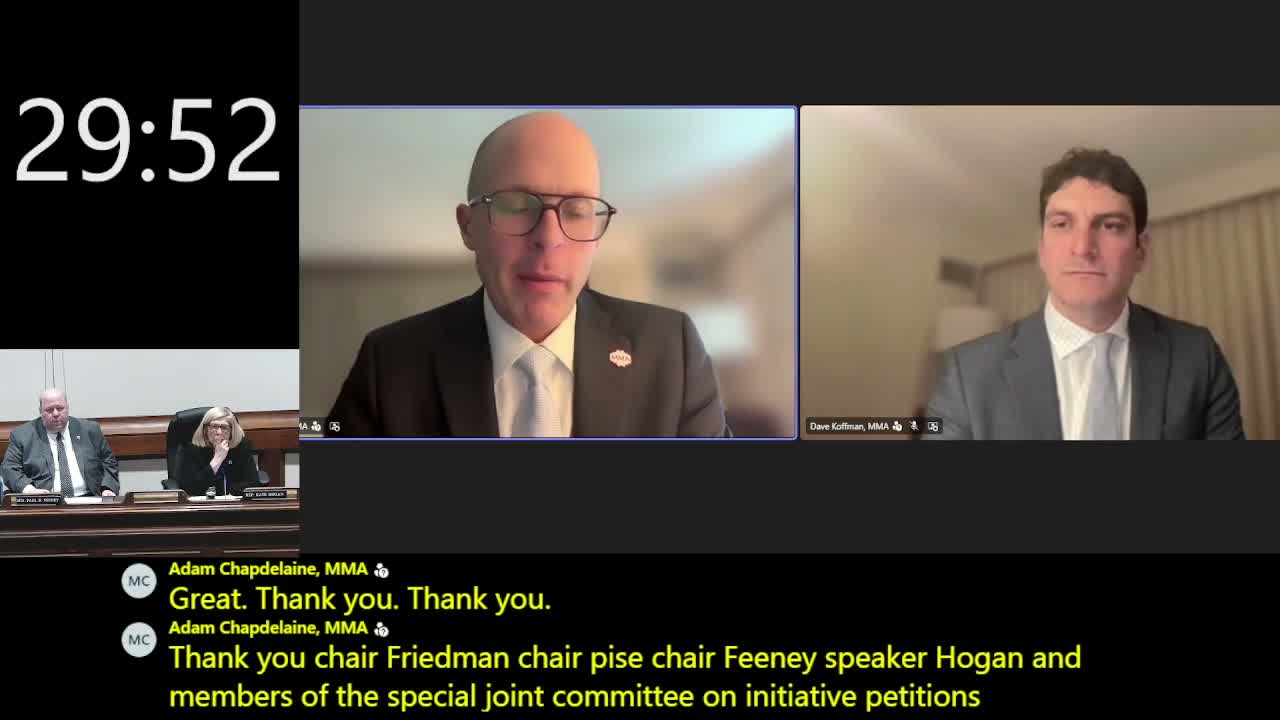
The Special Joint Committee on Initiative Petitions heard nearly three hours of testimony on initiative petition 25‑03 (House Bill 5000), which would amend the Zoning Act (M.G.L. Chapter 40A) to require most Massachusetts cities and towns — excluding Boston — to allow single‑family homes on lots of at least 5,000 square feet with 50 feet of frontage where public water and sewer service is available.
Proponents argued the change would unlock substantial new homebuilding. "This policy will allow for up to nearly 700,000 new buildable lots statewide," said Andrew Mikula, chair of the VOW Committee and a proponent of the petition, citing the campaign's geographic analysis. He and other proponents told the committee that permitting more smaller lots would increase supply, reduce competition for existing homes and help younger buyers and seniors downsize.
"We are trying to make it legal to build single‑family homes on lots as small as 5,000 square feet and as narrow as 50 feet at the street everywhere in Massachusetts that has public sewer and water services," Mikula said, adding that the initiative leaves other controls — wetlands protections, short‑term‑rental rules, setbacks and local design standards — to local law and EOHLC oversight.
Advocates provided supporting data and polling: Jesse Kansen Beninov of Abundant Housing Massachusetts pointed to surveys showing majority public support for lot‑size reform and argued the measure targets a major driver of high home prices. The Charles River Regional Chamber's Max Wolf said businesses face hiring and retention problems tied to housing access in the western suburbs.
Experts and municipal representatives raised multiple practical and legal concerns. Chris Klutchman, Undersecretary for the Livable Communities Division at the Executive Office of Housing and Livable Communities, described the petition's core parameters — 5,000 sq ft minimum, 50 ft frontage and access to public sewer and water — and emphasized unanswered regulatory questions about wetlands, how to define "access" to utility lines, and how moratoria or capacity limits would affect eligibility.
"There are a lot of complications with pre‑existing nonconforming situations in local zoning," Klutchman said, noting that regulations would be needed to clarify developability rules and to address situations where water or sewer service lacks capacity.
Susan Murphy, a land‑use attorney with more than three decades of experience, told the committee that the petition would effect a "radical change" to dimensional rules across local zoning ordinances if read to mandate 5,000‑sq‑ft lots wherever public utilities are present. She flagged five central questions the petition leaves unresolved: its precise scope in relation to existing protections for nonconforming lots, whether it would permit new subdivisions or only protect pre‑existing lots, how it would apply across different zoning districts (commercial, industrial, downtown), what legal meaning "access to public water and sewer" carries when capacity is limited, and the fact that the petition sets no limit on house size.
Municipal officials, represented by the Massachusetts Municipal Association (MMA), urged the committee to take no action. "Any attempt to preempt local process with a one‑size‑fits‑all policy strips local residents and officials of their voice," Adam Chaplin, MMA executive director, told the committee. MMA counsel Ali Dimitayo and senior executive Dave Coffin pointed to wastewater and drinking‑water capacity limits across regions, projects with nine‑ and ten‑figure price tags to expand connections to the MWRA, and the absence of affordability requirements in the petition's language.
Dimitayo told the committee that the ballot text does not address capacity constraints at treatment plants or allocation policies municipalities use; she warned that constructing new subdivisions wherever a line exists — regardless of available treatment capacity — could impose large infrastructure costs on towns and ratepayers.
Committee members pressed both sides on mechanics and tradeoffs: whether smaller lots would actually lower prices in high‑cost suburbs, how the petition would interact with Chapter 40B affordable‑housing rules, and whether the legislature should prefer a negotiated legislative package (for example, incentives under Chapter 40Y or the YIMBY proposals) to a binding statewide mandate enacted by ballot.
Several proponents acknowledged most signature collection was paid. Mikula said the campaign raised about $1.3 million to qualify the measure for the ballot and that only a small share of signatures were gathered by volunteers.
A single registered public commenter, Benjamin Fierro, attorney and lobbyist for the Home Builders and Remodelers Association of Massachusetts, also urged the committee to enact similar reforms, arguing that decades of down‑zoning and high minimum lot sizes have driven land costs up and blocked builder economics for starter homes.
The committee did not take formal action on the petition. Chair Paul Feeney announced that written testimony will be accepted through Friday, March 20 at 5 p.m., and the hearing was closed by voice vote. The committee’s next formal step will depend on the volume and content of the written submissions it receives.
Sources: public hearing before the Special Joint Committee on Initiative Petitions on Initiative Petition 25‑03 (H.5000).
Proponents argued the change would unlock substantial new homebuilding. "This policy will allow for up to nearly 700,000 new buildable lots statewide," said Andrew Mikula, chair of the VOW Committee and a proponent of the petition, citing the campaign's geographic analysis. He and other proponents told the committee that permitting more smaller lots would increase supply, reduce competition for existing homes and help younger buyers and seniors downsize.
"We are trying to make it legal to build single‑family homes on lots as small as 5,000 square feet and as narrow as 50 feet at the street everywhere in Massachusetts that has public sewer and water services," Mikula said, adding that the initiative leaves other controls — wetlands protections, short‑term‑rental rules, setbacks and local design standards — to local law and EOHLC oversight.
Advocates provided supporting data and polling: Jesse Kansen Beninov of Abundant Housing Massachusetts pointed to surveys showing majority public support for lot‑size reform and argued the measure targets a major driver of high home prices. The Charles River Regional Chamber's Max Wolf said businesses face hiring and retention problems tied to housing access in the western suburbs.
Experts and municipal representatives raised multiple practical and legal concerns. Chris Klutchman, Undersecretary for the Livable Communities Division at the Executive Office of Housing and Livable Communities, described the petition's core parameters — 5,000 sq ft minimum, 50 ft frontage and access to public sewer and water — and emphasized unanswered regulatory questions about wetlands, how to define "access" to utility lines, and how moratoria or capacity limits would affect eligibility.
"There are a lot of complications with pre‑existing nonconforming situations in local zoning," Klutchman said, noting that regulations would be needed to clarify developability rules and to address situations where water or sewer service lacks capacity.
Susan Murphy, a land‑use attorney with more than three decades of experience, told the committee that the petition would effect a "radical change" to dimensional rules across local zoning ordinances if read to mandate 5,000‑sq‑ft lots wherever public utilities are present. She flagged five central questions the petition leaves unresolved: its precise scope in relation to existing protections for nonconforming lots, whether it would permit new subdivisions or only protect pre‑existing lots, how it would apply across different zoning districts (commercial, industrial, downtown), what legal meaning "access to public water and sewer" carries when capacity is limited, and the fact that the petition sets no limit on house size.
Municipal officials, represented by the Massachusetts Municipal Association (MMA), urged the committee to take no action. "Any attempt to preempt local process with a one‑size‑fits‑all policy strips local residents and officials of their voice," Adam Chaplin, MMA executive director, told the committee. MMA counsel Ali Dimitayo and senior executive Dave Coffin pointed to wastewater and drinking‑water capacity limits across regions, projects with nine‑ and ten‑figure price tags to expand connections to the MWRA, and the absence of affordability requirements in the petition's language.
Dimitayo told the committee that the ballot text does not address capacity constraints at treatment plants or allocation policies municipalities use; she warned that constructing new subdivisions wherever a line exists — regardless of available treatment capacity — could impose large infrastructure costs on towns and ratepayers.
Committee members pressed both sides on mechanics and tradeoffs: whether smaller lots would actually lower prices in high‑cost suburbs, how the petition would interact with Chapter 40B affordable‑housing rules, and whether the legislature should prefer a negotiated legislative package (for example, incentives under Chapter 40Y or the YIMBY proposals) to a binding statewide mandate enacted by ballot.
Several proponents acknowledged most signature collection was paid. Mikula said the campaign raised about $1.3 million to qualify the measure for the ballot and that only a small share of signatures were gathered by volunteers.
A single registered public commenter, Benjamin Fierro, attorney and lobbyist for the Home Builders and Remodelers Association of Massachusetts, also urged the committee to enact similar reforms, arguing that decades of down‑zoning and high minimum lot sizes have driven land costs up and blocked builder economics for starter homes.
The committee did not take formal action on the petition. Chair Paul Feeney announced that written testimony will be accepted through Friday, March 20 at 5 p.m., and the hearing was closed by voice vote. The committee’s next formal step will depend on the volume and content of the written submissions it receives.
Sources: public hearing before the Special Joint Committee on Initiative Petitions on Initiative Petition 25‑03 (H.5000).
Don't Miss a Word: See the Full Meeting!
Go beyond summaries. Unlock every video, transcript, and key insight with a Founder Membership.
✓
Get instant access to full meeting videos
✓
Search and clip any phrase from complete transcripts
✓
Receive AI-powered summaries & custom alerts
✓
Enjoy lifetime, unrestricted access to government data
30-day money-back guarantee
