Assemblymember Todd’s bill would give microbusinesses $5,000 credit to hire formerly incarcerated workers
March 16, 2026 | California State Assembly, House, Legislative, California
This article was created by AI summarizing key points discussed. AI makes mistakes, so for full details and context, please refer to the video of the full meeting. Please report any errors so we can fix them. Report an error »
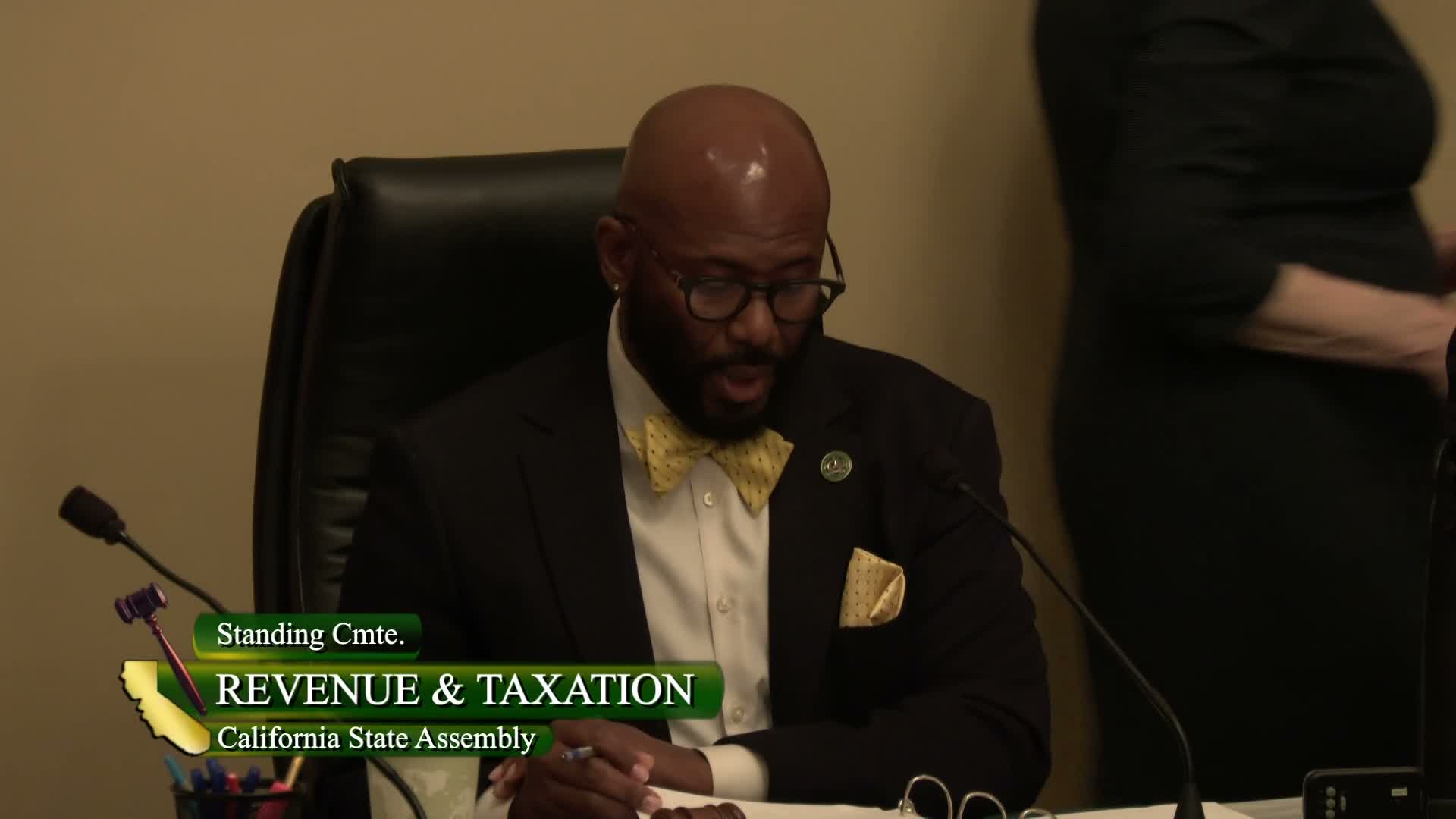
Assemblymember Todd introduced AB 1565 on March 18 before the Assembly Committee on Revenue and Taxation, proposing a $5,000 tax credit for microbusinesses that hire a formerly incarcerated person within one year of release and retain that employee for at least six months.
Supporters argued the credit addresses high unemployment after incarceration and would improve public safety while helping small employers. "According to the California Department of Corrections and Rehabilitation, over 60 percent of formerly incarcerated people are unemployed for a year after release," a presenter said, and later testimony cited a figure that employment within a year can reduce recidivism substantially. Elizabeth Kim, policy director at Initiate Justice and a person with lived experience, said, "People with felony records face enormous barriers to employment," and described how employment changed her own life.
Proponents framed the credit as both compassionate and fiscally prudent. Witnesses contrasted the $5,000 credit with the testimony-supplied figure of roughly $133,000 in annual incarceration costs per person, arguing the program could produce net savings if it reduces rearrests. Advocates also cited the existing Fair Chance Act protections that limit criminal-history questions in hiring, saying the credit would complement those rules for very small employers.
Opponents urged caution. Danny Kando Kaiser of the California Tax Reform Association testified in opposition, saying employment tax credits "have never been shown to be effective in reaching social goals" and that targeted reentry programs funded through budgets can be more efficient.
Committee discussion focused on effectiveness and alternatives. Assemblymember DeMaio asked opposition witnesses to name comparable government programs and pressed for unit-cost comparisons; proponents referenced restorative and reentry programs as complements to a tax-based pilot. No committee vote was held; Chair Trey Gibson referred AB 1565 to the committee's suspense file in accordance with the committee rule that proposals with revenue impacts above $150,000 are not eligible for a vote at this hearing.
The committee took no formal fiscal action on the bill today; the next procedural step will be the suspense-file review and potential referral to Appropriations or another committee if the fiscal analysis supports moving forward.
Supporters argued the credit addresses high unemployment after incarceration and would improve public safety while helping small employers. "According to the California Department of Corrections and Rehabilitation, over 60 percent of formerly incarcerated people are unemployed for a year after release," a presenter said, and later testimony cited a figure that employment within a year can reduce recidivism substantially. Elizabeth Kim, policy director at Initiate Justice and a person with lived experience, said, "People with felony records face enormous barriers to employment," and described how employment changed her own life.
Proponents framed the credit as both compassionate and fiscally prudent. Witnesses contrasted the $5,000 credit with the testimony-supplied figure of roughly $133,000 in annual incarceration costs per person, arguing the program could produce net savings if it reduces rearrests. Advocates also cited the existing Fair Chance Act protections that limit criminal-history questions in hiring, saying the credit would complement those rules for very small employers.
Opponents urged caution. Danny Kando Kaiser of the California Tax Reform Association testified in opposition, saying employment tax credits "have never been shown to be effective in reaching social goals" and that targeted reentry programs funded through budgets can be more efficient.
Committee discussion focused on effectiveness and alternatives. Assemblymember DeMaio asked opposition witnesses to name comparable government programs and pressed for unit-cost comparisons; proponents referenced restorative and reentry programs as complements to a tax-based pilot. No committee vote was held; Chair Trey Gibson referred AB 1565 to the committee's suspense file in accordance with the committee rule that proposals with revenue impacts above $150,000 are not eligible for a vote at this hearing.
The committee took no formal fiscal action on the bill today; the next procedural step will be the suspense-file review and potential referral to Appropriations or another committee if the fiscal analysis supports moving forward.
Don't Miss a Word: See the Full Meeting!
Go beyond summaries. Unlock every video, transcript, and key insight with a Founder Membership.
✓
Get instant access to full meeting videos
✓
Search and clip any phrase from complete transcripts
✓
Receive AI-powered summaries & custom alerts
✓
Enjoy lifetime, unrestricted access to government data
30-day money-back guarantee
