Committee backs statewide cold‑case task force in strike‑and‑insert for House Bill 4799
March 04, 2026 | 2026 Legislature WV, West Virginia
This article was created by AI summarizing key points discussed. AI makes mistakes, so for full details and context, please refer to the video of the full meeting. Please report any errors so we can fix them. Report an error »
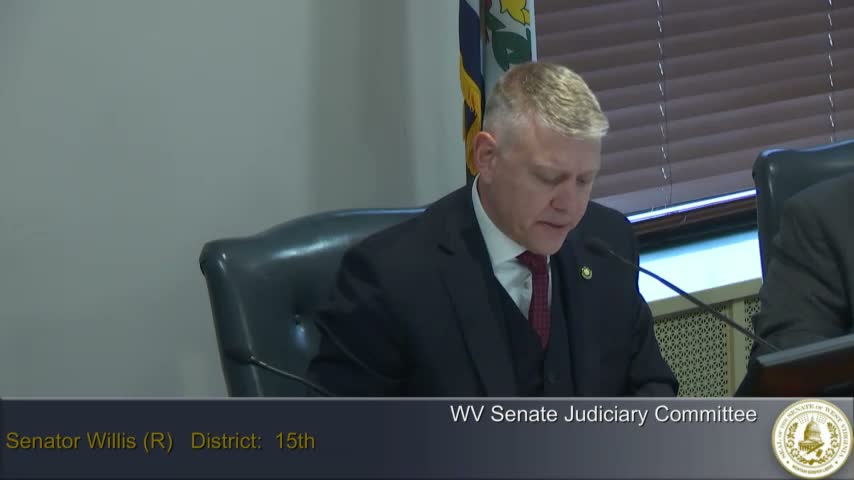
The Senate committee on which this hearing convened adopted a strike‑and‑insert amendment for House Bill 4799 to create a statewide cold‑case task force.
Counsel told the committee the bill establishes an executive board composed of the state superintendent of police and presidents of police chiefs and sheriffs associations but gives the state superintendent the authority to select the task force director and assign state police to the unit "subject to the available funding." Counsel said the director will establish policies and procedures and may use retired state troopers on the task force. The bill creates a Cold Case Task Force Fund at the state treasurer that may be funded by gifts, grants and legislative appropriations; counsel said the legislature must appropriate funds beginning in fiscal year 2028 for the task force to expend money from the fund.
The chair confirmed there is a fiscal note and counsel said it is zero. Counsel also provided the bill's statutory definition of a cold case: an investigation into a qualifying crime, a missing person, or unidentified human remains where all investigative leads have been exhausted and the crime remains unsolved.
Senator from Greenbrier said the state has at least 34 open cold cases "just at first blush" and urged the committee to act so families can get closure. Counsel noted several other states — including Arkansas, Colorado, Maine, Texas, Utah, Wyoming and Connecticut — operate similar task forces.
Senator from Jefferson and others asked whether the task force would supersede local investigations; counsel said the bill expressly does not authorize superseding another agency's ongoing investigation and that the director would be answerable to the state superintendent of police (and, politically, to the governor), but the bill does not create a legislative reporting requirement for the director or executive board. In response to questions about how the task force would prioritize cases, counsel said the executive board may recommend procedures but the director will make operational decisions and internal meetings of the executive board are not FOIA‑able.
The committee called a state police representative to testify. Zach Ott, who identified himself as vice president with the West Virginia Interpreters Association, said "the state police would not overtake other investigations" and described the task force as a cooperative effort that could help "clear the backlog within the state of cold cases." Several senators praised the proposal as a way to supply manpower and cross‑agency cooperation to pursue long‑dormant investigations.
Vice Chair moved adoption of the strike‑and‑insert amendment and then moved that House Bill 4799 as amended be reported to the full Senate with a recommendation that it do pass. Both motions were adopted by voice vote and a title amendment was adopted; the bill will be reported to the full Senate.
The committee did not record a roll‑call vote; the actions were taken by voice vote as reflected in the committee proceedings.
Counsel told the committee the bill establishes an executive board composed of the state superintendent of police and presidents of police chiefs and sheriffs associations but gives the state superintendent the authority to select the task force director and assign state police to the unit "subject to the available funding." Counsel said the director will establish policies and procedures and may use retired state troopers on the task force. The bill creates a Cold Case Task Force Fund at the state treasurer that may be funded by gifts, grants and legislative appropriations; counsel said the legislature must appropriate funds beginning in fiscal year 2028 for the task force to expend money from the fund.
The chair confirmed there is a fiscal note and counsel said it is zero. Counsel also provided the bill's statutory definition of a cold case: an investigation into a qualifying crime, a missing person, or unidentified human remains where all investigative leads have been exhausted and the crime remains unsolved.
Senator from Greenbrier said the state has at least 34 open cold cases "just at first blush" and urged the committee to act so families can get closure. Counsel noted several other states — including Arkansas, Colorado, Maine, Texas, Utah, Wyoming and Connecticut — operate similar task forces.
Senator from Jefferson and others asked whether the task force would supersede local investigations; counsel said the bill expressly does not authorize superseding another agency's ongoing investigation and that the director would be answerable to the state superintendent of police (and, politically, to the governor), but the bill does not create a legislative reporting requirement for the director or executive board. In response to questions about how the task force would prioritize cases, counsel said the executive board may recommend procedures but the director will make operational decisions and internal meetings of the executive board are not FOIA‑able.
The committee called a state police representative to testify. Zach Ott, who identified himself as vice president with the West Virginia Interpreters Association, said "the state police would not overtake other investigations" and described the task force as a cooperative effort that could help "clear the backlog within the state of cold cases." Several senators praised the proposal as a way to supply manpower and cross‑agency cooperation to pursue long‑dormant investigations.
Vice Chair moved adoption of the strike‑and‑insert amendment and then moved that House Bill 4799 as amended be reported to the full Senate with a recommendation that it do pass. Both motions were adopted by voice vote and a title amendment was adopted; the bill will be reported to the full Senate.
The committee did not record a roll‑call vote; the actions were taken by voice vote as reflected in the committee proceedings.
Don't Miss a Word: See the Full Meeting!
Go beyond summaries. Unlock every video, transcript, and key insight with a Founder Membership.
✓
Get instant access to full meeting videos
✓
Search and clip any phrase from complete transcripts
✓
Receive AI-powered summaries & custom alerts
✓
Enjoy lifetime, unrestricted access to government data
30-day money-back guarantee
