DHS outlines Medicaid hospital payments, cites $248 million in cost settlements and $119 million in hospital assessments
March 16, 2026 | 2026 Legislature AR, Arkansas
This article was created by AI summarizing key points discussed. AI makes mistakes, so for full details and context, please refer to the video of the full meeting. Please report any errors so we can fix them. Report an error »
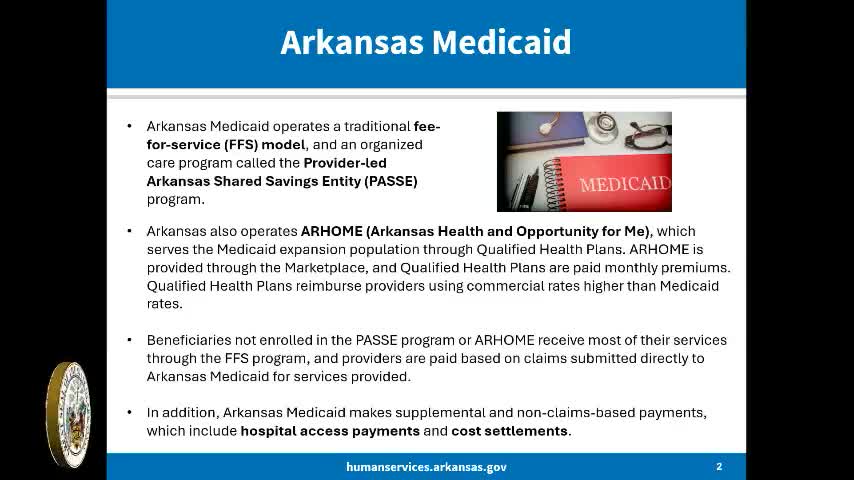
The Arkansas Department of Human Services told the Legislature’s public‑health subcommittee on March 3 that Medicaid hospital payments encompass several programs and substantial supplemental payments.
“Today, we're here, to talk about hospital payments in Arkansas Medicaid,” DHS Secretary Janet Mann said, opening the department’s presentation. Mann and Deputy Secretary Misty Eubanks said Medicaid pays hospitals largely on a fee‑for‑service per‑diem for the fee‑for‑service population, while other beneficiaries receive services through the state’s PASS organized‑care model or through purchased commercial plans for the expansion population.
Mann and Eubanks broke down SFY25 hospital totals: inpatient and outpatient claims about $688,000,000; the upper payment limit (UPL) slot $473,000,000; cost settlements $248,000,000; and a smaller category for graduate medical education and disproportionate‑share payments of roughly $47,000,000. Eubanks described cost settlements as "lump sum payments to a hospital provider to shore up the difference between what it costs to provide the services to Medicaid fee‑for‑service versus how much the hospital would have received from a different rate program." The department said the state share required to fund the cost settlements is about $68,000,000 annually.
Eubanks explained the UPL program is a federally defined mechanism: states calculate the difference between Medicaid payments and the Medicare limit, then use hospital assessment or access payments (the state share) to draw federal matching funds. She said assessment fees in SFY25 totaled $119,000,000 (excluding some children's and public‑hospital flows) and that supplemental payments to hospitals after federal match totaled $548,000,000; DHS said no general revenue was used for that supplemental total.
Members pressed DHS for more data. Representative Carolyn Brown asked for a plain‑English definition of a cost settlement; Representative Beatty asked that exhibits reporting dollar totals be augmented with unduplicated counts of Arkansans served. DHS said it would ask its data team whether claims can be tied back to unduplicated individuals for inpatient and outpatient claims and return that information offline.
Committee members also questioned why per‑diem rates vary widely. Eubanks said some differences are historical: critical access hospitals (25 beds or fewer) have historically higher per‑diems and some large public institutions such as UAMS and Arkansas Children’s have distinct per‑diem structures to address unique costs. Eubanks said DHS calculates UPL annually, applies a uniform state‑share methodology across hospitals, and routes the assessment and distribution work through its contractors and CMS review.
The department said it will continue to provide the committee with more detailed cost‑reporting methodology and to work with hospitals and the hospital association on technical questions.
The subcommittee did not take formal action; DHS remained available for follow‑up and said it would supply additional data requested by legislators.
“Today, we're here, to talk about hospital payments in Arkansas Medicaid,” DHS Secretary Janet Mann said, opening the department’s presentation. Mann and Deputy Secretary Misty Eubanks said Medicaid pays hospitals largely on a fee‑for‑service per‑diem for the fee‑for‑service population, while other beneficiaries receive services through the state’s PASS organized‑care model or through purchased commercial plans for the expansion population.
Mann and Eubanks broke down SFY25 hospital totals: inpatient and outpatient claims about $688,000,000; the upper payment limit (UPL) slot $473,000,000; cost settlements $248,000,000; and a smaller category for graduate medical education and disproportionate‑share payments of roughly $47,000,000. Eubanks described cost settlements as "lump sum payments to a hospital provider to shore up the difference between what it costs to provide the services to Medicaid fee‑for‑service versus how much the hospital would have received from a different rate program." The department said the state share required to fund the cost settlements is about $68,000,000 annually.
Eubanks explained the UPL program is a federally defined mechanism: states calculate the difference between Medicaid payments and the Medicare limit, then use hospital assessment or access payments (the state share) to draw federal matching funds. She said assessment fees in SFY25 totaled $119,000,000 (excluding some children's and public‑hospital flows) and that supplemental payments to hospitals after federal match totaled $548,000,000; DHS said no general revenue was used for that supplemental total.
Members pressed DHS for more data. Representative Carolyn Brown asked for a plain‑English definition of a cost settlement; Representative Beatty asked that exhibits reporting dollar totals be augmented with unduplicated counts of Arkansans served. DHS said it would ask its data team whether claims can be tied back to unduplicated individuals for inpatient and outpatient claims and return that information offline.
Committee members also questioned why per‑diem rates vary widely. Eubanks said some differences are historical: critical access hospitals (25 beds or fewer) have historically higher per‑diems and some large public institutions such as UAMS and Arkansas Children’s have distinct per‑diem structures to address unique costs. Eubanks said DHS calculates UPL annually, applies a uniform state‑share methodology across hospitals, and routes the assessment and distribution work through its contractors and CMS review.
The department said it will continue to provide the committee with more detailed cost‑reporting methodology and to work with hospitals and the hospital association on technical questions.
The subcommittee did not take formal action; DHS remained available for follow‑up and said it would supply additional data requested by legislators.
Don't Miss a Word: See the Full Meeting!
Go beyond summaries. Unlock every video, transcript, and key insight with a Founder Membership.
✓
Get instant access to full meeting videos
✓
Search and clip any phrase from complete transcripts
✓
Receive AI-powered summaries & custom alerts
✓
Enjoy lifetime, unrestricted access to government data
30-day money-back guarantee
