Hospital association: Arkansas hospitals paid far less than neighboring states, survey to take 12 months
March 16, 2026 | 2026 Legislature AR, Arkansas
This article was created by AI summarizing key points discussed. AI makes mistakes, so for full details and context, please refer to the video of the full meeting. Please report any errors so we can fix them. Report an error »
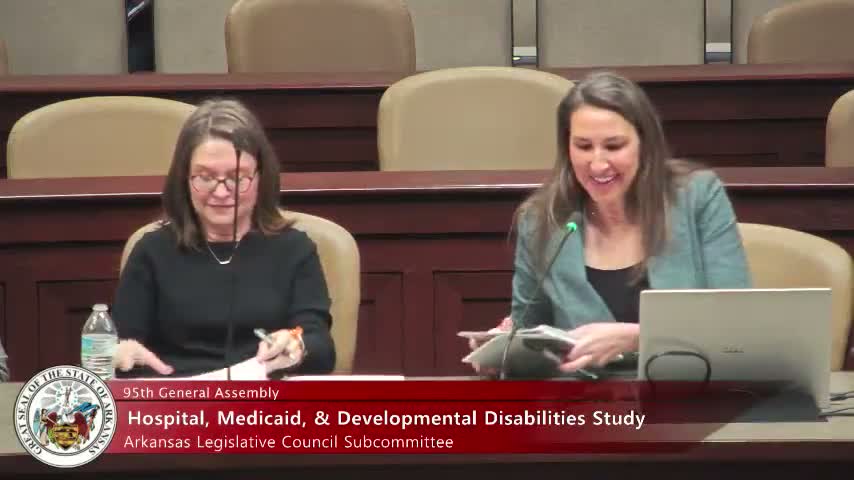
Jodi Ann Trit, executive vice president of the Arkansas Hospital Association, told the subcommittee that Arkansas hospitals operate under acute financial strain and that commercial and Medicare payment differences contribute to the stress.
"Hospitals contribute $18,500,000,000 to the economy each year," Trit said as she summarized the broader economic role of hospitals and then framed why payment shortfalls matter. Trit presented a 2024 regional comparison of average per‑patient payments that showed Arkansas at about $8,842.50 compared with Texas at $17,346.60, Oklahoma $14,567.20, Tennessee $13,618.60 and Mississippi $12,517.20.
Trit said those regional gaps drive a revenue disadvantage: "If every patient costs $10,000, then we're losing $1,200 every patient," she told members. She described how the assessment/UPL mechanisms improve Medicaid coverage of costs — raising Medicaid reimbursement from about $0.52–$0.53 on the dollar to roughly $0.78 — but said hospitals still generally operate at a loss on net patient revenue.
Committee members pressed for current financial data. Senator Lubb asked whether the association had updated hospital financial assessments; Trit said the board authorized a statewide survey of members to gather current cost and margin information, and estimated the work would take about 12 months to complete and be available prior to the 2027 session.
Members and the association discussed commercial payer behavior (prior authorization and administrative delay) and whether medical loss ratio transparency or other policy options should be considered to address commercial reimbursement shortfalls.
Trit also noted that hospital types and federal designations (critical access, rural emergency hospitals, PPS/specialty hospitals) affect reimbursement and cash flow, and that Arkansas is disadvantaged by the federal area‑wage index and Medicare payment structures.
The association said it will continue to work with DHS and legislators and offered to return with more precise economic impact and survey results once available.
"Hospitals contribute $18,500,000,000 to the economy each year," Trit said as she summarized the broader economic role of hospitals and then framed why payment shortfalls matter. Trit presented a 2024 regional comparison of average per‑patient payments that showed Arkansas at about $8,842.50 compared with Texas at $17,346.60, Oklahoma $14,567.20, Tennessee $13,618.60 and Mississippi $12,517.20.
Trit said those regional gaps drive a revenue disadvantage: "If every patient costs $10,000, then we're losing $1,200 every patient," she told members. She described how the assessment/UPL mechanisms improve Medicaid coverage of costs — raising Medicaid reimbursement from about $0.52–$0.53 on the dollar to roughly $0.78 — but said hospitals still generally operate at a loss on net patient revenue.
Committee members pressed for current financial data. Senator Lubb asked whether the association had updated hospital financial assessments; Trit said the board authorized a statewide survey of members to gather current cost and margin information, and estimated the work would take about 12 months to complete and be available prior to the 2027 session.
Members and the association discussed commercial payer behavior (prior authorization and administrative delay) and whether medical loss ratio transparency or other policy options should be considered to address commercial reimbursement shortfalls.
Trit also noted that hospital types and federal designations (critical access, rural emergency hospitals, PPS/specialty hospitals) affect reimbursement and cash flow, and that Arkansas is disadvantaged by the federal area‑wage index and Medicare payment structures.
The association said it will continue to work with DHS and legislators and offered to return with more precise economic impact and survey results once available.
Don't Miss a Word: See the Full Meeting!
Go beyond summaries. Unlock every video, transcript, and key insight with a Founder Membership.
✓
Get instant access to full meeting videos
✓
Search and clip any phrase from complete transcripts
✓
Receive AI-powered summaries & custom alerts
✓
Enjoy lifetime, unrestricted access to government data
30-day money-back guarantee
