Transit Enhancement program reports $11 million spent and coordination with CapMetro as projects move forward
March 16, 2026 | Austin, Travis County, Texas
This article was created by AI summarizing key points discussed. AI makes mistakes, so for full details and context, please refer to the video of the full meeting. Please report any errors so we can fix them. Report an error »
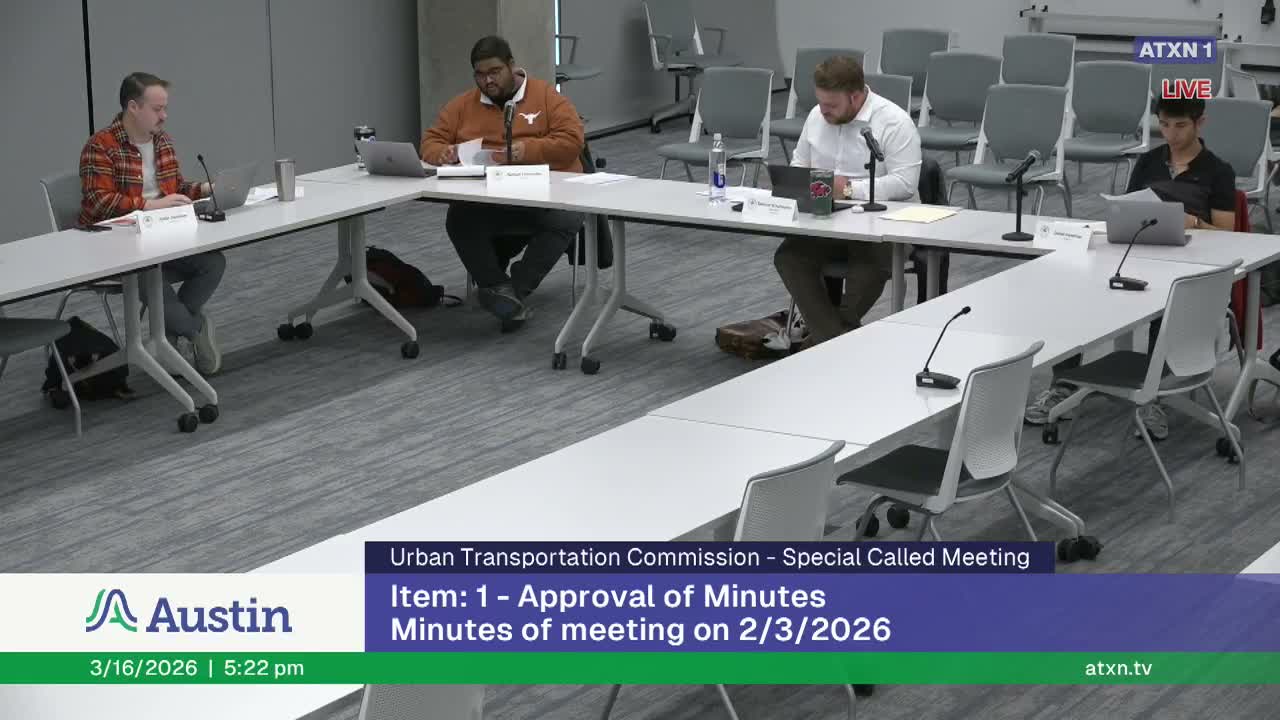
Max Schwartz, Capital Improvement Program Manager with Austin Transportation and Public Works, told the Urban Transportation Commission that the Transit Enhancement program has encumbered "about 86% of our total funding" from the 2020 Mobility Bond and had spent approximately $11 million as of February, with $3 million in projects under construction and $1 million in design.
The program, Schwartz said, is guided by a Transit Enhancement Infrastructure Report that identifies roughly $50 million in potential improvements across about 30 prioritized locations. It works under an interlocal agreement with CapMetro to deliver bus stop upgrades, access improvements and transit-priority infrastructure. "We build out about $1,000,000 a year in infrastructure, which we build back to CapMetro as we go along," Schwartz said, describing day‑to‑day coordination with CapMetro staff.
Schwartz reviewed recent accomplishments: five transit queue jumps, more than eight miles of transit-priority lanes, 66 access improvements (mostly crossings and sidewalks) and 82 upgraded bus stops. He described Trinity and San Jacinto as a recent larger project that reallocated curb space to a transit-priority lane and protected bike facilities; the project, he said, reduced measured crash costs by 56% and produced an estimated $10 million in societal cost savings.
Commissioners asked about priorities, decisions on where to apply red surfacing, and enforcement. Schwartz said surfacing choices are "context sensitive" and that the red material used in some bus lanes is a costly methyl methacrylate product applied where most effective. On enforcement, he noted options used elsewhere but said video enforcement is not permitted under Texas state law: "Across the country, some municipalities use video enforcement. That is not allowed by state law here," he said, adding that TPW favors design-based compliance (striping, signage and red surfacing) and in-person enforcement when needed.
What’s next: Schwartz said the program is continuing preliminary engineering, design and construction work funded by the 2020 bond allocation and other grants; commissioners and staff agreed to continue coordination with CapMetro on routing and enforcement strategies.
The presentation and exchange ran without a formal action item; commissioners thanked staff for the update and invited follow-up questions after the meeting.
The program, Schwartz said, is guided by a Transit Enhancement Infrastructure Report that identifies roughly $50 million in potential improvements across about 30 prioritized locations. It works under an interlocal agreement with CapMetro to deliver bus stop upgrades, access improvements and transit-priority infrastructure. "We build out about $1,000,000 a year in infrastructure, which we build back to CapMetro as we go along," Schwartz said, describing day‑to‑day coordination with CapMetro staff.
Schwartz reviewed recent accomplishments: five transit queue jumps, more than eight miles of transit-priority lanes, 66 access improvements (mostly crossings and sidewalks) and 82 upgraded bus stops. He described Trinity and San Jacinto as a recent larger project that reallocated curb space to a transit-priority lane and protected bike facilities; the project, he said, reduced measured crash costs by 56% and produced an estimated $10 million in societal cost savings.
Commissioners asked about priorities, decisions on where to apply red surfacing, and enforcement. Schwartz said surfacing choices are "context sensitive" and that the red material used in some bus lanes is a costly methyl methacrylate product applied where most effective. On enforcement, he noted options used elsewhere but said video enforcement is not permitted under Texas state law: "Across the country, some municipalities use video enforcement. That is not allowed by state law here," he said, adding that TPW favors design-based compliance (striping, signage and red surfacing) and in-person enforcement when needed.
What’s next: Schwartz said the program is continuing preliminary engineering, design and construction work funded by the 2020 bond allocation and other grants; commissioners and staff agreed to continue coordination with CapMetro on routing and enforcement strategies.
The presentation and exchange ran without a formal action item; commissioners thanked staff for the update and invited follow-up questions after the meeting.
View the Full Meeting & All Its Details
This article offers just a summary. Unlock complete video, transcripts, and insights as a Founder Member.
✓
Watch full, unedited meeting videos
✓
Search every word spoken in unlimited transcripts
✓
AI summaries & real-time alerts (all government levels)
✓
Permanent access to expanding government content
30-day money-back guarantee
