Committee advances bill to require legislative ratification, punish 'faithless' Article V delegates
March 16, 2026 | 2026 Legislature Arizona, Arizona
This article was created by AI summarizing key points discussed. AI makes mistakes, so for full details and context, please refer to the video of the full meeting. Please report any errors so we can fix them. Report an error »
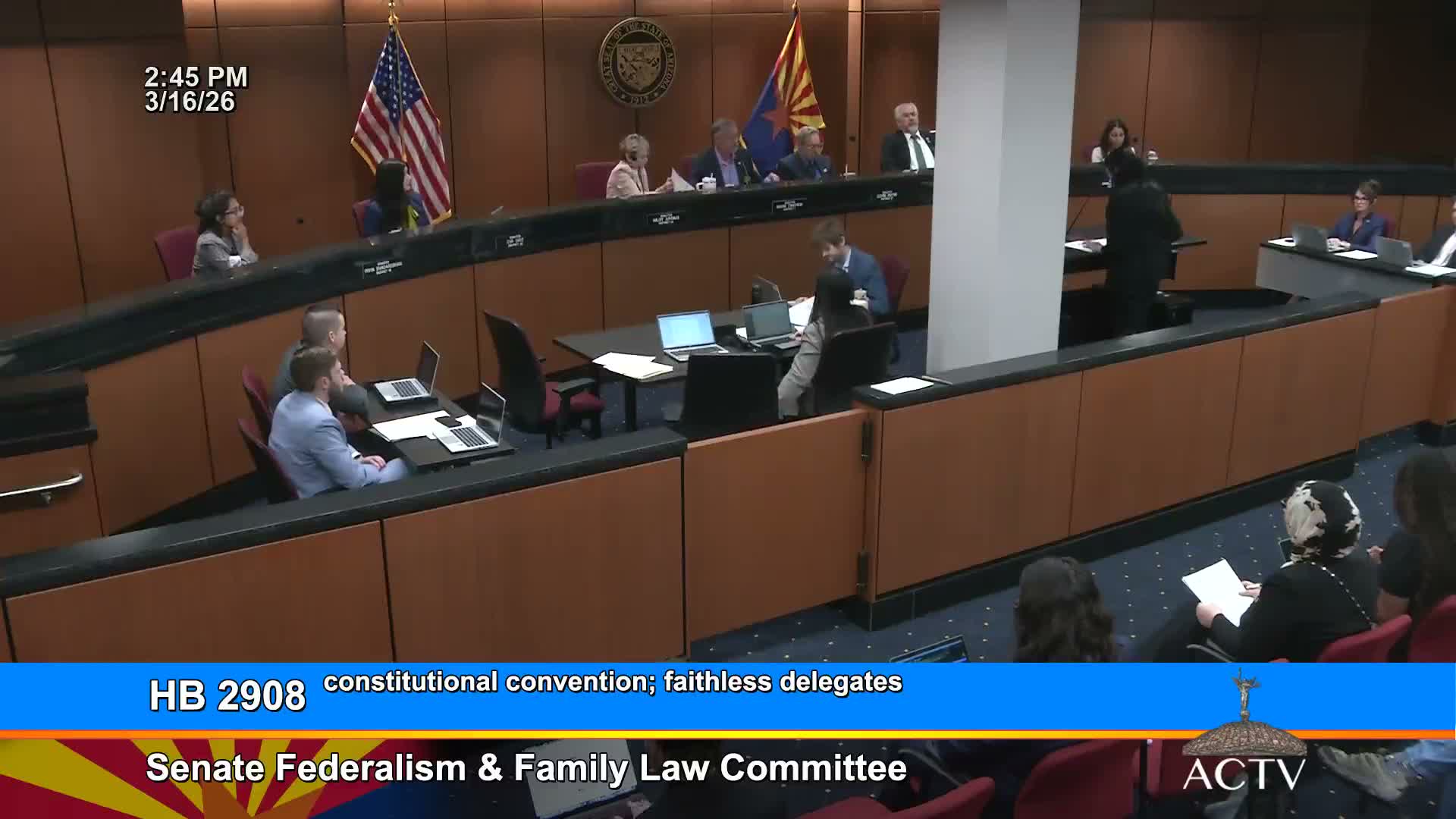
The Senate Federalism and Law Committee on March 12 passed House Bill 2908 as amended, advancing a measure that would require any amendment to the U.S. Constitution affecting Arizona to be ratified by a bill passed by both chambers and signed by the governor.
Sponsor Representative Collin said the bill is procedural, not a statement on whether an Article V convention is desirable, and called it “something better than nothing” as a set of guardrails if a convention ever produces a proposed amendment. The measure requires convention delegates to take an oath before appointment, obliges delegates who observe a violation by another delegate to report it to the attorney general and legislative leaders, and defines a “faithless delegate.” The bill prescribes a civil penalty of at least $5,000 and makes knowingly acting as a faithless delegate a class 2 felony. A two‑page amendment dated March 12 would disqualify a faithless delegate immediately and give the senate president and the speaker of the house authority to determine disqualification.
Opponents, including Hugo Polanco of Common Cause, warned the committee that state laws cannot meaningfully constrain a constitutional convention. “There are no safeguards that would actually work. None,” Polanco testified, arguing Article V gives states limited control over delegates and that a convention could act by one package vote, making recall or disqualification ineffective. Representative Collin and the chair said penalties and a requirement that ratification occur by ordinary legislation create legal and political checks on any convention action.
Committee members pressed the sponsor on timing and enforcement: whether disqualification could occur before a faithless vote affects a convention outcome, and whether wealthy actors could circumvent monetary penalties. Collin said criminal penalties and the prospect of judicial review create significant risks for delegates who exceed the call. The chair described procedural options — including requiring written vote slips approved by legislative leaders — as potential ways to spot and remove unfaithful delegates during a voting process.
The committee adopted the Finchem amendment and then moved HB 2908 as amended. The chair announced the bill passed by a roll call vote of 4 ayes, 3 nays, 0 not voting. The measure will now proceed to the next step in the legislative process.
Provenance: The committee first heard the bill and amendment in SEG 038; deliberations and the final roll call appear through SEG 601.
Sponsor Representative Collin said the bill is procedural, not a statement on whether an Article V convention is desirable, and called it “something better than nothing” as a set of guardrails if a convention ever produces a proposed amendment. The measure requires convention delegates to take an oath before appointment, obliges delegates who observe a violation by another delegate to report it to the attorney general and legislative leaders, and defines a “faithless delegate.” The bill prescribes a civil penalty of at least $5,000 and makes knowingly acting as a faithless delegate a class 2 felony. A two‑page amendment dated March 12 would disqualify a faithless delegate immediately and give the senate president and the speaker of the house authority to determine disqualification.
Opponents, including Hugo Polanco of Common Cause, warned the committee that state laws cannot meaningfully constrain a constitutional convention. “There are no safeguards that would actually work. None,” Polanco testified, arguing Article V gives states limited control over delegates and that a convention could act by one package vote, making recall or disqualification ineffective. Representative Collin and the chair said penalties and a requirement that ratification occur by ordinary legislation create legal and political checks on any convention action.
Committee members pressed the sponsor on timing and enforcement: whether disqualification could occur before a faithless vote affects a convention outcome, and whether wealthy actors could circumvent monetary penalties. Collin said criminal penalties and the prospect of judicial review create significant risks for delegates who exceed the call. The chair described procedural options — including requiring written vote slips approved by legislative leaders — as potential ways to spot and remove unfaithful delegates during a voting process.
The committee adopted the Finchem amendment and then moved HB 2908 as amended. The chair announced the bill passed by a roll call vote of 4 ayes, 3 nays, 0 not voting. The measure will now proceed to the next step in the legislative process.
Provenance: The committee first heard the bill and amendment in SEG 038; deliberations and the final roll call appear through SEG 601.
View the Full Meeting & All Its Details
This article offers just a summary. Unlock complete video, transcripts, and insights as a Founder Member.
✓
Watch full, unedited meeting videos
✓
Search every word spoken in unlimited transcripts
✓
AI summaries & real-time alerts (all government levels)
✓
Permanent access to expanding government content
30-day money-back guarantee
