Committee approves two memorials urging federal review of Muslim organizations after hours of testimony
March 16, 2026 | 2026 Legislature Arizona, Arizona
This article was created by AI summarizing key points discussed. AI makes mistakes, so for full details and context, please refer to the video of the full meeting. Please report any errors so we can fix them. Report an error »
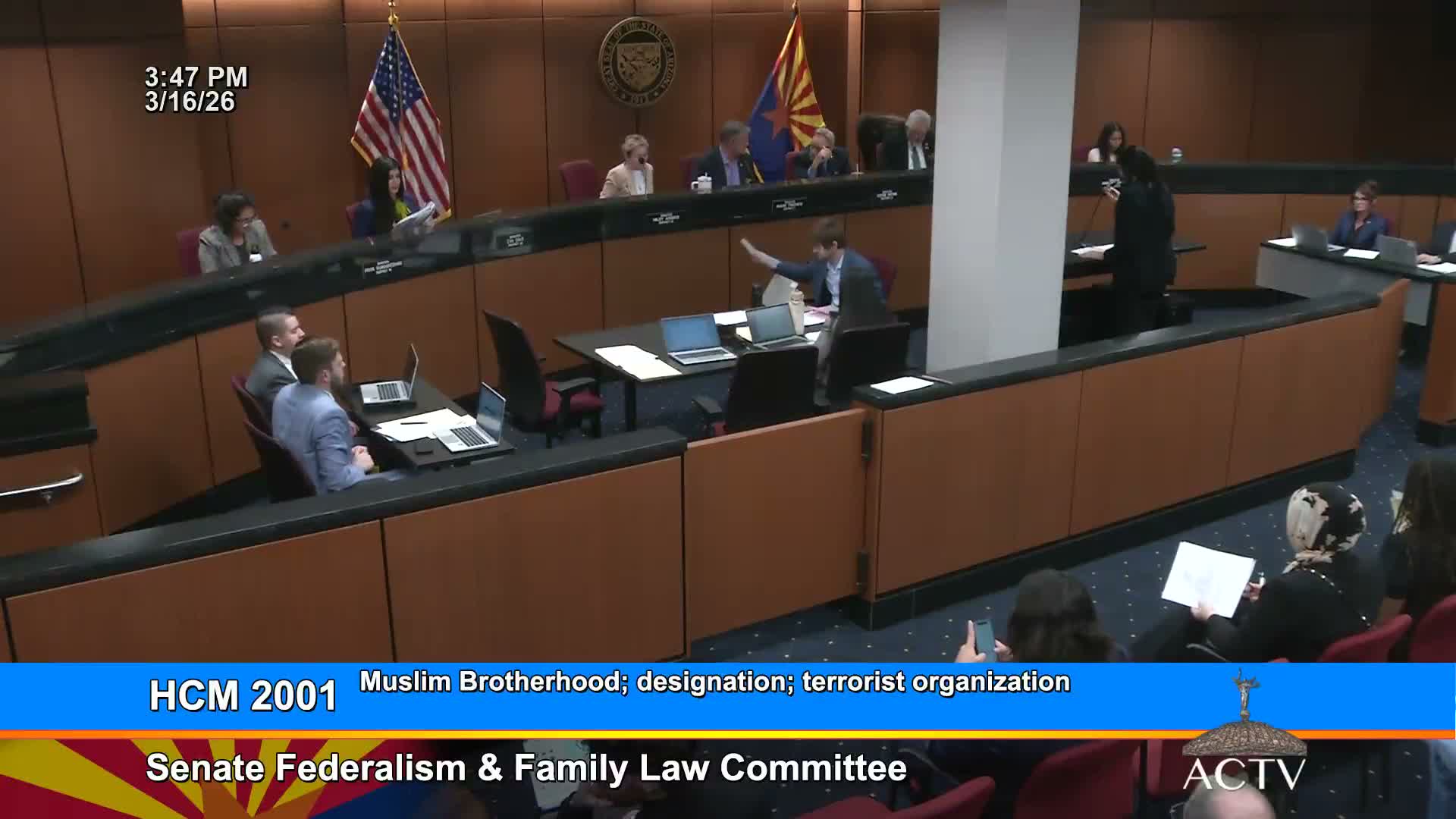
The Senate Federalism and Law Committee advanced two related memorials on March 12: HCM 2001, which urges the U.S. president and Congress to designate the Muslim Brotherhood as a foreign terrorist organization, and HCM 2002, which urges a federal review into whether the Council on American‑Islamic Relations (CAIR) or CARE meet criteria for such a designation.
Tatum summarized the memorial texts and said copies would be transmitted to federal officials and Arizona’s congressional delegation. Sponsors described the measures as "postcards to Congress" intended to press federal action. Opponents — including Martin Casada (who identified himself as civil‑rights director and attorney for CARE Arizona), Susan Bassal (attorney and former CNN White House journalist), and a series of Muslim community members — urged the committee to reject the memorials. They argued federal law assigns terrorist designations to the U.S. secretary of state after intelligence review, that state memorials are symbolic but dangerous, and that labeling community civil‑rights organizations risks chilling speech and endangering constituents.
Casada told the committee that federal statutory criteria make it legally impossible for a U.S.‑based organization like CARE to be designated an FTO under current law, and he warned of real‑world consequences: recent threats and violence targeting mosques and Muslim institutions in Arizona were cited by witnesses as evidence that inflammatory rhetoric has tangible risks. Several speakers said the measures wrongly substitute symbolic denunciations for federal investigations and could reinforce discrimination.
Despite those warnings, committee members moved the memorials and both passed on 4–3 votes. Sponsors and some members characterized the measures as expressions of state opinion to be vetted later on the floor; opponents said they risk constitutional and civil‑liberties harms and could require state resources to defend if challenged.
Provenance: Introductory language and the beginning of testimony appear at SEG 1473; clustered testimony, debate and final roll calls extend through SEG 2394.
Tatum summarized the memorial texts and said copies would be transmitted to federal officials and Arizona’s congressional delegation. Sponsors described the measures as "postcards to Congress" intended to press federal action. Opponents — including Martin Casada (who identified himself as civil‑rights director and attorney for CARE Arizona), Susan Bassal (attorney and former CNN White House journalist), and a series of Muslim community members — urged the committee to reject the memorials. They argued federal law assigns terrorist designations to the U.S. secretary of state after intelligence review, that state memorials are symbolic but dangerous, and that labeling community civil‑rights organizations risks chilling speech and endangering constituents.
Casada told the committee that federal statutory criteria make it legally impossible for a U.S.‑based organization like CARE to be designated an FTO under current law, and he warned of real‑world consequences: recent threats and violence targeting mosques and Muslim institutions in Arizona were cited by witnesses as evidence that inflammatory rhetoric has tangible risks. Several speakers said the measures wrongly substitute symbolic denunciations for federal investigations and could reinforce discrimination.
Despite those warnings, committee members moved the memorials and both passed on 4–3 votes. Sponsors and some members characterized the measures as expressions of state opinion to be vetted later on the floor; opponents said they risk constitutional and civil‑liberties harms and could require state resources to defend if challenged.
Provenance: Introductory language and the beginning of testimony appear at SEG 1473; clustered testimony, debate and final roll calls extend through SEG 2394.
Don't Miss a Word: See the Full Meeting!
Go beyond summaries. Unlock every video, transcript, and key insight with a Founder Membership.
✓
Get instant access to full meeting videos
✓
Search and clip any phrase from complete transcripts
✓
Receive AI-powered summaries & custom alerts
✓
Enjoy lifetime, unrestricted access to government data
30-day money-back guarantee
