Committee advances bill requiring clinicians with relevant experience to review behavioral‑health appeals
March 16, 2026 | 2026 Legislature Arizona, Arizona
This article was created by AI summarizing key points discussed. AI makes mistakes, so for full details and context, please refer to the video of the full meeting. Please report any errors so we can fix them. Report an error »
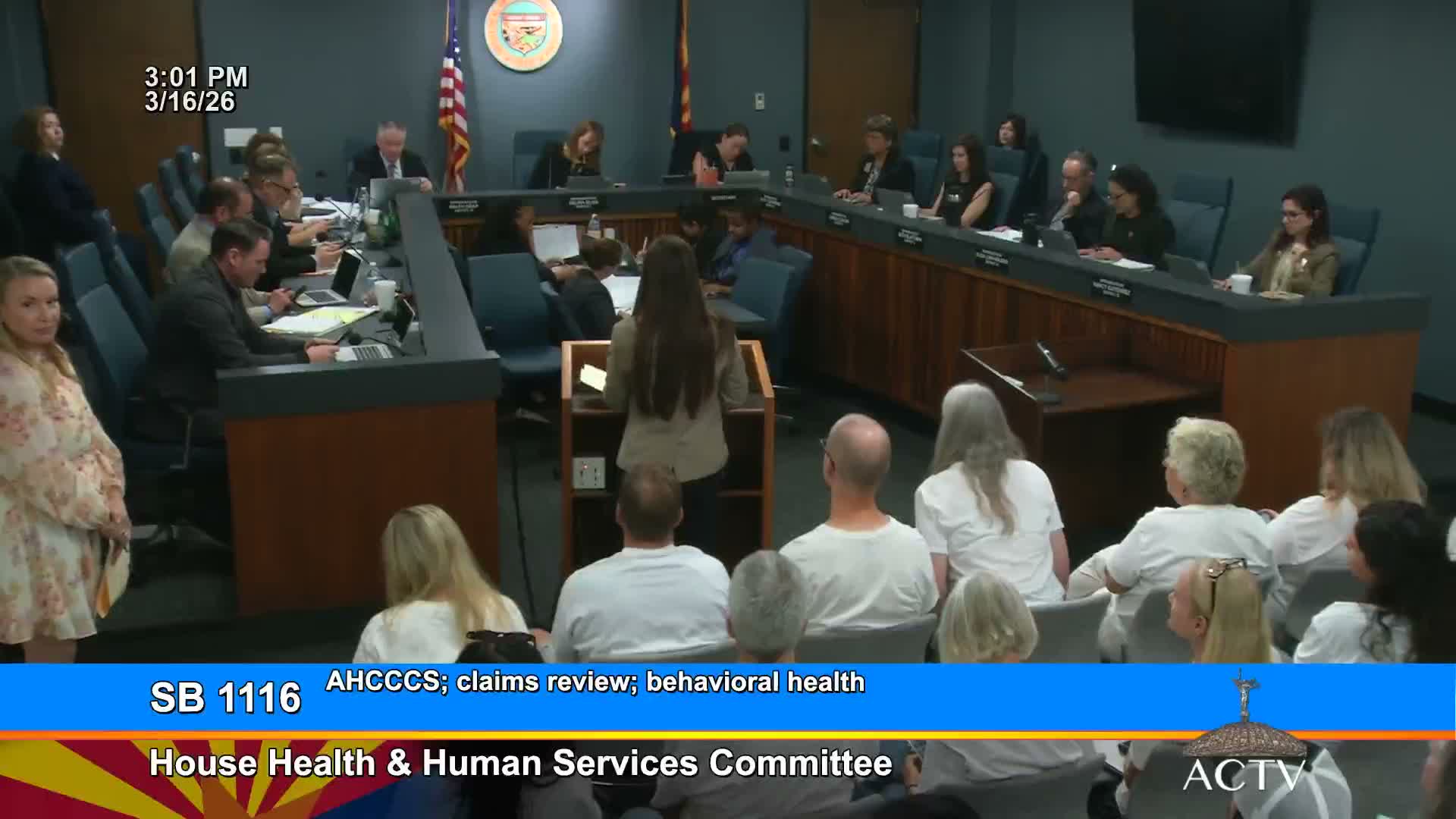
Logan told the committee SB 11‑16 would require that before any claim denial or adverse appeal determination regarding the medical necessity of behavioral‑health services covered by the American Indian Health Program, the claim and supporting documentation must be reviewed and approved by an individual with at least two years of relevant clinical experience providing the same or similar services.
Sen. Karen Warner framed the bill as a response to oversight into Access payments, saying the previous review process sometimes involved clinicians without behavioral‑health expertise ("a pediatrician and an emergency room doctor") evaluating complex behavioral‑health claims. She said the measure aims to protect credible providers who have been denied payments and reduce inappropriate denials.
Damien Carpenter (chief legislative liaison, Access) testified the agency is neutral. He said Access has been meeting with the sponsor, that the bill would broaden the expertise needed for appeals review and likely require additional FTEs (Access estimated roughly $490,000 GF for eight FTEs). He warned that broader language could increase appeals volume and administrative hearings, and that narrowing the definition (for example, to BHP) would reduce staffing needs. Members asked whether Access could narrow terms and about the fiscal note; some voted 'no' or 'present' citing staffing/funding concerns, but the committee returned the bill with a due‑pass recommendation (7 ayes, 4 nays, 1 present).
The committee did not adopt amendments during the hearing; members requested follow‑up on appropriations and precise definitions of “relevant clinical experience.”
Sen. Karen Warner framed the bill as a response to oversight into Access payments, saying the previous review process sometimes involved clinicians without behavioral‑health expertise ("a pediatrician and an emergency room doctor") evaluating complex behavioral‑health claims. She said the measure aims to protect credible providers who have been denied payments and reduce inappropriate denials.
Damien Carpenter (chief legislative liaison, Access) testified the agency is neutral. He said Access has been meeting with the sponsor, that the bill would broaden the expertise needed for appeals review and likely require additional FTEs (Access estimated roughly $490,000 GF for eight FTEs). He warned that broader language could increase appeals volume and administrative hearings, and that narrowing the definition (for example, to BHP) would reduce staffing needs. Members asked whether Access could narrow terms and about the fiscal note; some voted 'no' or 'present' citing staffing/funding concerns, but the committee returned the bill with a due‑pass recommendation (7 ayes, 4 nays, 1 present).
The committee did not adopt amendments during the hearing; members requested follow‑up on appropriations and precise definitions of “relevant clinical experience.”
View the Full Meeting & All Its Details
This article offers just a summary. Unlock complete video, transcripts, and insights as a Founder Member.
✓
Watch full, unedited meeting videos
✓
Search every word spoken in unlimited transcripts
✓
AI summaries & real-time alerts (all government levels)
✓
Permanent access to expanding government content
30-day money-back guarantee
