Maine Senate indefinitely postpones joint resolution honoring Charlie Kirk after heated floor debate
March 12, 2026 | 2026 Legislature ME, Maine
This article was created by AI summarizing key points discussed. AI makes mistakes, so for full details and context, please refer to the video of the full meeting. Please report any errors so we can fix them. Report an error »
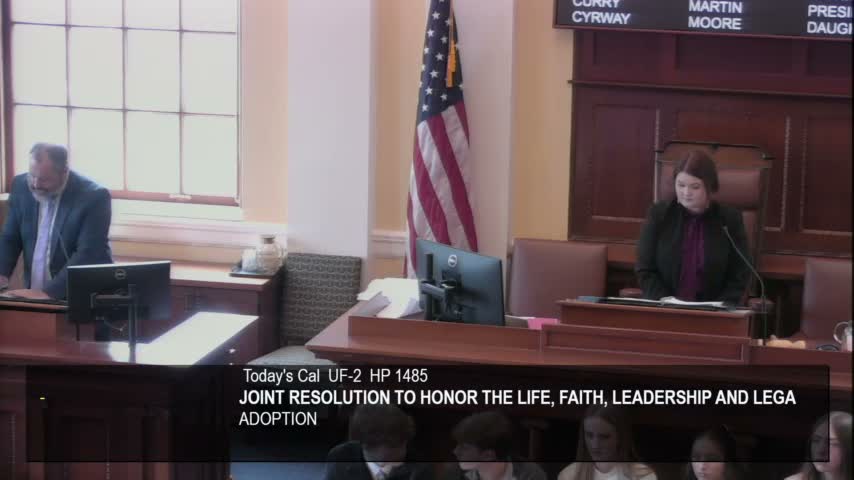
The Maine Senate moved to reconsider and then indefinitely postpone a joint resolution recognizing the life and legacy of Charlie Kirk, after senators engaged in a prolonged, often emotional debate about whether the chamber should adopt an expression of legislative sympathy for the nationally prominent conservative activist.
Senator Stewart rose in support of the resolution and described Kirk’s life and faith, saying the assassination was “a sobering reminder of the rising dangers of political extremism and hatred.” Stewart framed the resolution as a call to denounce political violence and to honor the decedent’s contributions, urging colleagues to unite against violence.
Senator DuSond countered on the floor that while violence must be condemned, the resolution risked honoring ideas that many find harmful. Quoting a statement by Congressional Black Caucus Chair Yvette Clark, DuSond said, “Violence has no place in our politics,” and argued that a legislative tribute should not serve to legitimize or sanitize viewpoints that others described as racist or harmful.
Following debate, Senator Perce moved reconsideration of the earlier action on the measure. The Senate approved reconsideration in a roll-call vote that the Chair recorded as 17 in favor and 15 opposed. After reconsideration, Senator Dusan moved to indefinitely postpone the resolution; that motion prevailed on a subsequent roll-call vote, 18 in favor and 15 opposed, removing the resolution from immediate consideration.
Senators on both sides spoke sharply during the motions. Senator Harrington described the decision to kill the measure as “truly pathetic,” reflecting frustration that the chamber moved to reverse a prior expression of sympathy. Supporters of the postponement framed their votes as a rejection of elevating the life of a divisive national figure in a bipartisan chamber.
The Senate’s action leaves unresolved broader questions raised during debate about how the legislature should respond to nationally prominent deaths that cross partisan lines. The chamber’s final action on this joint resolution was to indefinitely postpone it, and the Senate adjourned for the day with no further action on the memorial.
Senator Stewart rose in support of the resolution and described Kirk’s life and faith, saying the assassination was “a sobering reminder of the rising dangers of political extremism and hatred.” Stewart framed the resolution as a call to denounce political violence and to honor the decedent’s contributions, urging colleagues to unite against violence.
Senator DuSond countered on the floor that while violence must be condemned, the resolution risked honoring ideas that many find harmful. Quoting a statement by Congressional Black Caucus Chair Yvette Clark, DuSond said, “Violence has no place in our politics,” and argued that a legislative tribute should not serve to legitimize or sanitize viewpoints that others described as racist or harmful.
Following debate, Senator Perce moved reconsideration of the earlier action on the measure. The Senate approved reconsideration in a roll-call vote that the Chair recorded as 17 in favor and 15 opposed. After reconsideration, Senator Dusan moved to indefinitely postpone the resolution; that motion prevailed on a subsequent roll-call vote, 18 in favor and 15 opposed, removing the resolution from immediate consideration.
Senators on both sides spoke sharply during the motions. Senator Harrington described the decision to kill the measure as “truly pathetic,” reflecting frustration that the chamber moved to reverse a prior expression of sympathy. Supporters of the postponement framed their votes as a rejection of elevating the life of a divisive national figure in a bipartisan chamber.
The Senate’s action leaves unresolved broader questions raised during debate about how the legislature should respond to nationally prominent deaths that cross partisan lines. The chamber’s final action on this joint resolution was to indefinitely postpone it, and the Senate adjourned for the day with no further action on the memorial.
View the Full Meeting & All Its Details
This article offers just a summary. Unlock complete video, transcripts, and insights as a Founder Member.
✓
Watch full, unedited meeting videos
✓
Search every word spoken in unlimited transcripts
✓
AI summaries & real-time alerts (all government levels)
✓
Permanent access to expanding government content
30-day money-back guarantee
