City Manager Fletcher presents 5% reduction exercise as North Port braces for possible $18M property-tax reform hit
March 13, 2026 | North Port, Sarasota County, Florida
This article was created by AI summarizing key points discussed. AI makes mistakes, so for full details and context, please refer to the video of the full meeting. Please report any errors so we can fix them. Report an error »
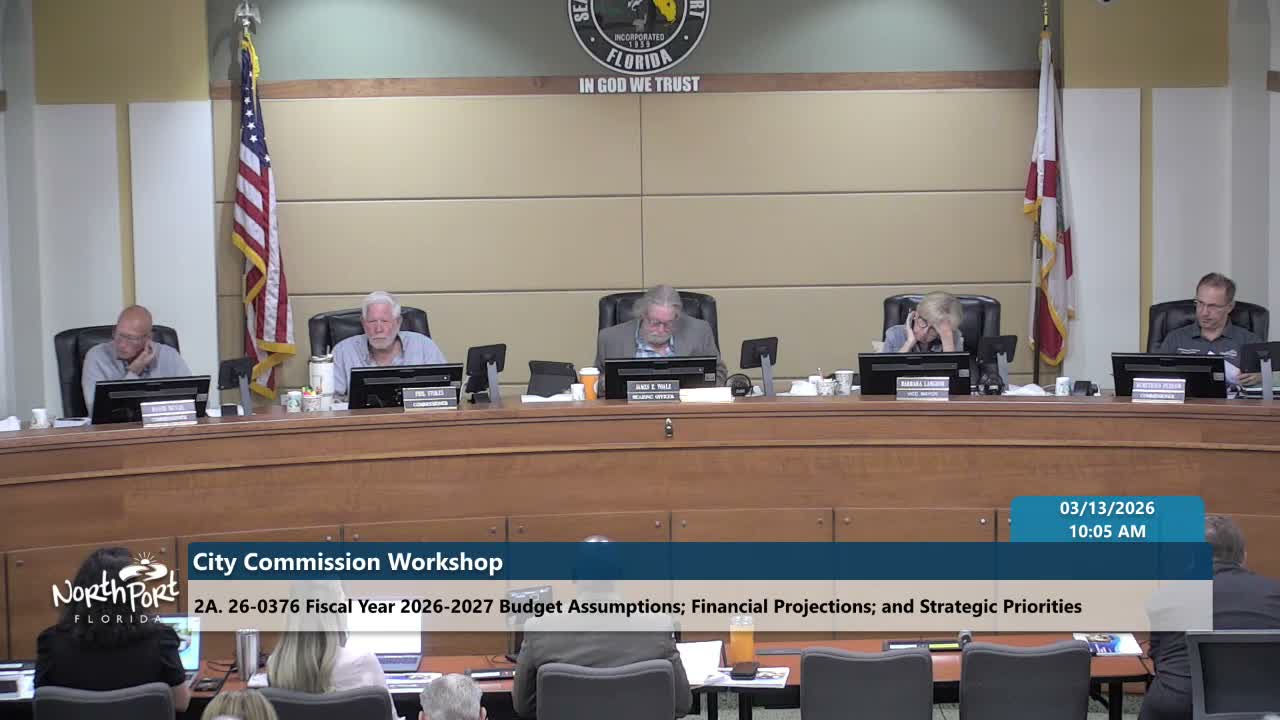
City Manager Fletcher opened the March 13 North Port budget workshop by framing the meeting as a feedback session and outlining a staff exercise that began with a flat FY26 budget and then identified what a 5% reduction would require. “The exercise that they were given were to take a flat budget and then reduce that budget by 5%,” Fletcher said, adding the goal was to test tradeoffs rather than present binding decisions.
The exercise, staff explained, showed personnel costs are the largest line item—about 75%–80% of city spending—and in some departments a uniform 5% cut would force deep personnel reductions. “In order to do their budget alone, [fire] will be looking at removing roughly 18 people,” Fletcher said, warning that certain core services are sensitive to cuts.
Why it matters: staff presented fiscal choices against the backdrop of pending state-level property-tax reform that city analysts estimate could cut roughly $18 million from North Port’s general fund. Fletcher said the city must plan for multiple scenarios and be prepared to “reimagine” service delivery if revenue declines. “Right now, we are just, in wait and see mode,” he said.
Commissioners pressed staff for more specificity. Commissioner Stokes emphasized that his policy preference is no property tax rate increase and asked staff to pursue expense reductions and alternative financing that avoid raising the millage. “One, no property tax rate increase at all,” Stokes said, urging a “flat revenue approach” while trimming expenses to protect services and build capital reserves.
Staff proposals and trade-offs: among the options discussed were raising cost recovery on certain Parks & Recreation activities (nonresident fees), targeted hiring freezes tied to vacancy management, deeper reviews of overtime and consultant spending, and potential borrowing for select capital projects rather than immediate pay-as-you-go funding. Fletcher noted the grants team has added capacity and reported roughly $35 million awarded and $15 million pending in recent grant activity, which helps offset general-fund needs.
Utilities and fee questions: staff presented two scenarios for the electric franchise fee (the city’s payment-in-lieu/franchise). A revenue-neutral reduction would lower the fee to about 9.4% and cost roughly $500,000; a deeper cut to 6% would cost approximately $3.2 million annually and save a typical 1,000-kilowatt-hour customer only about $14 per month under that scenario.
Capital priorities and CIP: staff presented a 10-year capital plan totaling roughly $1.2 billion with about half unfunded. Top unfunded projects include a police headquarters, wastewater improvements and fire-station work. Fletcher recommended the commission consider borrowing for a small set of high-priority projects (for example, Fire Station A and a community service center) and using operational savings to fund debt service rather than increase the millage.
Public comment and community concerns: during the public-comment period residents raised concerns about waterfront access and the city’s identity, the costs and maintenance of city-owned facilities, potential privatization of utilities, and traffic/evacuation impacts tied to future large developments. Multiple speakers urged the commission to protect recreational assets and to present the CIP with clearer prioritization for residents.
Next steps: staff will return with more detailed department-level analyses, vacancy and overtime deep dives, and modeling for property-tax reform scenarios. Fletcher recommended monthly budget check-ins and one-on-one briefings with commissioners as the FY27 process continues.
The commission recessed for lunch and returned to continue the workshop; no formal votes were taken during the session.
The exercise, staff explained, showed personnel costs are the largest line item—about 75%–80% of city spending—and in some departments a uniform 5% cut would force deep personnel reductions. “In order to do their budget alone, [fire] will be looking at removing roughly 18 people,” Fletcher said, warning that certain core services are sensitive to cuts.
Why it matters: staff presented fiscal choices against the backdrop of pending state-level property-tax reform that city analysts estimate could cut roughly $18 million from North Port’s general fund. Fletcher said the city must plan for multiple scenarios and be prepared to “reimagine” service delivery if revenue declines. “Right now, we are just, in wait and see mode,” he said.
Commissioners pressed staff for more specificity. Commissioner Stokes emphasized that his policy preference is no property tax rate increase and asked staff to pursue expense reductions and alternative financing that avoid raising the millage. “One, no property tax rate increase at all,” Stokes said, urging a “flat revenue approach” while trimming expenses to protect services and build capital reserves.
Staff proposals and trade-offs: among the options discussed were raising cost recovery on certain Parks & Recreation activities (nonresident fees), targeted hiring freezes tied to vacancy management, deeper reviews of overtime and consultant spending, and potential borrowing for select capital projects rather than immediate pay-as-you-go funding. Fletcher noted the grants team has added capacity and reported roughly $35 million awarded and $15 million pending in recent grant activity, which helps offset general-fund needs.
Utilities and fee questions: staff presented two scenarios for the electric franchise fee (the city’s payment-in-lieu/franchise). A revenue-neutral reduction would lower the fee to about 9.4% and cost roughly $500,000; a deeper cut to 6% would cost approximately $3.2 million annually and save a typical 1,000-kilowatt-hour customer only about $14 per month under that scenario.
Capital priorities and CIP: staff presented a 10-year capital plan totaling roughly $1.2 billion with about half unfunded. Top unfunded projects include a police headquarters, wastewater improvements and fire-station work. Fletcher recommended the commission consider borrowing for a small set of high-priority projects (for example, Fire Station A and a community service center) and using operational savings to fund debt service rather than increase the millage.
Public comment and community concerns: during the public-comment period residents raised concerns about waterfront access and the city’s identity, the costs and maintenance of city-owned facilities, potential privatization of utilities, and traffic/evacuation impacts tied to future large developments. Multiple speakers urged the commission to protect recreational assets and to present the CIP with clearer prioritization for residents.
Next steps: staff will return with more detailed department-level analyses, vacancy and overtime deep dives, and modeling for property-tax reform scenarios. Fletcher recommended monthly budget check-ins and one-on-one briefings with commissioners as the FY27 process continues.
The commission recessed for lunch and returned to continue the workshop; no formal votes were taken during the session.
Don't Miss a Word: See the Full Meeting!
Go beyond summaries. Unlock every video, transcript, and key insight with a Founder Membership.
✓
Get instant access to full meeting videos
✓
Search and clip any phrase from complete transcripts
✓
Receive AI-powered summaries & custom alerts
✓
Enjoy lifetime, unrestricted access to government data
30-day money-back guarantee
