Board of Natural Resources affirms most timber sales after extended public comment, splits on legacy-forest cases
March 16, 2026 | Board Council Commission Agencies , Executive, Washington
This article was created by AI summarizing key points discussed. AI makes mistakes, so for full details and context, please refer to the video of the full meeting. Please report any errors so we can fix them. Report an error »
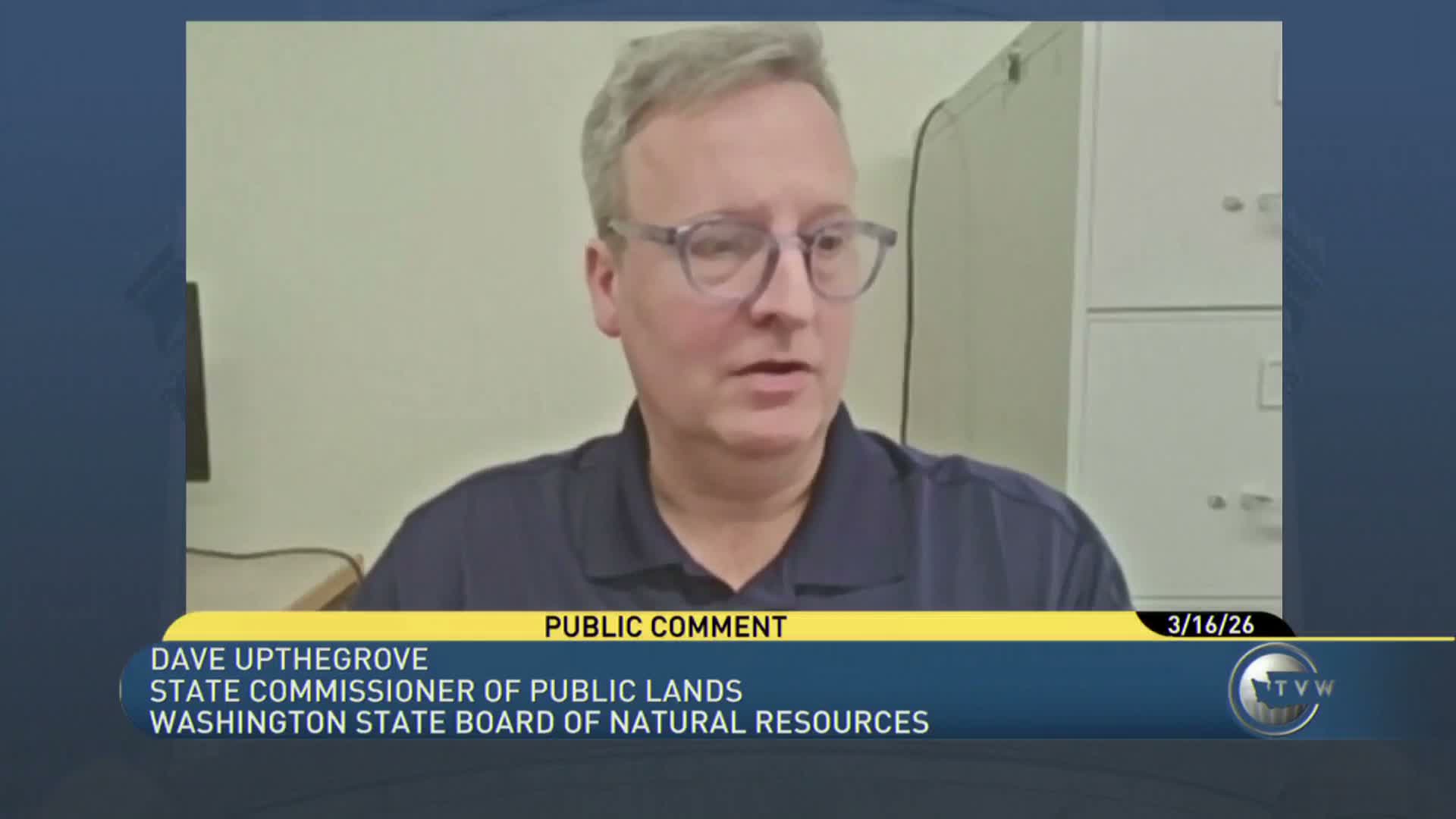
The Washington Board of Natural Resources voted March 16 to affirm most of the timber sales it had previously approved and to authorize a new set of proposed sales for auction in April after hearing more than an hour of public comment from industry representatives, county officials, school-district leaders and conservation advocates.
Chair Dave Uptegrove opened the special meeting and closed a public comment period that included competing appeals: industry and some county officials urged approval to protect jobs and trust revenue, while conservation advocates and legal advocates urged deferral or reanalysis of legacy-forest sales pending fuller SEPA alternatives review.
Why it matters: Trust land timber sales generate revenue for county services and schools but also raise legal and environmental questions when mature, complex forests are proposed for harvest. Several speakers pointed to recent court rulings requiring DNR to evaluate alternatives before proceeding with some legacy-forest sales.
Public testimony highlighted competing priorities. "Please approve all sales brought before you today," said Dave Sweitzer, executive director of the Washington Hardwoods Commission, who told the board a Centralia mill closure will cut about 70 jobs and urged the board to restore sale volumes to support rural economies. By contrast, Sally Keeley, citing a Center for Sustainable Economy letter and recent court decisions, urged the board to "immediately defer the 15 timber sales CSC lists in their letter," saying the agency had not yet provided a transparent alternatives analysis for legacy forests.
County and school-district officials emphasized fiscal stakes. Eric Johnson, representing the Skagit County Board of County Commissioners, described the Atonal sale as a 108-acre tract with 36% conserved and said trust revenues from sales support county funds, schools and ports. Russ Pfeifferhoit, chair of the Washington State School Directors Association Trust Land Advisory Committee, told the board that trust revenue is especially important for low-income rural school districts and said current offerings have not made up for earlier delays.
Staff presented updated sales and legal responses. Mike Sligh, assistant division manager for product sales and leasing, gave February auction results—six of seven offered sales sold representing roughly 26.5 million board feet and about $10.8 million in revenue—and said staff had prepared SEPA addenda that include three broad alternatives (no harvest, thinning, or the proposed action) to address the court’s direction. Dwayne Hammonds, assistant deputy for State Uplands, said the SEPA addenda assess environmental impacts sale-by-sale and that SEPA focuses on environmental impacts rather than financial analyses.
Board action and votes: Vice Chair Dan Brown moved to affirm the board’s prior approval of a group of February sales (named by staff as Tiger Stripes, Biscuits, Maple Ground, Synergize and Kew Crown Creek Fire Salvage); the motion was moved, seconded and approved by voice vote. Brown then moved to affirm prior approvals for the Chai and Atonal sales after considering the added alternatives; following discussion the motion passed by a 4–2 vote. Later the board voted to approve six proposed sales for auction in April (staff described acreage, conserved acres and minimum appraisals); the motion carried with at least one recorded nay.
What was not decided: Several public commenters and speakers urged a moratorium or additional oversight, and some board members signaled ongoing concern about particular legacy units. The board did not adopt a moratorium; staff said they are exploring natural-climate funding to purchase some units and that the SEPA addenda are intended to respond to the court’s remand.
The board acknowledged staff for expedited work producing addenda and additional analyses after recent court rulings. Chair Uptegrove thanked staff and adjourned the meeting.
Next steps: The approved sales will proceed toward auction in April unless staff or the board takes additional actions; staff will continue to publish SEPA materials and responses for the record and the department noted ongoing litigation could affect future actions.
Chair Dave Uptegrove opened the special meeting and closed a public comment period that included competing appeals: industry and some county officials urged approval to protect jobs and trust revenue, while conservation advocates and legal advocates urged deferral or reanalysis of legacy-forest sales pending fuller SEPA alternatives review.
Why it matters: Trust land timber sales generate revenue for county services and schools but also raise legal and environmental questions when mature, complex forests are proposed for harvest. Several speakers pointed to recent court rulings requiring DNR to evaluate alternatives before proceeding with some legacy-forest sales.
Public testimony highlighted competing priorities. "Please approve all sales brought before you today," said Dave Sweitzer, executive director of the Washington Hardwoods Commission, who told the board a Centralia mill closure will cut about 70 jobs and urged the board to restore sale volumes to support rural economies. By contrast, Sally Keeley, citing a Center for Sustainable Economy letter and recent court decisions, urged the board to "immediately defer the 15 timber sales CSC lists in their letter," saying the agency had not yet provided a transparent alternatives analysis for legacy forests.
County and school-district officials emphasized fiscal stakes. Eric Johnson, representing the Skagit County Board of County Commissioners, described the Atonal sale as a 108-acre tract with 36% conserved and said trust revenues from sales support county funds, schools and ports. Russ Pfeifferhoit, chair of the Washington State School Directors Association Trust Land Advisory Committee, told the board that trust revenue is especially important for low-income rural school districts and said current offerings have not made up for earlier delays.
Staff presented updated sales and legal responses. Mike Sligh, assistant division manager for product sales and leasing, gave February auction results—six of seven offered sales sold representing roughly 26.5 million board feet and about $10.8 million in revenue—and said staff had prepared SEPA addenda that include three broad alternatives (no harvest, thinning, or the proposed action) to address the court’s direction. Dwayne Hammonds, assistant deputy for State Uplands, said the SEPA addenda assess environmental impacts sale-by-sale and that SEPA focuses on environmental impacts rather than financial analyses.
Board action and votes: Vice Chair Dan Brown moved to affirm the board’s prior approval of a group of February sales (named by staff as Tiger Stripes, Biscuits, Maple Ground, Synergize and Kew Crown Creek Fire Salvage); the motion was moved, seconded and approved by voice vote. Brown then moved to affirm prior approvals for the Chai and Atonal sales after considering the added alternatives; following discussion the motion passed by a 4–2 vote. Later the board voted to approve six proposed sales for auction in April (staff described acreage, conserved acres and minimum appraisals); the motion carried with at least one recorded nay.
What was not decided: Several public commenters and speakers urged a moratorium or additional oversight, and some board members signaled ongoing concern about particular legacy units. The board did not adopt a moratorium; staff said they are exploring natural-climate funding to purchase some units and that the SEPA addenda are intended to respond to the court’s remand.
The board acknowledged staff for expedited work producing addenda and additional analyses after recent court rulings. Chair Uptegrove thanked staff and adjourned the meeting.
Next steps: The approved sales will proceed toward auction in April unless staff or the board takes additional actions; staff will continue to publish SEPA materials and responses for the record and the department noted ongoing litigation could affect future actions.
Don't Miss a Word: See the Full Meeting!
Go beyond summaries. Unlock every video, transcript, and key insight with a Founder Membership.
✓
Get instant access to full meeting videos
✓
Search and clip any phrase from complete transcripts
✓
Receive AI-powered summaries & custom alerts
✓
Enjoy lifetime, unrestricted access to government data
30-day money-back guarantee
