Senate committee hears plan to allow small plug‑in solar; lawmakers and electricians debate safety and code
March 13, 2026 | 2026 Legislature MN, Minnesota
This article was created by AI summarizing key points discussed. AI makes mistakes, so for full details and context, please refer to the video of the full meeting. Please report any errors so we can fix them. Report an error »
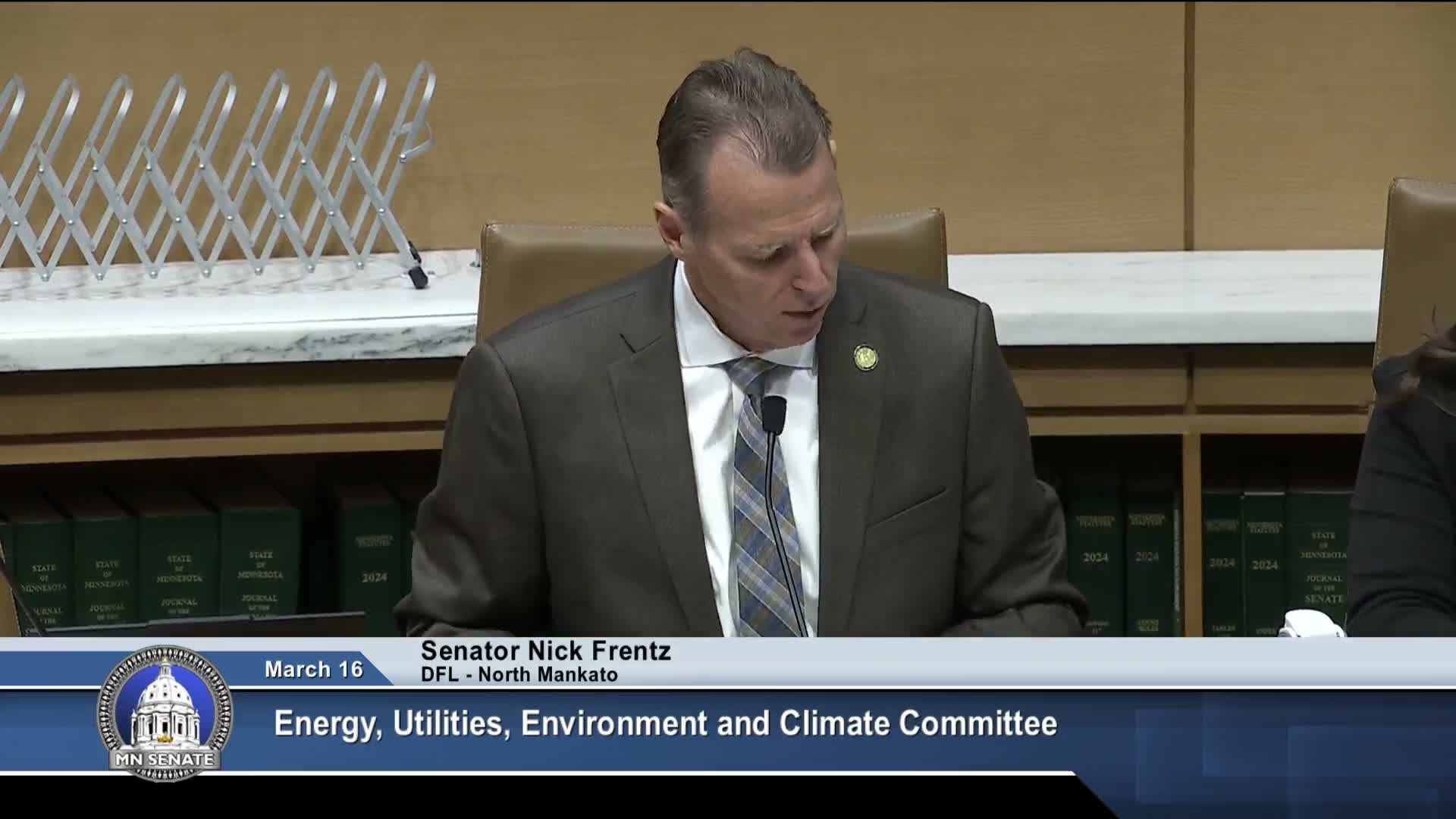
The Minnesota Senate Energy, Utilities, Environment and Climate Committee on March 16 heard testimony on Senate File 38 73, a bill to permit portable plug‑in solar systems of up to 1,200 watts that meet the UL 3700 standard.
Sen. Kupak, the bill sponsor, told the committee the devices — sometimes called "deck" solar — let people who rent or who have roofs unsuited to rooftop arrays reduce household electricity use without an interconnection agreement or participation in net metering. "It allows them for a much lower cost option," she said, adding that certified systems reduce the risk of shock and electrical fires.
Patty O'Keefe, Midwest regional director for Votoler, said the systems covered by the bill are small and can provide meaningful savings. "1,200 watts is the equivalent to a household blender and less than a hair dryer," she said, and estimated typical savings of $20 to $33 per month, or roughly $250 to $400 per year, depending on usage and whether a battery is paired with the system.
Electricians and clean‑energy advocates offered technical context and support. John Gecke, a Duluth electrician and owner of Star Power Electric, testified that 1,200 watts equals about 10 amps at 120 volts — "less than the smallest circuit size in a home of 15" — and said, "At this level, it's it's safe, and I'm a 100% confident in that." Will Mulhern of Fresh Energy and Sarah Wolf of Minnesota Interfaith Power & Light also urged the committee to lower barriers to this technology and to require nationally recognized testing‑laboratory certification to ensure safety.
Sen. Rarick pressed the technical and code implications. He cautioned that "to say that a UL listing meets code for electrical code for installation is flat out wrong," and said the National Electrical Code (NEC) contains defined requirements for how generators and solar are integrated. He raised several practical scenarios — including multiple devices plugged into a single receptacle or use of extension cords — that could overload wiring or interact with arc‑fault and ground‑fault devices. Rarick recommended further technical review by the Department of Labor or the state board of electricity.
The committee adopted an A3 amendment that tightened stakeholder language on notification and limited the effect of plug‑in systems on net‑metering capacity. After testimony and member questions, the chair said the intent was to lay the bill over for additional study and potential referral to the labor/code division. Senate File 38 73 was laid over without final action.
The committee did not vote on final passage; next steps include technical follow‑up on code interactions and whether to refer the bill for additional staff or agency review.
Sen. Kupak, the bill sponsor, told the committee the devices — sometimes called "deck" solar — let people who rent or who have roofs unsuited to rooftop arrays reduce household electricity use without an interconnection agreement or participation in net metering. "It allows them for a much lower cost option," she said, adding that certified systems reduce the risk of shock and electrical fires.
Patty O'Keefe, Midwest regional director for Votoler, said the systems covered by the bill are small and can provide meaningful savings. "1,200 watts is the equivalent to a household blender and less than a hair dryer," she said, and estimated typical savings of $20 to $33 per month, or roughly $250 to $400 per year, depending on usage and whether a battery is paired with the system.
Electricians and clean‑energy advocates offered technical context and support. John Gecke, a Duluth electrician and owner of Star Power Electric, testified that 1,200 watts equals about 10 amps at 120 volts — "less than the smallest circuit size in a home of 15" — and said, "At this level, it's it's safe, and I'm a 100% confident in that." Will Mulhern of Fresh Energy and Sarah Wolf of Minnesota Interfaith Power & Light also urged the committee to lower barriers to this technology and to require nationally recognized testing‑laboratory certification to ensure safety.
Sen. Rarick pressed the technical and code implications. He cautioned that "to say that a UL listing meets code for electrical code for installation is flat out wrong," and said the National Electrical Code (NEC) contains defined requirements for how generators and solar are integrated. He raised several practical scenarios — including multiple devices plugged into a single receptacle or use of extension cords — that could overload wiring or interact with arc‑fault and ground‑fault devices. Rarick recommended further technical review by the Department of Labor or the state board of electricity.
The committee adopted an A3 amendment that tightened stakeholder language on notification and limited the effect of plug‑in systems on net‑metering capacity. After testimony and member questions, the chair said the intent was to lay the bill over for additional study and potential referral to the labor/code division. Senate File 38 73 was laid over without final action.
The committee did not vote on final passage; next steps include technical follow‑up on code interactions and whether to refer the bill for additional staff or agency review.
Don't Miss a Word: See the Full Meeting!
Go beyond summaries. Unlock every video, transcript, and key insight with a Founder Membership.
✓
Get instant access to full meeting videos
✓
Search and clip any phrase from complete transcripts
✓
Receive AI-powered summaries & custom alerts
✓
Enjoy lifetime, unrestricted access to government data
30-day money-back guarantee
